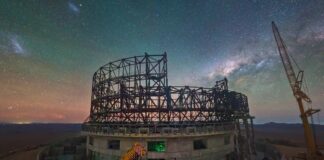
The Jiangmen Underground Neutrino Observatory (JUNO), a massive detector buried 700 meters underground in southern China, has already produced world-leading measurements of neutrino behavior after only 59 days of operation. The observatory, designed to solve fundamental mysteries about these elusive particles, is exceeding expectations.
The Challenge: Unlocking Neutrino Secrets
Trillions of neutrinos pass through Earth and our bodies daily, originating from the sun, space, and even nuclear reactors. Despite their abundance, studying neutrinos has been notoriously difficult. JUNO aims to determine the ordering of neutrino masses : whether they increase predictably (“normal mass ordering”) or in reverse.
Why this matters: Neutrinos, though lightweight, are so numerous that they may significantly impact the distribution of matter in the universe. Answering their mass ordering question could illuminate cosmological mysteries and drive new discoveries in physics.
JUNO’s First Successes
The observatory has already set new precision records for two key neutrino oscillation parameters. These parameters reflect differences in neutrino masses, and JUNO’s measurements are now the most accurate globally.
The detector works by observing electron antineutrinos produced by nearby nuclear plants. When these particles collide with protons inside the detector, they trigger light flashes that are then converted into electrical signals. This process allows physicists to analyze neutrino behavior in unprecedented detail.
“It is the first time we’ve turned on a scientific instrument like JUNO that we’ve been working on for over a decade,” says Juan Pedro Ochoa-Ricoux, a physicist co-leading the JUNO team. “And then to see that we’re able to already do world-leading measurements with it, even with such a small amount of data, that’s also really exciting.”
What’s Next?
While these initial results are promising, physicists will need years of continued data collection to definitively solve the neutrino mass ordering puzzle. JUNO’s spherical detector, roughly the size of a 13-story fishbowl, is equipped to gather this data efficiently.
The observatory’s rapid success demonstrates the power of cutting-edge instrumentation and confirms that JUNO is poised to become a central hub for neutrino research in the years to come.
JUNO’s early achievements prove that even short-term operation can yield groundbreaking results in fundamental physics, highlighting the importance of continued investment in large-scale scientific projects.