For nearly six decades, the first human-made object to successfully land on the moon – the Soviet Union’s Luna 9 spacecraft – has remained lost. Now, an international team of scientists believes they are closer than ever to locating it. Using an advanced machine learning program, they’ve identified potential locations within a limited search area, as detailed in a recent study published in npj Space Exploration.
The Mystery of Luna 9’s Disappearance
While the United States ultimately won the space race to land a human on the moon in 1969, the Soviets were ahead in robotic lunar landings. On February 3, 1966, Luna 9 achieved the first successful soft landing on the lunar surface and transmitted the first photographs from another celestial body.
However, unlike the well-documented Apollo landing sites, Luna 9’s precise location remained unknown for decades. This is partly due to outdated calculations and the spacecraft’s unique landing method. Luna 9 deployed a spherical capsule with inflatable shock absorbers to cushion its descent, causing it to bounce before settling on the surface. The Soviets published estimated coordinates in the newspaper Pravda, but these proved inaccurate. NASA’s Lunar Reconnaissance Orbiter Camera (LROC) confirmed in 2009 that the lander was not where it was supposed to be, and may be miles off course.
The YOLO-ETA Breakthrough
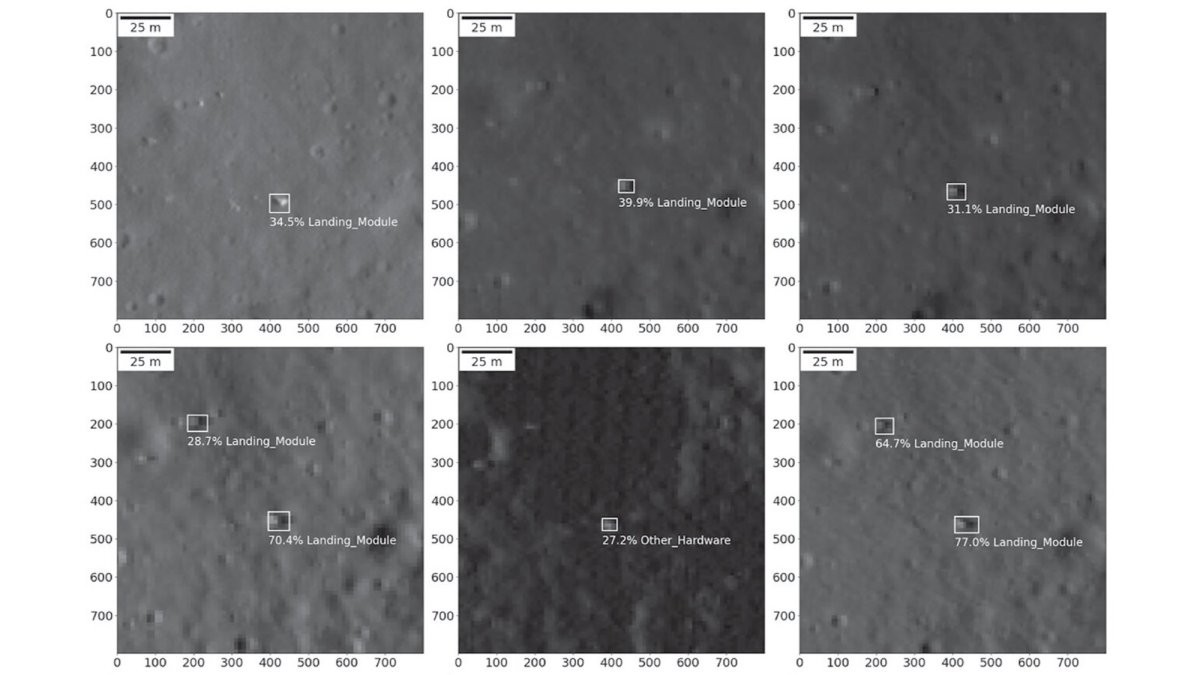
To advance the search, data scientist Lewis Pinault at University College London developed a machine learning algorithm called You-Only-Look-Once—Extraterrestrial Artifact (YOLO-ETA). The program was trained on LROC imagery of Apollo landing sites to identify subtle surface features created by landers.
After rigorous testing on images of the Luna 16 lander (1970), YOLO-ETA demonstrated high accuracy in locating artificial disturbances on the lunar surface. Researchers then tasked the program to scan the 3.1-by-3.1 mile area from Pravda ‘s article. YOLO-ETA identified several possible locations displaying potential signs of a lander’s impact on the lunar soil.
Confirmation on the Horizon
The mystery may soon be resolved. India’s Chandrayaan-2 orbiter is scheduled to pass over the search area in March 2026 during its ongoing surface mapping mission. High-definition data from Chandrayaan-2 will allow researchers to verify YOLO-ETA’s predictions and finally pinpoint Luna 9’s resting place, potentially ending a six-decade-long space mystery.
The search for Luna 9 highlights the ongoing challenges in lunar exploration, even for objects we know were successfully deployed. Its rediscovery would be a significant historical achievement, demonstrating how modern technology can recover lost pieces of space history.