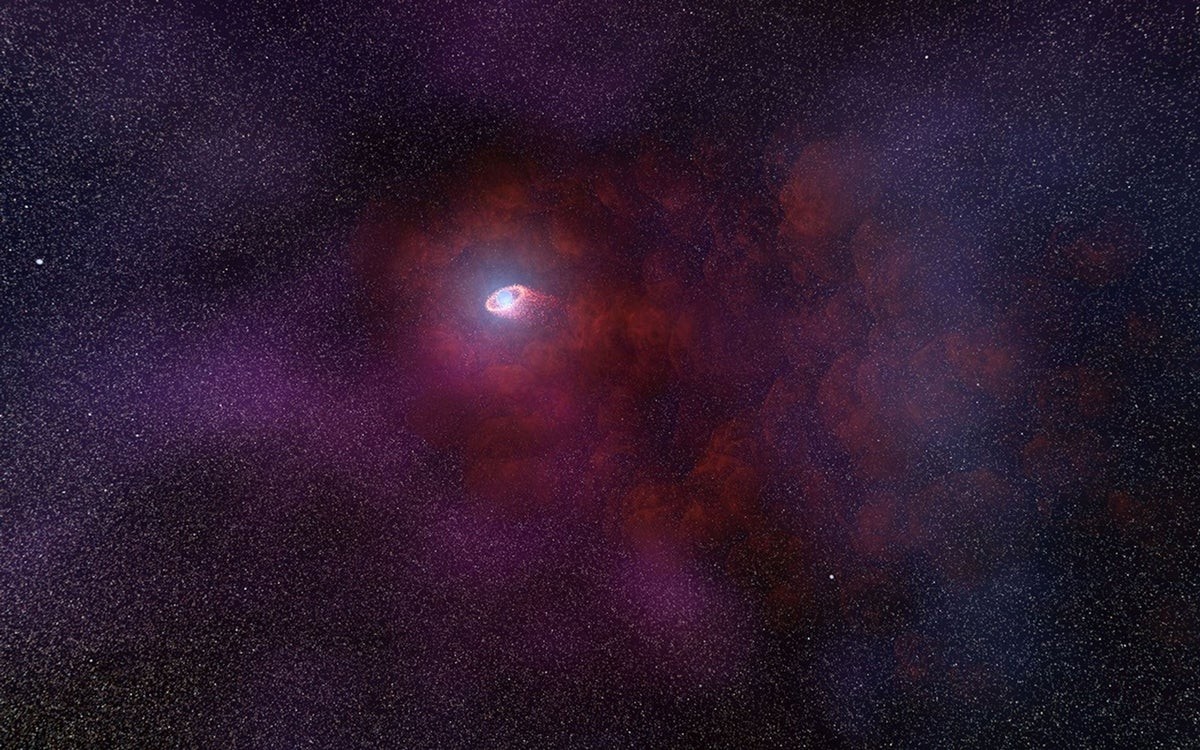
Astronomers may have detected a pulsar – a rapidly spinning, highly magnetized remnant of a collapsed star – at the very heart of the Milky Way galaxy. This potential discovery, detailed in a new research paper, could provide unprecedented insights into the behavior of gravity and spacetime near supermassive black holes.
What are Pulsars and Why Do They Matter?
Pulsars act like cosmic clocks. They emit beams of radiation as they rotate, creating predictable pulses that scientists can use to measure the universe with extreme precision. Any distortion in these pulses indicates gravitational influences, making pulsars invaluable tools for detecting gravitational waves and studying extreme environments.
The Milky Way’s central region is dominated by Sagittarius A*, a supermassive black hole millions of times the mass of our sun. Detecting a pulsar in close proximity to this black hole would allow researchers to map spacetime distortions and test the limits of Einstein’s theory of General Relativity.
How the Discovery Could Change Our Understanding
“The steady pulses from a pulsar act as a highly sensitive probe,” explains Slavko Bogdanov, a co-author of the study from Columbia University. “External forces, like the gravity of Sagittarius A*, would cause measurable changes in the timing of these pulses.”
If confirmed, this finding could not only refine our understanding of the Milky Way’s center but also deepen our knowledge of fundamental physics. Karen Perez, lead author of the study from the SETI Institute, believes this could “help us better understand both our own Galaxy, and General Relativity as a whole.”
What’s Next?
The discovery is preliminary and requires further confirmation. Astronomers will continue to analyze data and refine their models to verify the pulsar’s existence and precise location. However, the possibility of a pulsar orbiting Sagittarius A* represents a monumental opportunity to test the most extreme predictions of General Relativity in a real-world setting.
Ultimately, this potential discovery highlights the ongoing quest to reconcile our observations of the universe with our deepest theoretical frameworks. It underscores the power of precision astrophysics in pushing the boundaries of human knowledge.