


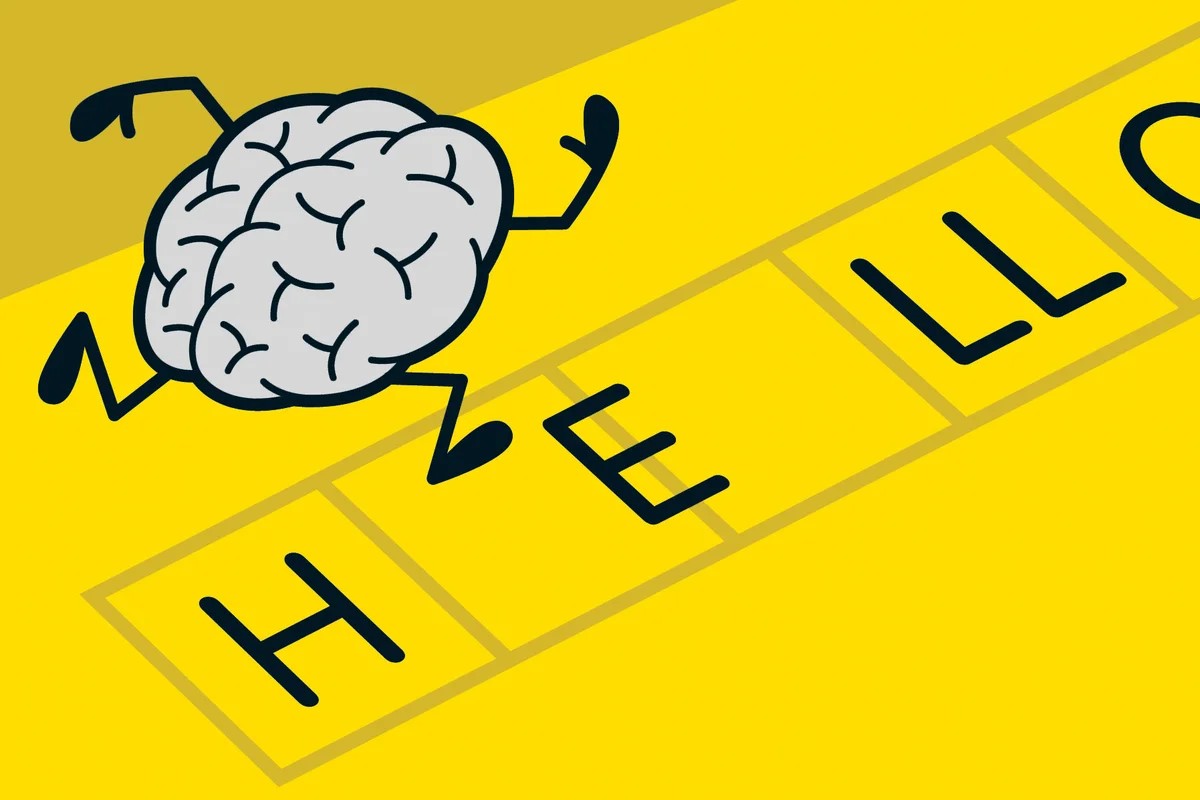
Recent neuroscience research has pinpointed a key neural signature of word recognition: a rapid drop in high-gamma brain waves occurring roughly 100 milliseconds after a word boundary. This discovery sheds light on how the brain transforms continuous streams of sound into discrete units of meaning, a process that has long been a mystery given the lack of clear acoustic separation between words in natural speech.
The Illusion of Word Boundaries
Human speech doesn’t come neatly packaged in individual words. Pauses within words are just as frequent as those between them, especially in fast conversation or unfamiliar languages where sounds tend to blend together. This means our perception of distinct words isn’t solely dictated by the physical properties of sound, but rather by internal cognitive processes.
Neurologist Edward Chang and his team at the University of California, San Francisco, have identified a direct neural correlate of word boundaries by studying fast brain waves (high-gamma) in speech perception areas. Their findings, published in Neuron, show that these waves consistently weaken immediately after each word is spoken.
“To my knowledge, this is the first time that we have a direct neural brain correlate of words,” Chang explains. “That’s a big deal.”
Neural Signatures Across Languages
The research team further investigated this phenomenon across multiple languages. A study in Nature revealed that native English, Spanish, and Mandarin speakers all exhibit the same high-gamma drop when listening to their mother tongues. However, this response is weaker and less consistent when processing unfamiliar speech. Bilingual individuals demonstrate nativelike patterns in both languages, and English learners show stronger neural responses as their proficiency increases.
This suggests that the brain doesn’t simply react to acoustic patterns but actively organizes speech based on learned linguistic structures. The more familiar a language, the clearer the neural signal for word boundaries becomes.
The Interplay of Sound and Meaning
While these findings offer a major breakthrough, questions remain about how comprehension affects word recognition. Some researchers suggest the brain may detect patterns regardless of understanding, while others propose that meaning plays a crucial role—similar to how subtitles enhance clarity in muffled audio.
Chang’s work challenges the traditional view of language processing, which assumed separate brain regions for sound, words, and meaning. Instead, his research indicates that all these levels of structure are processed in the same areas, blurring the lines between acoustic and cognitive analysis.
In essence, the brain doesn’t just hear sounds; it actively constructs words from a continuous flow of audio by leveraging learned patterns and neural timing. Further studies using artificial languages will be crucial to fully understand the complex interplay between sound processing, meaning, and the brain’s word recognition mechanisms.


