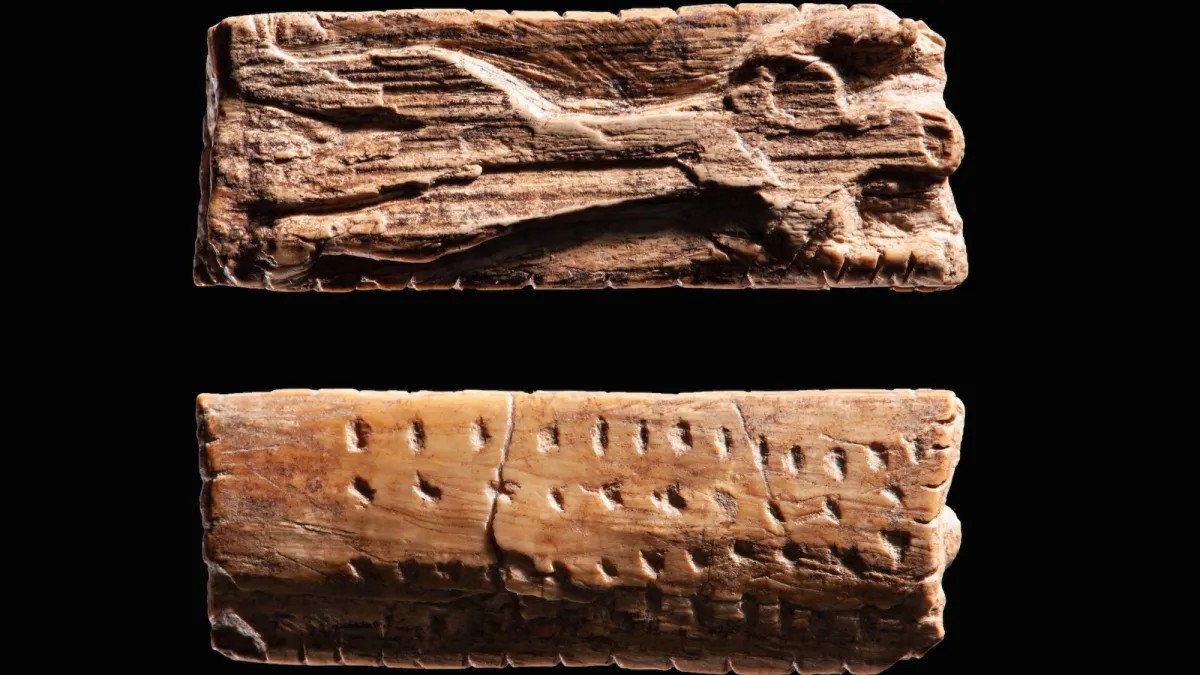
New research published in Proceedings of the National Academy of Sciences reveals compelling evidence that humans experimented with symbolic communication at least 40,000 years ago – tens of thousands of years before the earliest known written languages. This discovery challenges established timelines of human cognitive development and the origins of written expression.
The Stone Age Database
Archaeologists led by Ewa Dutkiewicz of Berlin’s Museum of Prehistory and Early History analyzed over 260 artifacts from Stone Age cave sites in southwestern Germany’s Swabian Jura. These relics, including mammoth ivory carvings and the famous “Adorant” human-lion figure, are covered in recurring geometric patterns: lines, crosses, dots, and notches. The team compiled a database of over 3,000 such carvings, then used computational tools to assess their structure.
Comparing Ancient Signs with Modern Writing
The researchers didn’t attempt to translate the symbols; instead, they compared their measurable characteristics to those of later writing systems – including Mesopotamian cuneiform and modern scripts. This approach, utilizing quantitative linguistics and statistical modeling, allowed them to estimate the information capacity of the Paleolithic carvings.
“The human ability to encode information in signs and symbols was developed over many thousands of years. Writing is only one specific form in a long series of sign systems.” – Christian Bentz, Saarland University
The results suggest that writing systems haven’t fundamentally changed in tens of thousands of years. In fact, early cuneiform appears more similar to these Stone Age symbols than modern writing, hinting that communication methods evolved more slowly than previously assumed. The repetition observed in the carvings (e.g., “cross, cross, cross, line, line, line”) indicates these symbols likely didn’t represent spoken language but served a different purpose.
Cognitive Capabilities of Early Humans
The discovery underscores that Stone Age humans possessed cognitive abilities comparable to those of modern humans. This means the capacity for symbolic thought and the drive to encode information were present far earlier in our history than once believed.
The team emphasizes that this is just the beginning. With thousands of artifacts yet to be studied, the true extent of Paleolithic symbolic communication remains largely unknown. However, the evidence suggests that the roots of writing extend much deeper into prehistory than previously imagined.