


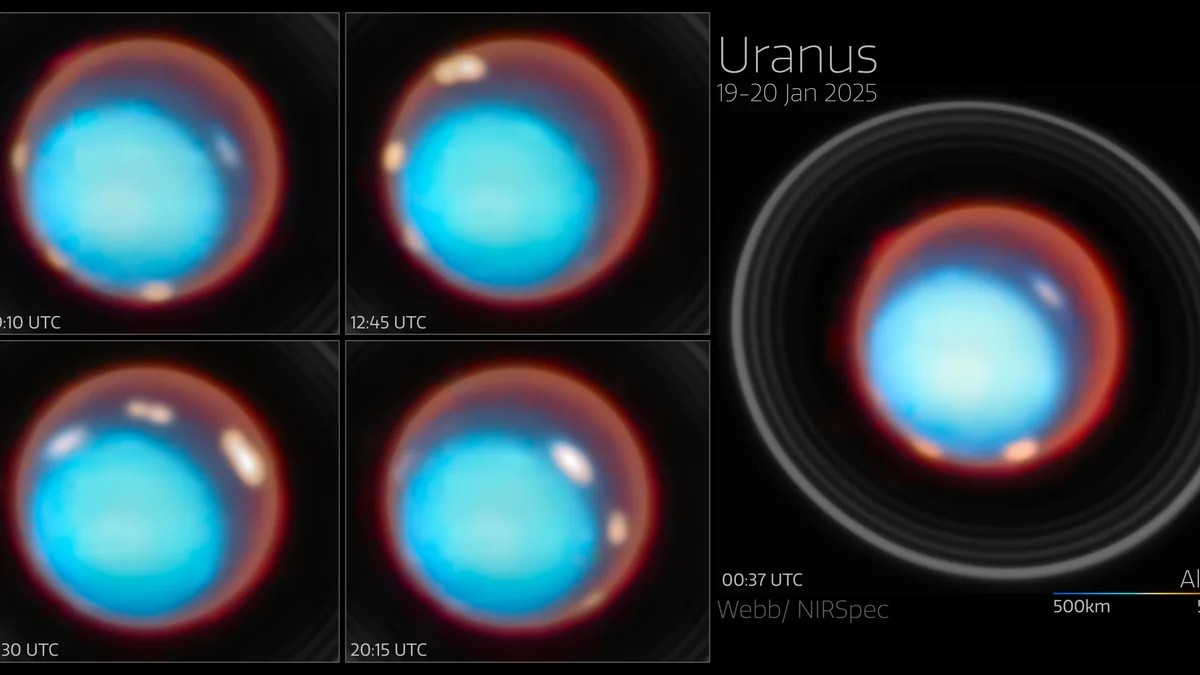
Uranus, the solar system’s overlooked ice giant, is finally receiving the attention it deserves thanks to groundbreaking observations from NASA’s James Webb Space Telescope (JWST). Despite being the only planet in our system that rotates on its side, and the only major planet orbiting the sun that moves backwards, Uranus has remained poorly understood since the Voyager 2 flyby over 40 years ago.
Why Uranus Matters
The planet’s unusual tilt—nearly perpendicular to its orbit—and retrograde rotation are likely the result of a massive collision early in the solar system’s history. This violent past gives Uranus bizarre 42-year seasons and a chaotic magnetic field, misaligned with the planet’s core. Understanding Uranus is crucial because planets like it are the most common type found in other star systems. By studying Uranus, scientists hope to unravel how planets form and evolve throughout the galaxy.
JWST’s Breakthrough Observations
New data, led by Paola Tiranti at Northumbria University and published in Geophysical Research Letters, provides the most detailed map yet of Uranus’s upper atmosphere. The observations trace the abundance of H3+ ions, revealing how energy moves through the planet’s atmosphere and interacts with its lopsided magnetic field. This is the first time scientists have mapped Uranus in three dimensions with such precision.
The images show glowing auroras sweeping across the atmosphere, which directly reflect the planet’s internal magnetic field. These detections are significant because remote probing of a magnetic field without a spacecraft in situ is impossible without instruments like JWST.
The Mystery of Uranus’s Cooling Atmosphere
One enduring puzzle that remains unsolved is the unexplained cooling of Uranus’s upper atmosphere. The latest JWST measurements confirm that this trend continues, with temperatures averaging around -150 degrees Celsius—lower than previously recorded. While the images capture beautiful views of the planet’s rings and clouds, it’s the auroras that offer the most valuable scientific insight.
These latest findings are a critical step towards characterizing giant planets beyond our solar system, revealing how energy flows within ice giants and furthering our understanding of planetary evolution.
The new JWST observations of Uranus represent a significant leap forward in planetary science, moving beyond pretty pictures to unlock fundamental mysteries about this unique world.


