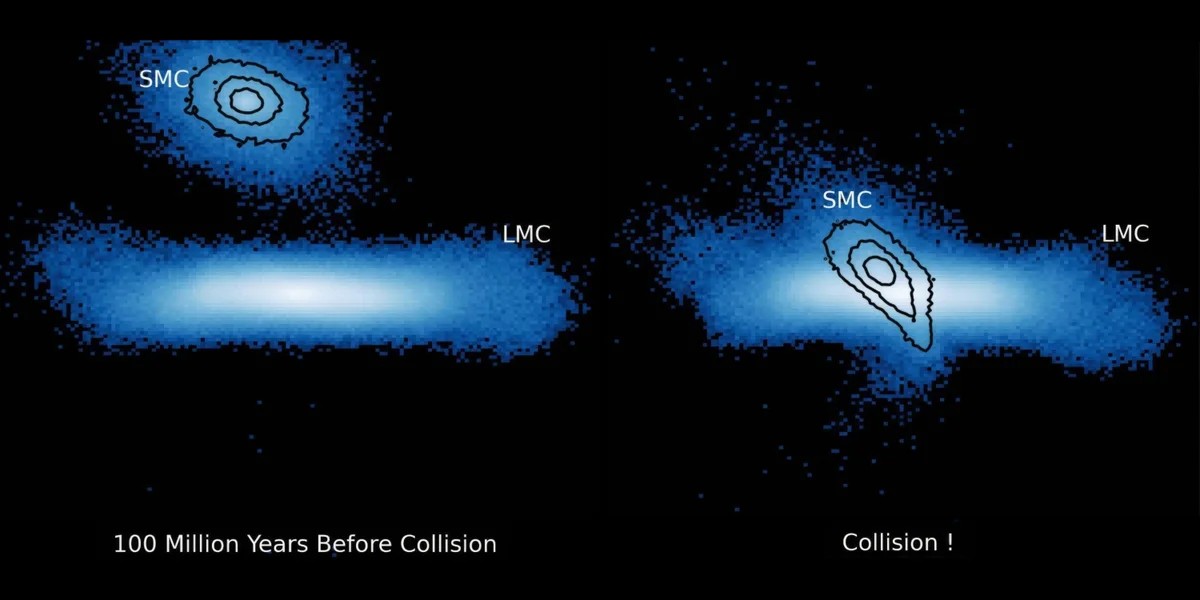
Astronomers believe they’ve solved a long-standing mystery: why the Small Magellanic Cloud (SMC) spins slower than expected. New research confirms that the dwarf galaxy is still recovering from a violent collision with its larger neighbor, the Large Magellanic Cloud (LMC), an event that occurred roughly 100 million years ago.
The Puzzle of Uneven Rotation
For decades, astronomers observed an anomaly in the SMC. Its stars don’t orbit its center as quickly as they should, especially when compared to the faster rotation of the surrounding gas disk. This discrepancy suggested something unusual had disrupted the galaxy’s natural spin. The leading theory proposed that a past collision with the LMC could be responsible, but definitive proof remained elusive.
Simulation Confirms the Crash
A team of researchers used sophisticated computer simulations to reconstruct the hypothetical impact between the two galaxies. Their model spanned hundreds of millions of years, charting the gravitational chaos of the collision. The results matched observed data: the simulated SMC exhibited the same slow stellar rotation, confirming that the ancient crash scrambled its internal structure.
“The SMC went through a catastrophic crash that injected a lot of energy into the system,” explains Gurtina Besla, a co-author of the study. “It is not a ‘normal’ galaxy by any means.”
Why This Matters
The SMC is often used as a proxy for studying early galaxies in the universe because it’s relatively metal-poor—meaning it contains fewer heavy elements. This makes it a valuable analog for understanding galactic evolution in the early cosmos. However, this discovery reveals that the SMC’s history is far from typical. The violent collision has fundamentally altered its structure, meaning comparisons with other galaxies must now account for this dramatic event.
A Distorted Legacy
The impact wasn’t just a one-time event; the aftermath continues to shape the SMC today. The lingering effects of the collision will influence how astronomers interpret its properties and use it as a benchmark for other galaxies. This research highlights how galactic interactions can rewrite the history of even small cosmic bodies, leaving behind a distorted legacy that lasts for billions of years.
The findings suggest that galactic collisions are more common and impactful than previously thought, shaping the universe in ways that are only now coming into focus.