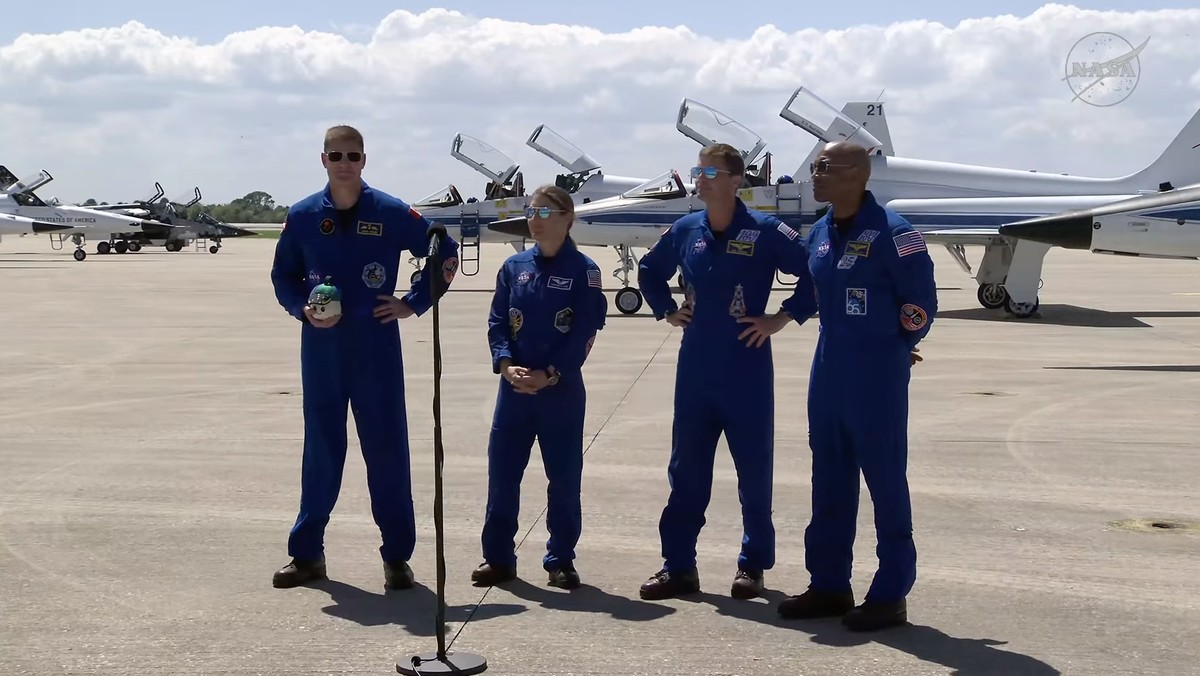
The four astronauts of NASA’s Artemis II mission have arrived at Kennedy Space Center in Florida, marking a crucial step toward humanity’s return to lunar orbit for the first time in over 50 years. The crew – Reid Wiseman, Victor Glover, Christina Koch, and Jeremy Hansen – flew from Houston on March 27, five days before their scheduled April 1 liftoff. This mission isn’t just a repeat of past achievements; it will push the boundaries of human space travel, potentially sending the crew farther from Earth than any previous mission.
The Crew’s Arrival and Preparation
The astronauts arrived in two T-38 training jets and addressed reporters upon landing. Wiseman, the mission commander, expressed the anticipation felt globally: “Hey, let’s go to the moon! I think the nation and the world has been waiting a long time to do this again.” Hansen echoed this excitement, adding, “We’re all fired up to go do this.”
The crew has been in strict medical quarantine since March 18 to minimize the risk of introducing unwanted microbes into the spacecraft’s closed environment. This measure highlights the meticulous planning behind the mission, where even the smallest biological contamination could jeopardize the entire voyage.
Launch Window and Contingency Plans
The Artemis II mission is scheduled to launch from Launch Complex 39B at 6:24 P.M. EDT on April 1. However, spaceflight is inherently unpredictable; if conditions don’t align within the initial two-hour window, backup launch opportunities extend through April 6. The astronauts themselves acknowledge this reality, with Wiseman stating, “A little piece of my brain is always holding on that April 1 is not a guarantee, April 6 is not a guarantee.” Glover concurred, emphasizing that the launch will occur only “when the engines light at T-zero.”
Why This Matters
The Artemis II mission represents more than just a scientific endeavor. It signals a renewed commitment to deep-space exploration, laying the groundwork for future lunar settlements and eventual missions to Mars. The mission’s success will depend on meticulous execution, not just from the astronauts, but from the ground support teams, engineers, and mission control. The fact that the crew is already in Florida, physically ready to launch, is a symbolic milestone, but the actual ignition is still subject to a series of critical checks and conditions. The journey back to the moon has been decades in the making, and now it’s within reach.
The Artemis II crew is prepared for potential delays, remaining focused on the mission’s ultimate objective. As Koch noted, the crew is ready to “fulfill our mission for all of you.”
The mission is set to mark the first crewed flight beyond Earth orbit since 1972.