


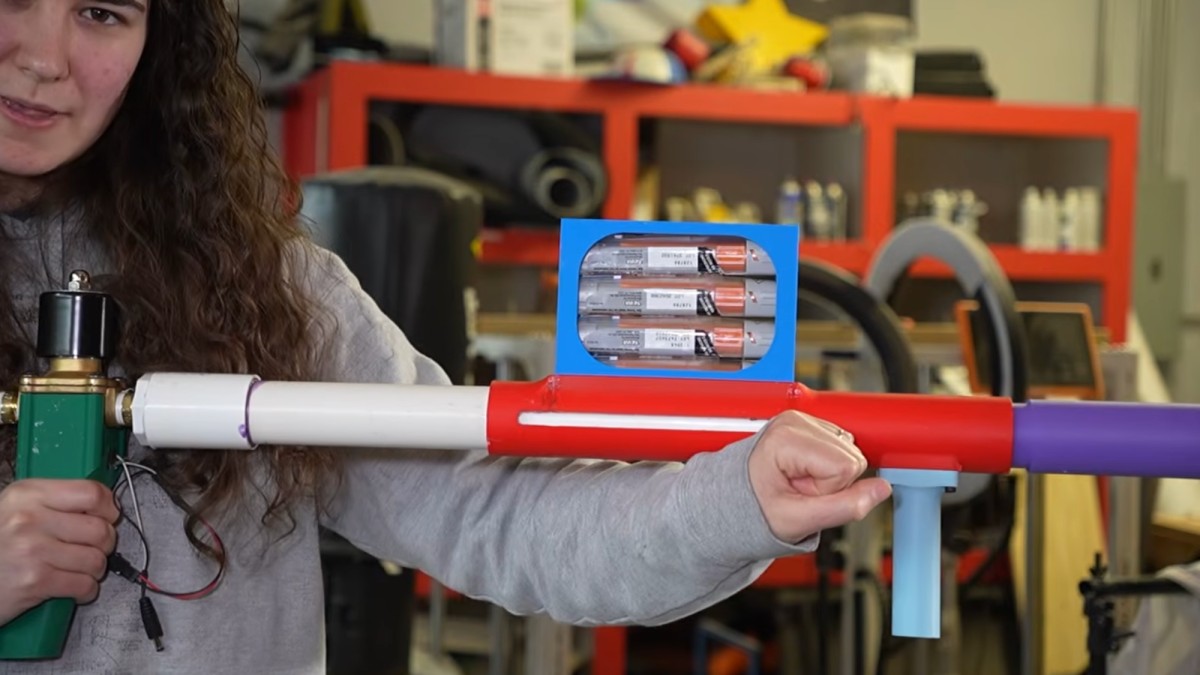
A popular YouTuber has taken the concept of the classic PVC potato gun and applied it to a much more serious piece of medical technology: the EpiPen. In a recent video, creator Emily the Engineer demonstrated a custom-built “EpiPen Launcher,” designed to deliver epinephrine from a distance.
The Concept: Bridging Engineering and Medicine
The project began with a provocative question: if a potato gun can launch almost any object of a certain size, why not use that same mechanism to distribute life-saving medicine?
The EpiPen (an epinephrine autoinjector) has been a cornerstone of allergy treatment since its FDA approval in 1987. It is designed to treat anaphylaxis —a severe, potentially fatal allergic reaction—by injecting a precise dose of adrenaline into the user. Traditionally, this requires the device to be pressed firmly against the skin to trigger a spring-loaded or CO2-driven needle. Emily’s goal was to see if that delivery could be achieved remotely.
Engineering the Device
Building a functional launcher required more than just a simple tube. To move beyond a single-shot prototype, the team implemented several sophisticated engineering features:
- Bolt-Action Mechanism: A 3D-printed attachment allows the user to cycle through a magazine of up to four EpiPens.
- Continuous Pressure: To ensure each injector has enough force, the team integrated an air compressor into a backpack, which provides a steady stream of pressurized air to the launcher.
- Precision Aiming: The design accounts for the need for accuracy, which is critical in a medical emergency where every second counts.
Does It Actually Work?
The results of the experiment were a mix of technical success and practical limitations. Through rigorous testing, the team achieved the following:
- Medical Delivery: Using “tester” EpiPens, the team successfully delivered epinephrine into a slab of ballistic gel (a substance used to simulate human tissue) from across a garage.
- Distance and Velocity: In outdoor tests, the launcher was able to hurl a pen approximately 105 feet.
However, the experiment also highlighted a major hurdle: velocity. While the launcher can throw the device a significant distance, it struggled to maintain enough kinetic energy to ensure the needle would penetrate human skin upon impact.
Why This Matters
While the EpiPen Launcher is clearly a feat of DIY engineering rather than a viable medical tool, the project highlights an interesting intersection of mechanical engineering and emergency response.
In high-stress medical scenarios, such as an allergic reaction in a crowd, the ability to deliver medication rapidly and accurately is a constant challenge for medical professionals. While a pressurized air cannon is not the solution, the “trial and error” approach used by creators like Emily the Engineer pushes the boundaries of how we think about device delivery and rapid-response technology.
While the EpiPen Launcher is more of an engineering spectacle than a medical breakthrough, it serves as a fascinating study in how specialized mechanics can be adapted to solve complex delivery problems.


