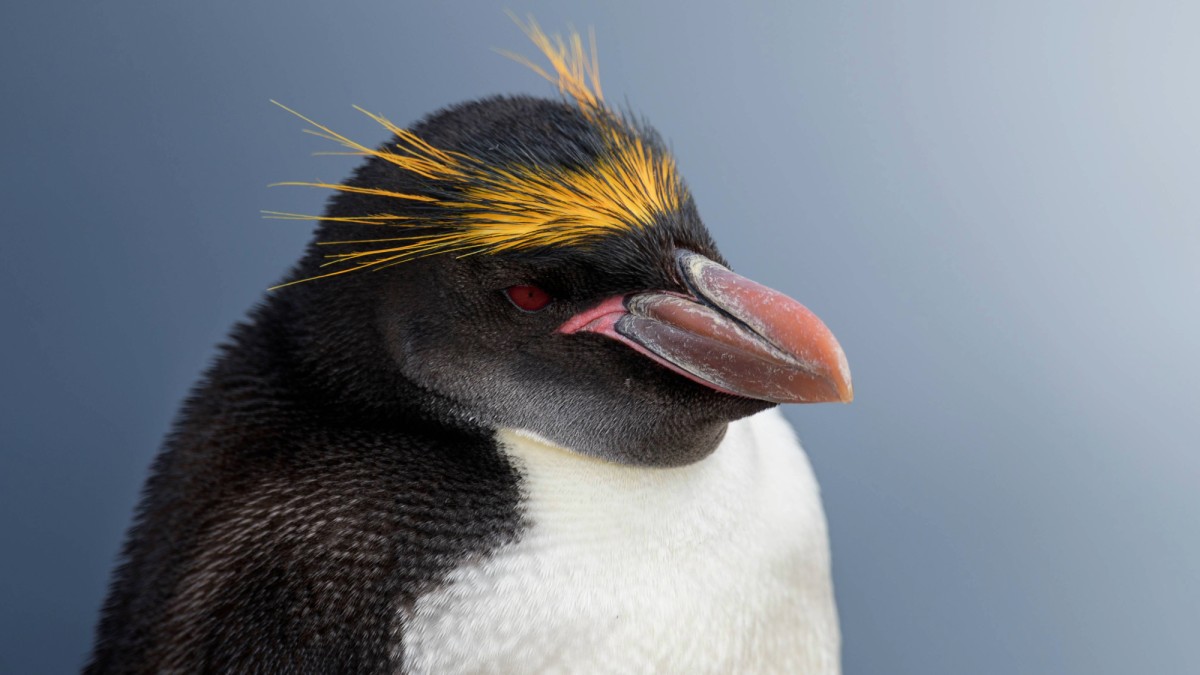
While the macaroni penguin (Eudyptes chrysolophus ) is often characterized by its comical appearance and signature bright-yellow plumes, recent scientific findings reveal a much more sophisticated biological machine. A study published in The Anatomical Record suggests that beneath their “goofy” exterior lies a highly specialized muscular system designed for extreme physical efficiency.
Engineering for Underwater Flight
Because penguins have traded aerial flight for aquatic movement, their physiology has undergone a radical transformation. Moving through water presents a massive physical challenge: water is roughly 700 times denser than air, creating significantly more resistance than the atmosphere.
To overcome this, macaroni penguins have evolved a unique muscular configuration in their wings (flippers):
- Enhanced Power: The supracoracoideus muscle—the primary muscle responsible for lifting the wing—is significantly larger in penguins than in flying birds.
- The “Backwards” Stroke: This enlarged muscle allows for a more powerful upstroke and downstroke. This creates a propulsion mechanism similar to “underwater flight,” featuring a stronger backward component that pushes the bird through dense water more effectively.
Solving a Century-Old Mystery
For over 100 years, biologists have been puzzled by how penguins maintain such a streamlined shape while swimming. The new research has finally identified the culprit: a specific muscle in the hindlimb that keeps the legs tucked tightly against the body.
The research team proposes naming this muscle the adductor tibialis . This anatomical feature serves two vital purposes:
- Hydrodynamics: Much like the streamlined forms of dolphins, whales, and humans, keeping the legs close to the body reduces drag, allowing for more efficient swimming.
- Stability: This muscle also aids in maintaining balance when the penguin is standing upright on land.
The Science of the Waddle
The iconic, clumsy-looking “waddle” of the macaroni penguin is not a sign of inefficiency, but rather a byproduct of this specialized anatomy. The combination of the adductor tibialis and the way their limbs are held close to their bodies creates a movement pattern that, while appearing awkward to humans, is actually an energy-efficient method for navigating both terrestrial and aquatic environments.
Why This Research Matters
Beyond pure biological curiosity, understanding the intricate muscular maps of these birds has practical applications for conservation and care.
Detailed knowledge of penguin musculature provides a vital roadmap for veterinary professionals, particularly in zoo settings and wildlife rehabilitation centers.
By understanding how these muscles function, experts can better treat injuries, develop more effective rehabilitation strategies, and improve the overall health of penguin populations in captivity and the wild.
Conclusion: The macaroni penguin is a masterclass in evolutionary adaptation, possessing specialized muscles that turn a seemingly clumsy bird into a highly efficient, streamlined athlete of the Southern Atlantic.