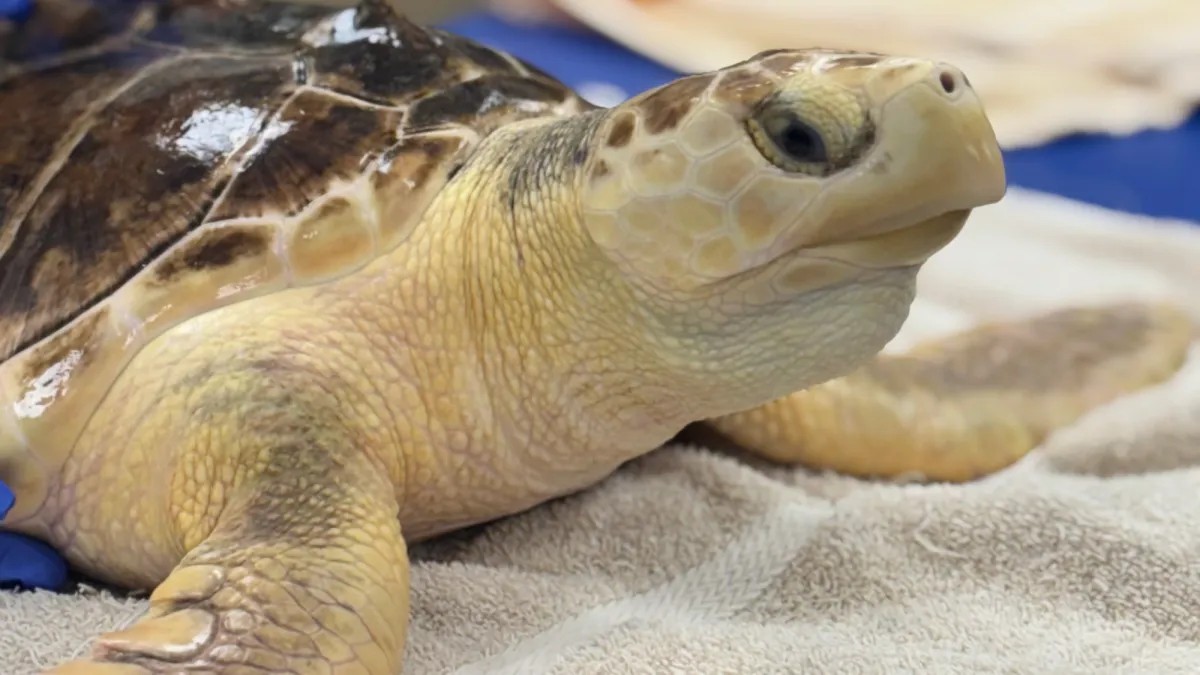
A rare biological phenomenon has been confirmed at the Georgia Sea Turtle Center: a first-generation hybrid sea turtle named Earl Grey. Born from the union of two distinct species—a Kemp’s ridley mother and a Loggerhead father—this turtle represents a unique case study for marine biologists studying adaptation and survival.
A Tale of Two Species
The parentage of Earl Grey is particularly striking because the two species occupy very different ecological niches:
- Kemp’s ridley (Lepidochelys kempii ): The world’s smallest sea turtle and a critically endangered species. Their nesting grounds are extremely limited, primarily restricted to Texas and Mexico.
- Loggerhead (Caretta caretta ): One of the largest hard-shelled sea turtles, reaching lengths of up to 3.5 feet. Unlike the Kemp’s ridley, Loggerheads have much broader nesting ranges across multiple oceans.
Because these species differ significantly in size, behavior, and nesting patterns, their offspring presents a biological anomaly that challenges standard understandings of species boundaries.
From Rescue to Discovery
Earl Grey’s journey to the Georgia Sea Turtle Center began with a health crisis. The turtle was originally found stranded on a beach in Brewster, Massachusetts, suffering from “cold-stunning.” This condition occurs when sudden drops in water temperature leave turtles too weak and sluggish to swim, often leading them to wash ashore vulnerable to disease or injury.
After initial care at the New England Aquarium, Earl Grey was transferred to Georgia in November. It was only through rigorous genetic testing at the rehabilitation center that scientists discovered the turtle’s true identity as a hybrid.
Why Hybridization Matters for Conservation
While hybridization occurs naturally in areas where species’ habitats overlap, it is often difficult to detect without DNA analysis. Currently, scientists lack reliable estimates of how many hybrid sea turtles exist in the wild.
The discovery of Earl Grey raises several critical scientific questions:
1. Behavioral Development: How will a hybrid navigate life stages? Will it follow the nesting patterns of the Kemp’s ridley or the Loggerhead?
2. Diet and Movement: Will its nutritional needs and migratory paths reflect one parent more than the other?
3. Evolutionary Impact: Could hybridization serve as a mechanism to introduce much-needed genetic diversity into dwindling populations?
“Each confirmed case helps scientists better understand how these animals are adapting in the wild—and ensures that conservation strategies can evolve alongside them.” — Jaynie L. Gaskin, Director of the Georgia Sea Turtle Center
Looking Ahead
The discovery serves as a call to action for marine researchers. Experts are encouraging other rehabilitation facilities to implement genetic testing for any suspected hybrids, as the existence of Earl Grey suggests that hybrid individuals may be more common in the ocean than previously realized.
The presence of hybrid sea turtles provides a vital window into how marine life adapts to changing environments, offering new insights that could reshape future conservation efforts.