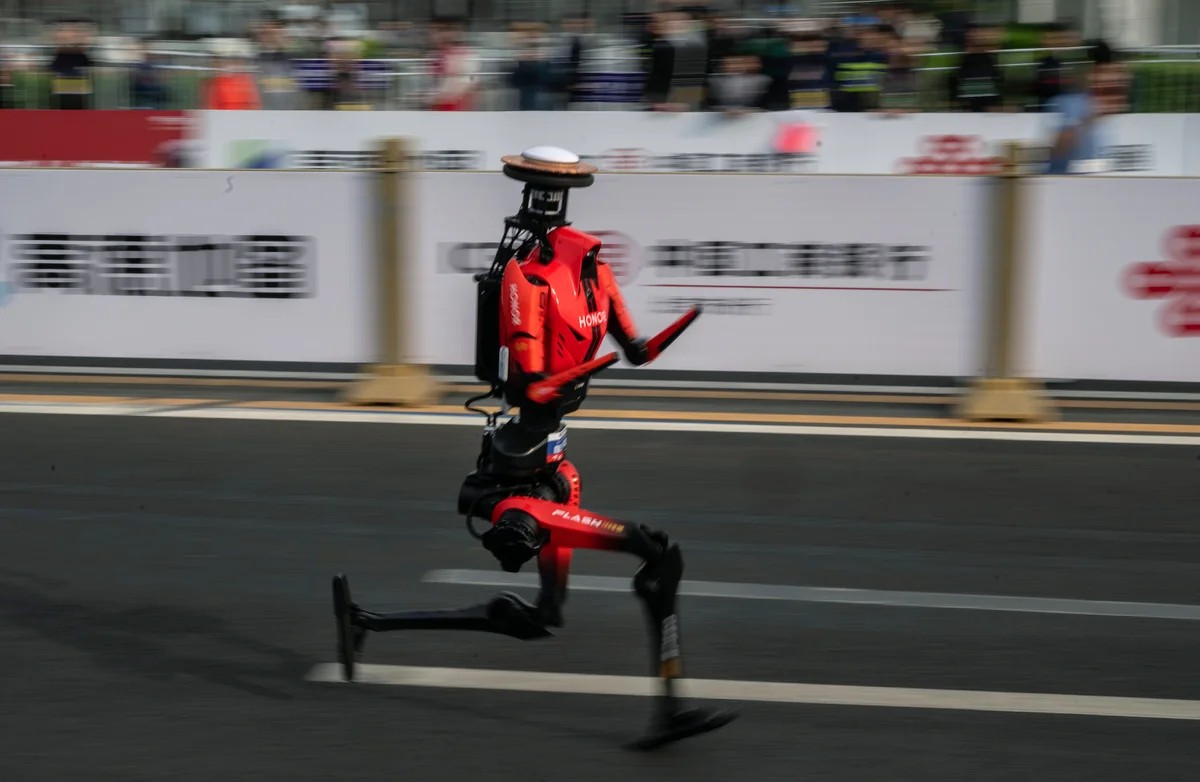
A red humanoid robot named Lightning recently captured global attention by finishing the Beijing E-Town Half Marathon in 50 minutes and 26 seconds. On paper, the achievement is staggering: the machine outpaced the human world record. However, beneath the headline-grabbing speed lies a complex reality that distinguishes mere mechanical performance from true robotic intelligence.
The Performance: Engineering Excellence
The Lightning robot is a marvel of specialized engineering. To achieve such high speeds over long distances, its creators—including the Chinese tech company Honor—implemented several sophisticated design choices:
- Advanced Thermal Management: To prevent the motors from overheating during the intense exertion, the robot utilizes a liquid-circulation cooling system, a technology adapted from high-end smartphone and computer engineering.
- Biomechanical Optimization: Much like an elite athlete or a greyhound, the robot is built for efficiency. It features large, powerful motors at the hips and knees, paired with a lightweight upper body and thin limbs to minimize energy loss during each stride.
- Durability: Unlike previous years where robots frequently broke down, this year’s machines demonstrated significantly improved structural robustness.
The Reality Check: Performance vs. Competence
Despite the impressive time, many experts argue that the race was more of a “publicity stunt” than a scientific breakthrough. The distinction lies in the difference between specialized performance and general competence.
“Humans conflate performance with competence,” warns Rodney Brooks, professor emeritus at MIT. “When you see a robot perform one task well, it fools us into thinking it has the same general intelligence as a human.”
The limitations of the Beijing race highlight a critical gap in current robotics:
- Lack of True Autonomy: While some robots ran without human pilots, most were operating on “pre-mapped” courses. They were essentially following a known path rather than making real-time decisions.
- Zero Environmental Interaction: The robots did not have to navigate crowds, avoid obstacles, or react to unpredictable changes. In fact, the Lightning robot actually crashed into a barricade and required human assistance to stand back up.
- Controlled Environments: Unlike human runners who navigate a real world, these robots ran on dedicated, rehearsed tracks with support crews and vehicles following closely behind.
The “Inversion” of Difficulty
For humans, running a marathon is a peak physical feat, while folding laundry or navigating a crowded grocery store is a trivial daily task. In the world of robotics, this hierarchy is completely reversed.
The Hardware vs. The Brain
As robotics expert Yanran Ding notes, the hardware bottleneck is largely disappearing. We now have the motors, the cooling systems, and the structural materials to make robots move incredibly fast. The real challenge has shifted to algorithms and cognition.
The industry is currently moving from “specialized autonomy”—the ability to follow a lane or a track—to “general competence”—the ability to move safely and intelligently among humans in an unmapped, chaotic world.
Conclusion
The Beijing race proved that we can build machines capable of superhuman physical feats, but it also highlighted that speed is not the same as intelligence. The next great frontier for robotics is not running faster, but learning how to move safely and unpredictably through the human world.