


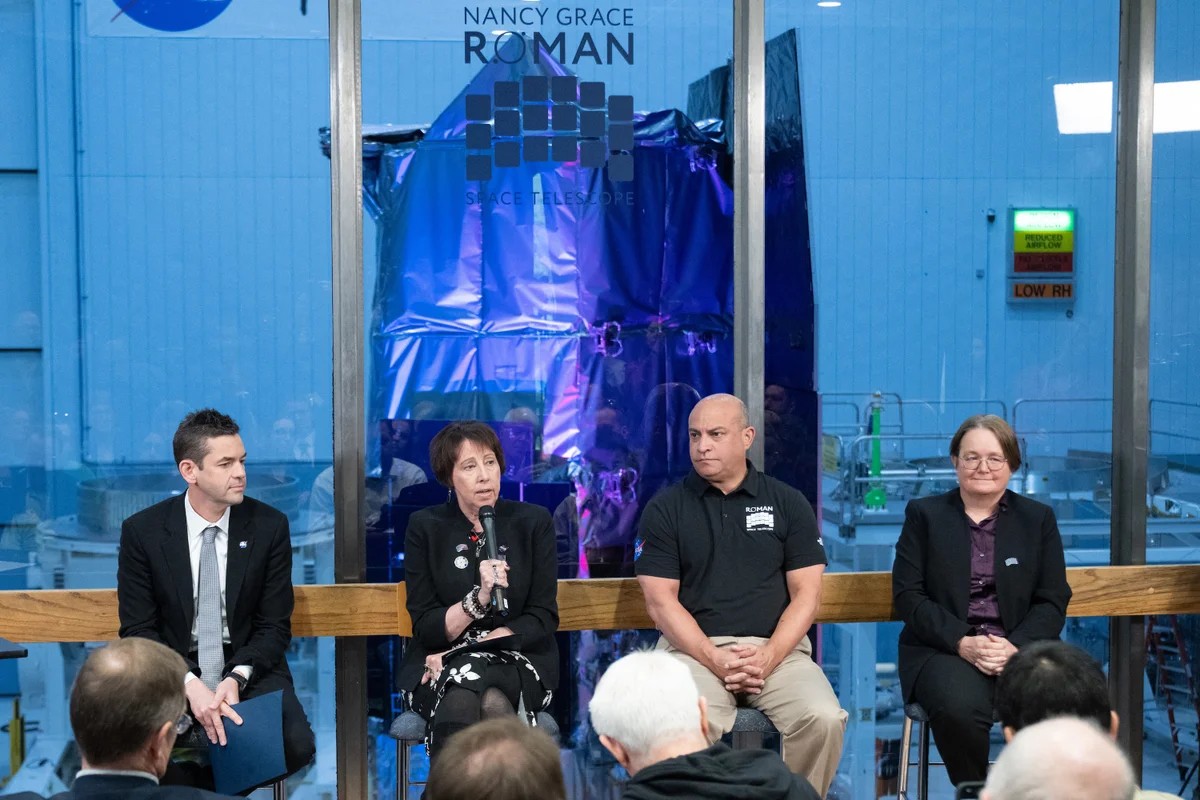
NASA has announced an early September launch window for the Nancy Grace Roman Space Telescope, a multibillion-dollar “flagship” observatory designed to revolutionize our understanding of the cosmos. Unlike previous telescopes that focus on deep, narrow views of specific objects, Roman is built to survey the universe on a massive scale, providing a panoramic “atlas” of stars, galaxies, and planets.
A Massive Leap in Observational Power
While the telescope’s primary mirror is comparable in size to that of the aging Hubble Space Telescope, its capabilities represent a generational leap in efficiency. NASA Administrator Jared Isaacman noted that Roman can process data at a rate far exceeding its predecessor: what would take Hubble 2,000 years to accomplish, Roman can complete in just one year.
The telescope’s defining feature is its wide field of view. It can capture 200 times more of the sky in a single image than Hubble, creating high-resolution data so vast that no current digital screen is large enough to display a single full-resolution image.
Unlocking the Mysteries of Dark Matter and Dark Energy
The scientific community is particularly focused on Roman’s ability to tackle the “big questions” that current physics cannot fully answer. The mission aims to investigate two of the greatest enigmas in modern astrophysics:
- Dark Matter: The invisible substance that provides the gravitational scaffolding holding galaxies together.
- Dark Energy: The mysterious force driving the accelerating expansion of the universe.
By mapping the distribution of galaxies across cosmic history, Roman will help scientists determine if our current “standard model” of the universe is accurate or if a fundamental shift in our understanding is required. This mission will work in tandem with other major projects, such as the European Space Agency’s Euclid mission and the ground-based Vera C. Rubin Observatory, to create a comprehensive picture of the evolving universe.
A Rare Success Story in Project Management
In an era where many large-scale NASA missions face significant delays and cost overruns, the $4.3-billion Roman project is a notable outlier. It is currently ahead of schedule and under budget.
Several factors contributed to this efficiency:
1. Strategic Funding: NASA utilized a “milestone-based” funding model, which allowed the agency to “buy down risk” by securing future congressional appropriations only after meeting specific technical goals.
2. Hardware Origins: The project’s development was jump-started in 2012 when the National Reconnaissance Office donated surplus wide-field optics to NASA. While integrating this hardware presented its own technical challenges, it provided a vital foundation for the mission.
3. Resilience: Despite proposed White House budget cuts last year, Congress maintained funding, allowing the project to maintain steady momentum.
The Path to Launch and Beyond
The spacecraft is scheduled to move to the Kennedy Space Center in Florida this June. Following its launch on a SpaceX Falcon Heavy rocket in September, the mission will begin with a 90-day setup period:
* First 45 days: Deployment of solar panels and antennas.
* Next 45 days: Calibration of optics, including a cutting-edge coronagraph.
This coronagraph is a critical technological test; it is designed to block out the blinding light of stars to reveal the much fainter planets orbiting them. Success here will pave the way for NASA’s next great endeavor: the Habitable Worlds Observatory, which aims to find Earth-like planets in distant solar systems.
“I expect that the most exciting science from Roman is going to be the things that we didn’t expect… that will set the new deep questions for future missions.” — Julie McEnery, Senior Project Scientist
Conclusion
The Nancy Grace Roman Space Telescope represents a pivotal shift toward wide-scale cosmic surveying. By combining unprecedented speed with a massive field of view, it is poised to transform our maps of the universe and provide the data necessary to solve the mysteries of dark energy and dark matter.


