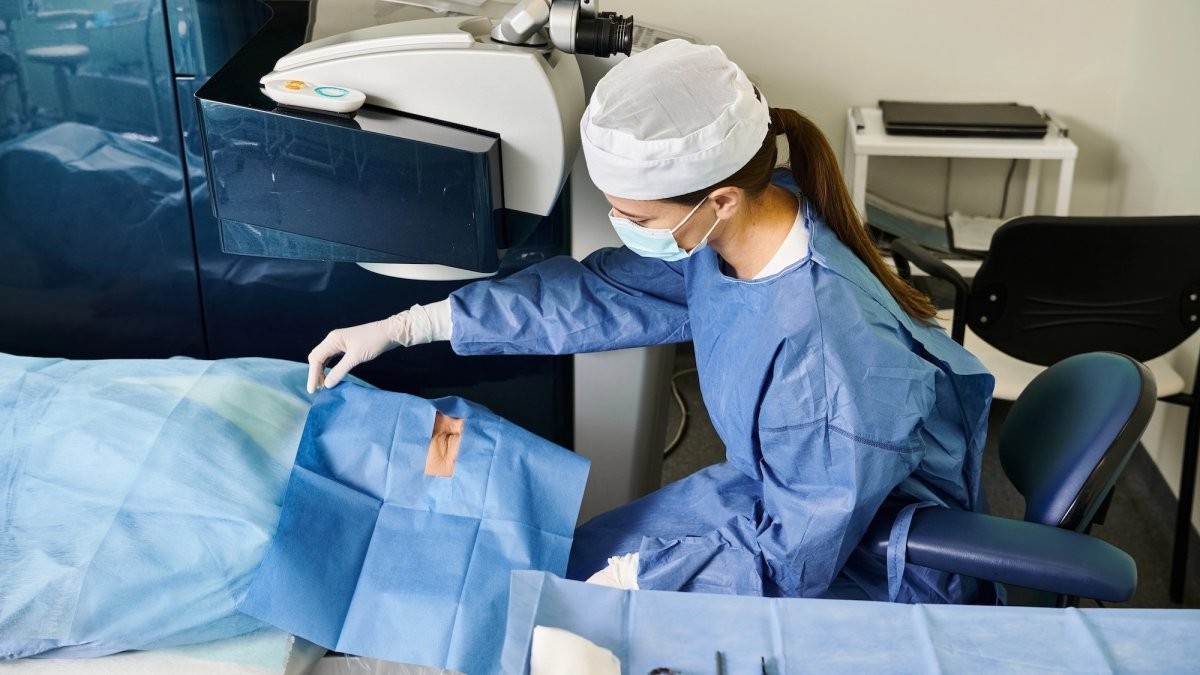
While Apple’s Vision Pro has struggled to find its footing in the consumer market, it has quietly carved out a niche in high-stakes medical environments. In a significant milestone for surgical technology, Dr. Eric Rosenberg of SightMD in New England successfully utilized the headset to perform a cataract surgery in October 2025. This procedure marks the first time the device was used for this specific type of eye surgery, leveraging a custom-built application called ScopeXR to facilitate real-time, remote collaboration.
Since that initial operation, Dr. Rosenberg reports using the system for hundreds of additional patients. The core innovation lies not just in the hardware, but in the software’s ability to broadcast the surgeon’s first-person view to remote consultants, residents, or students anywhere in the world. This effectively allows experts to “beam in” and observe every incision and suture as if they were standing in the operating room.
Redefining the Operating Room
The Vision Pro is classified as a mixed-reality headset, blending virtual and augmented reality to create an immersive workspace. For medical applications, this hybrid approach offers distinct advantages over previous attempts to digitize the operating room.
Earlier devices, such as Google Glass and Microsoft HoloLens, were tested in medical settings but often fell short due to insufficient display resolution. In contrast, the Vision Pro offers best-in-class visual clarity, which is critical when viewing delicate anatomical structures. However, hardware alone does not solve the problem of surgical workflow.
To bridge the gap between consumer tech and clinical utility, Dr. Rosenberg co-developed a “mixed reality surgical platform.” This software integrates data feeds from 3D digital microscopes and other OR equipment, projecting them directly into the surgeon’s field of view. The system provides:
- Stereoscopic 3D Visualization: Allowing for precise depth perception during intricate procedures.
- Data Overlay: Augmented reality features enable the projection of relevant patient data directly onto the workstation or patient.
- Global Collaboration: Multiple surgeons can access the same live video feed, offering guidance from remote locations.
“We are now able to bring the world’s best surgeon into any operating room, at any hour, from anywhere on the planet,” Dr. Rosenberg stated. “This technology democratizes access to expertise and that will save vision.”
From Commercial Flop to Clinical Tool
The trajectory of the Vision Pro in healthcare stands in stark contrast to its reception in the general market. Released in February 2024 with high expectations, the headset has seen sluggish sales compared to other Apple products. Many early adopters reported regret over the $3,499 price tag, and internal reports suggest Apple has shifted some engineering resources away from the device toward other projects.
Despite this commercial underperformance, the Vision Pro has found unexpected traction in professional sectors, particularly medicine. The trend began in earnest in September 2024, when Dr. Santiago Horgan of UC San Diego Health performed the first operation using the headset—a paraesophageal hernia repair. Following this success, the device was used in dozens of subsequent surgeries, including procedures for acid reflux and obesity.
Why Medicine Works Where Consumers Hesitate
The growing appeal of the Vision Pro in healthcare is driven by a unique economic and functional alignment. While $3,500 is prohibitive for most consumers, it is remarkably affordable in the context of medical equipment. Compared to specialized surgical monitors, robotic systems, or dedicated telemedicine infrastructure, the Vision Pro offers a high-resolution, adaptable platform at a fraction of the cost.
This affordability, combined with its ease of integration with existing hospital technology, makes it particularly attractive to regional and community hospitals with tighter budgets. These institutions can now offer advanced remote consultation capabilities without investing in million-dollar infrastructure upgrades.
Conclusion
The Vision Pro’s journey from a consumer curiosity to a clinical tool highlights a broader trend in medical technology: the repurposing of high-end consumer hardware for specialized professional use. By enabling real-time, high-fidelity remote collaboration, the device addresses a critical gap in surgical training and expert access. As more hospitals adopt this technology, it may well redefine how expertise is shared and how surgeries are performed globally.