Size is a prison for engineering.
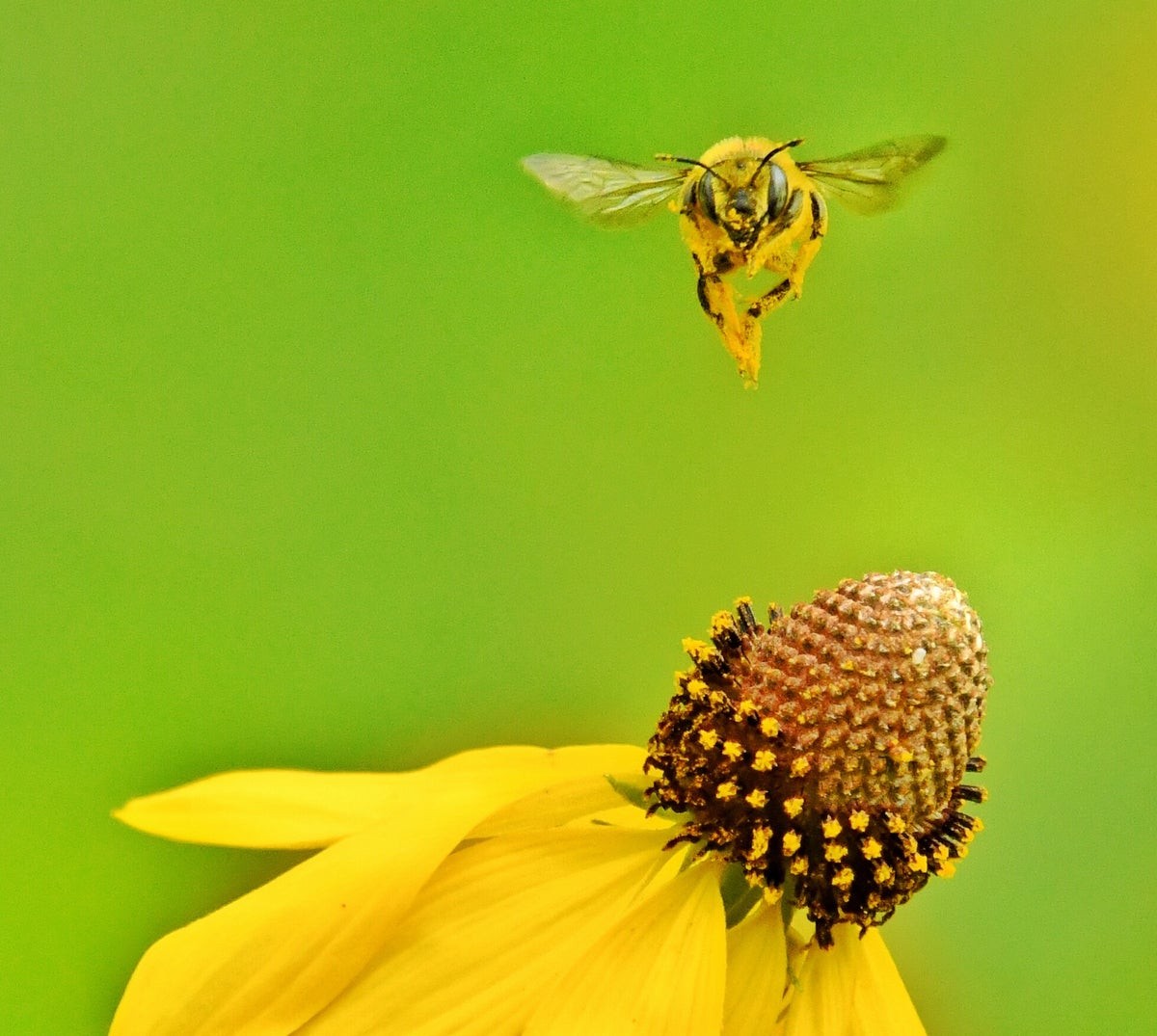
If you want to build a drone that fits in your palm, you cannot afford GPS. You cannot carry heavy lithium-ion bricks, complex LIDAR, or bulky processing units. The physics simply does not work. Yet researchers at Delft University of Technology have found a workaround by stealing from nature’s oldest aerialists: the honeybee.
They call it Bee-Nav.
The idea, published in Nature, is deceptively simple. Honeybees do not navigate with satellite precision. They learn. Guido de Croon, the study’s lead author, explains that when a bee leaves its hive, it takes a short “learning flight.” It memorizes landmarks. Then, as it ventures out, it tracks direction and speed through path integration. It keeps a running tally of how far and where it has gone.
Path integration is messy. Small errors compound over time. If you only trust your internal compass, you eventually get lost. Bees fix this by relying on those initial landmark memories to correct their course on the way back.
The researchers copied this exact workflow.
Learning the View
A Bee-Nav equipped drone starts by hovering near its launch site. A minuscule omnidirectional camera scans the scenery. This isn’t passive observation. Mid-flight, a tiny neural network on board maps these images to “home vectors.”
Think of these as invisible arrows pointing straight back to the pad.
This creates what the team calls a Learned Homing Area. Once the drone knows what “home” looks like, it can fly far away. To return, it relies first on path integration—backtracking based on speed and direction. If it lands within that familiar safe zone, the visual network kicks in. The camera recognizes the surroundings and guides it the rest of the way.
No satellites. No global maps. Just memory.
Tiny Computers, Big Results
The hardware doing the heavy lifting? An off-the-shelf Raspberry Pi 4. It’s the size of a credit card. It runs neural nets using between 3.4 and 42.3 kilobyles of memory.
Pause there for a second.
That is thousands of times less memory than conventional mapping systems use. And it worked. The test drones returned from 600 meters away (nearly 2,000 feet) outdoors. They dealt with wind gusts. They handled camera-blinding sun glare. They found their way.
Sarah Bergbreiter, a mechanical engineering professor at Carnegie Mellon, wasn’t part of the study, but she was impressed. She sees the potential clearly.
“For the small-scale robots that my team works on, this is the kind approach that makes serious outdoor deployment plausible.”
Still Not Quite There
It’s not a silver bullet yet.
There are holes in the armor. What if the drone needs to navigate between multiple memorized places, not just home? What if it launches in a featureless field with no landmarks to anchor its memory? Those remain open questions.
Sean Humbert from the University of Colorado Boulder points out another snag: cluttered environments. The Bee-Nav helps with orientation, but it doesn’t handle dynamic obstacles. You still need local avoidance systems to prevent crashes into walls or moving cars.
Yet de Croon argues the path is clear enough.
This technology could shrink autonomous drones down to 30 or 50 grams. He notes that scaling all the way down to insect size requires solving battery miniaturization first—a stubborn fundamental problem. But the brain? The brain is ready.
Or at least, it’s smaller than you think it has to be.