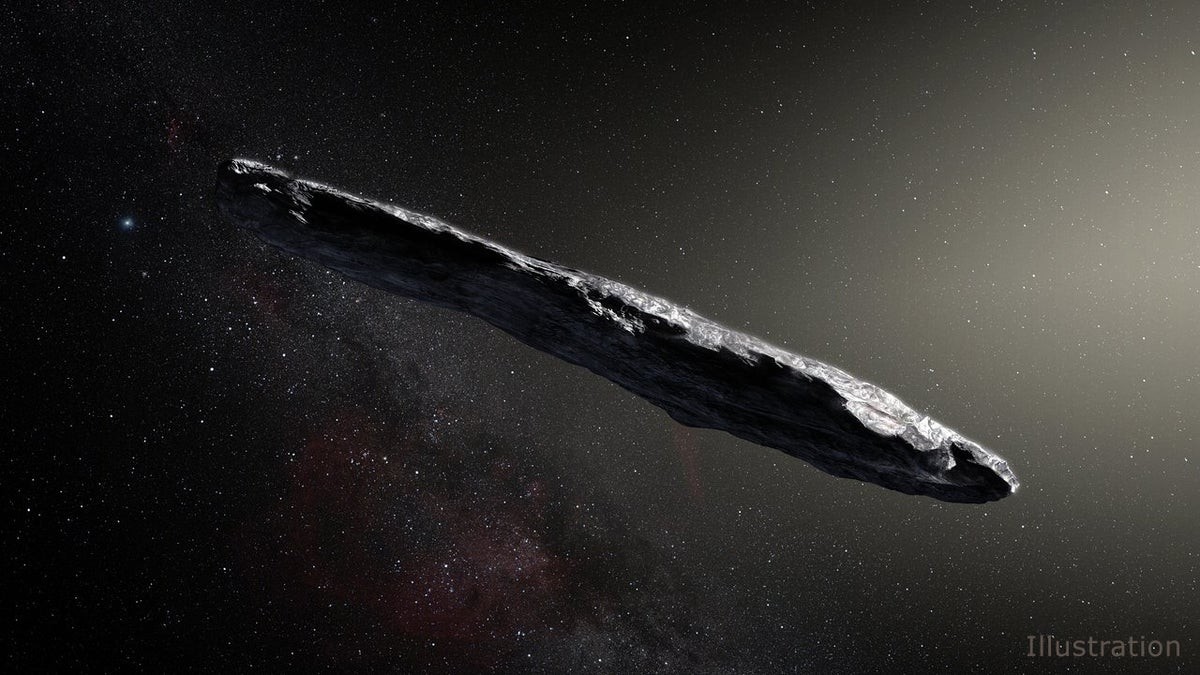
It happened in 2017. A rock showed up. Not ours.
1I/’Oumuamua streaked through the solar system. Scientists watched. They expected it to slow down. Gravity works that way. But it didn’t slow. It sped up.
Ghostly acceleration.
People went crazy. Aliens. Probes. Starships with broken engines. The headlines loved it. The reality was more boring, which is often true. Most astronomers knew better. It was probably just a space rock with a weird quirk.
Here’s the catch. Normal comets get warm near the Sun. They outgas. Little jets of dust push off. This creates a tail. It also pushes the comet faster. A tiny rocket effect.
‘Oumuamua sped up like that. But it had no tail.
Where was the gas?
Critics said, “Special pleading.” They laughed at the idea of invisible jets. If there’s no tail, it’s not a comet. It must be artificial. Or maybe the laws of physics got lazy that week.
Then came the “dark comets.”
Objects looking exactly like asteroids. Dark. Dull. Sitting in asteroid lists. But moving funny. Just like ‘Oumuamua. Slight pushes. Subtle nudges. Dozens of them popped up. Over a dozen known by 2023 now almost 20.
Davide Farnocchia at JPL saw the pattern. He found seven objects doing this dance. I got involved because I was trying to fix the ‘Oumuamua puzzle. We published our findings in 2023: these asteroids were actually comets. Just quiet ones. Sporadic takers of mass. We assumed we hadn’t caught one flashing a tail yet.
Until now.
I have been hunting with the Very Large Telescope in Chile. Waiting for a dark comet to wake up. One object screamed for attention. Farnocchia spotted its weird motion. I pointed the VLT.
Snap.
A tail. Faint, thin, undeniable.
We caught a dark comet in the act.
This changes things. It proves the acceleration comes from outgassing. No aliens needed. No starship drivers flooring it. Just ice turning to gas. Pushing rock. Physics working as intended.
This discovery validates that nongravitational motion is a legitimate tool for finding comets. We don’t need to see the dust. We just need to track the drift.
Qicheng Zhang and his team found another one recently too. Using old data from the SOHO mission. Different object. Same story. Tail present.
These aren’t anomalies. They are a category. A “missing link” between asteroids and comets.
Think about how we find Neptune. We saw planets wobbling. We didn’t see Neptune first. We calculated where it should be. Then we looked. Same thing here. We track the wobble. We find the comet.
This matters. Not just for taxonomy. But for history.
Earth got wet. Water didn’t form here originally. It arrived. Brought in on comets. Delivered over eons. Comets also bring organic soup. Building blocks of life.
If dark comets are common?
If they masquerade as asteroids near Earth?
We might be surrounded by them. We underestimated the comet population. The solar system might be much messier. More active. More dangerous. Maybe more promising for studying prebiotic chemistry than we thought.
‘Oumuamua is gone. Passed by long ago. We will likely never catch it. But its legacy is this clarity. It taught us to look harder at the quiet objects. To trust the motion when the eye fails.
The next interstellar visitor won’t have to prove it’s alien to be interesting. It might just be another rock. Sprouting a ghost tail. Flying alone.