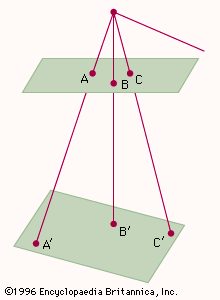
Geometric projection is less about drawing pictures and more about defining relationships. It acts as a bridge, creating a correspondence between the points of a figure and a surface or line. Think of it as a systematic way to translate data from one space to another. In plane projections, you take a series of points on one plane and map them onto a second plane. You do this by picking a focal point, or origin. From that origin, you construct lines that pass through the initial points and hit the second plane. This specific mapping is known as central projection.
The resulting figures are said to be in perspective. The new image is simply the projection of the original figure. But the geometry changes depending on how you draw those lines. If the rays are parallel rather than converging to a single point, the projection is called parallel. If those parallel rays hit the target plane at a perfect right angle, you have an orthogonal projection. The orientation of the planes matters, too. If the two planes are parallel to each other, the point configurations remain identical. If they are not, the shapes will distort.
How Stereographic Projection Works on a Sphere
A second common type is stereographic projection. This moves points from a sphere onto a plane. The simplest method involves choosing a plane that cuts through the center of the sphere. You then project the surface points along normals, or perpendicular lines, to that plane. You do not have to keep the plane centered. The math works regardless of the plane’s attitude relative to the sphere.
Mathematically, this is a mapping of sphere points to plane points. When a one-to-one correspondence exists, the map is called conformal. This means it preserves local shapes, even if it changes sizes.
Why Projective Geometry Matters
Projective geometry is the discipline built entirely around these concepts. It studies projections and the properties of projective configurations. It asks how shapes behave when viewed from different angles or mapped onto different surfaces. This field does not just look at static figures; it looks at the invariants that survive the translation.
“The figures made to correspond by the projection are said to be in perspective.”
Understanding these mappings helps explain how we visualize three-dimensional objects on two-dimensional surfaces. It is the foundation for many practical applications, from computer graphics to cartography.