


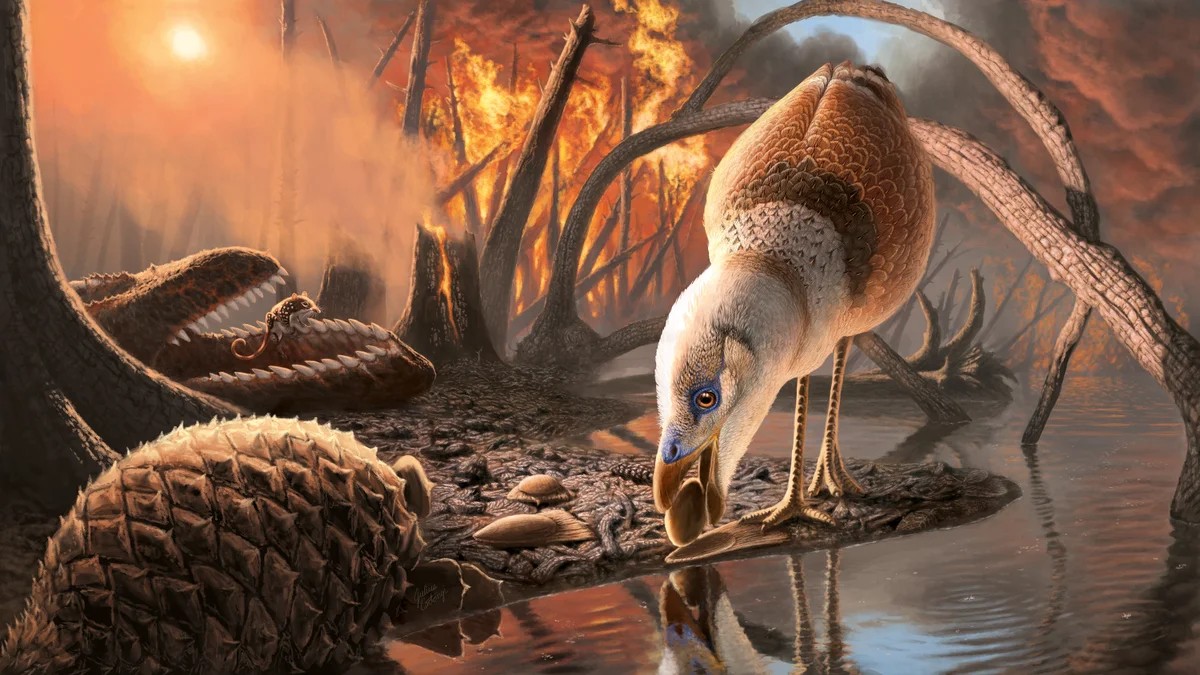
Sixty-six million years ago, the Earth was a masterpiece of prehistoric diversity. In North America, the Tyrannosaurus rex reigned supreme; in Asia, agile raptors hunted through dense brush; and across the globe, massive, long-necked behemoths shook the ground with every step. It was a world of giants, yet it was also a world of feathered creatures—some of which were already taking to the skies.
Then, the end arrived. A 10-kilometer-wide asteroid slammed into the Gulf of Mexico with the force of a billion nuclear bombs. The immediate aftermath was a nightmare of tsunamis, wildfires, and earthquakes, followed by a prolonged “impact winter” as dust and soot choked the atmosphere, blocking the sun for years.
The catastrophe was so absolute that it wiped out three out of every four species on the planet. But while the era of the giants ended, one lineage of dinosaurs escaped the grave: birds.
The Myth of Total Extinction
There is a common misconception that the asteroid killed all dinosaurs. In reality, birds are the direct descendants of specific dinosaur lineages. The real scientific mystery isn’t just why dinosaurs died, but why most birds died with them, leaving only a tiny fraction to repopulate the Earth.
For decades, paleontologists have studied the evolutionary bridge between dinosaurs and birds. Discoveries in China’s Liaoning Province have revealed feathered dinosaurs—like the Zhenyuanlong —that possessed wispy, hair-like feathers and primitive wings. These fossils prove that many “bird-like” features, such as hollow bones, efficient lungs, and feathers, actually evolved in ground-dwelling carnivores long before the first true bird took flight.
The Rule of Size: Why the Giants Fell
New research suggests that the asteroid was not a “bystander” to a gradual decline, but the primary driver of a sudden, violent extinction. Evidence from fossil beds in New Mexico shows that dinosaur communities were thriving right up until the moment of impact.
When the dust settled, a grim pattern emerged: If you were big, you died.
The non-avian dinosaurs—from the massive Alamosaurus to smaller, feathered raptors—were doomed by their own biology:
– High Caloric Needs: Large bodies require massive amounts of food. When ecosystems collapsed and plants died off, the food chain broke.
– Lack of Shelter: Most large dinosaurs could not burrow or find refuge from the intense heat of wildfires or the freezing temperatures of the impact winter.
– Slow Development: Many large species took years to reach maturity, making it nearly impossible for populations to recover from sudden mass mortality.
The “Winning Combo”: How a Few Birds Survived
It is a mistake to think that all birds survived. In fact, an estimated 90% of bird species perished alongside the T. rex. Many primitive birds—those with teeth, long bony tails, and large bodies—could not endure the collapse.
The survivors were members of the “crown group”—the ancestors of modern birds like ducks and chickens. Recent studies of fossils like Vegavis (from Antarctica) and Asteriornis (the “Wonderchicken” from Europe) reveal the specific traits that allowed them to endure:
1. Small Size and Efficiency
Unlike their larger cousins, these birds required very little food to sustain themselves. Their small frames allowed them to survive on much leaner resources during the years of darkness.
2. Rapid Growth
Fossil analysis shows that these successful lineages grew from hatchlings to adults incredibly quickly—often within a single year. This “fast-track” life cycle allowed them to replenish their populations much faster than larger animals could.
3. Strategic Habitat and Diet
The most critical factor was likely a combination of where they lived and what they ate. While forests were devastated by fire and shockwaves, birds that lived near water or in diverse habitats had a better chance of finding food. By possessing beaks instead of teeth and having more flexible diets, these “modern-style” birds could pivot to new food sources as the world changed.
The survival of birds was not a guarantee of their lineage, but a triumph of circumstance. It was a combination of small stature, rapid maturation, and dietary flexibility that allowed a few “plucky survivors” to navigate the apocalypse.
Conclusion: The asteroid didn’t just select for flight; it selected for efficiency. Modern birds exist today because their ancestors were small, fast-growing, and adaptable enough to survive a world where being a giant was a death sentence.


