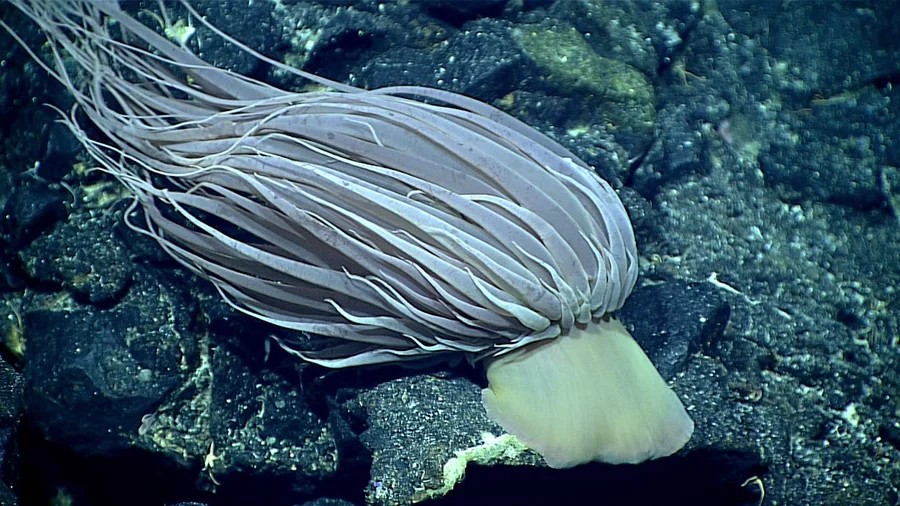
In August 2023, researchers exploring the depths of the Gulf of Alaska stumbled upon an object that looked more like a science-fiction prop than a biological organism. A shimmering, golden orb, roughly four inches in diameter, was captured on video by remote-controlled submersibles two miles beneath the ocean surface.
While initial theories ranged from unknown egg casings to entirely new life forms, a collaborative effort between the National Oceanic and Atmospheric Administration (NOAA) and the Smithsonian Institution has finally revealed its true identity.
From Sci-Fi Mystery to Biological Reality
The discovery occurred during an expedition by the NOAA ship Okeanos Explorer. While surveying a seamount, the crew spotted the dome-shaped object stuck to a rock. Its unusual appearance—resembling a “yellow hat”—prompted immediate curiosity. Because the object appeared biological but lacked recognizable features, it was collected and sent to the Smithsonian’s National Museum of Natural History for rigorous testing.
To solve the puzzle, scientists employed a multidisciplinary approach, combining:
– Morphological analysis (studying physical structure)
– Genetic sequencing (analyzing DNA)
– Bioinformatics (processing complex biological data)
The Reveal: A Hidden Life Cycle
The investigation revealed that the “orb” was not a single creature in a new life stage, but rather the remnants of a deep-sea anemone.
Through whole-genome sequencing, researchers determined that the object shared nearly identical mitochondrial DNA with a known species: Relicanthus daphneae . This species of anemone was first discovered in the 1970s but was not formally classified until 2006.
Why did it look so strange?
The orb’s unusual shape is a result of how the organism attaches itself to the seafloor.
– Relicanthus daphneae secretes a sticky substance to anchor itself to rocks.
– Over time, the anemone builds up “layers and layers” of this fibrous material.
– The “golden orb” is essentially the accumulated mass of these secretions and biological structures that the anemone uses to glue itself in place.
While the orb appeared solitary and inorganic, it was actually the structural footprint of a living creature that typically features pinkish or pale purple tentacles stretching up to seven feet in length.
Why Deep-Sea Exploration Matters
This discovery highlights a broader trend in marine biology: the gap between what we see and what we actually understand. The deep ocean remains one of the least explored frontiers on Earth, and many species remain “hidden in plain sight” because their physical forms do not match our expectations.
“So often in deep ocean exploration, we find these captivating mysteries… With advanced techniques like DNA sequencing, we are able to solve more and more of them.”
— William Mowitt, acting director of NOAA Ocean Exploration
The ability to sequence the DNA of unknown specimens is transforming deep-sea research. Scientists believe that thousands of unidentified specimens currently sitting in museum collections could yield similar breakthroughs if subjected to the same genetic scrutiny.
Conclusion
The “golden orb” was ultimately identified as the accumulated anchoring material of a Relicanthus daphneae anemone. This case demonstrates how modern genetic technology is turning mysterious deep-sea anomalies into vital pieces of biological knowledge.