Ancient humans stared up and asked grand questions. Did the moon form from a giant impact? Why does it wax? Is it cheese? We have answers. No, sadly.
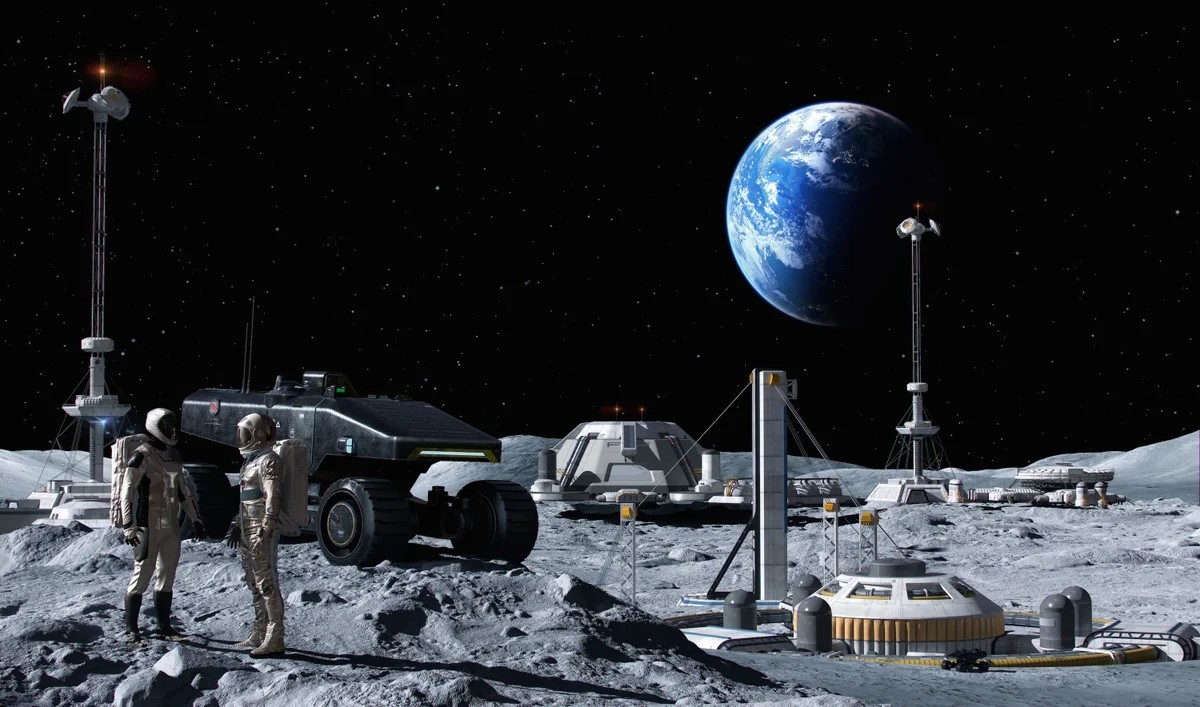
Now, a 21st-century space race is heating up. A single pragmatic question remains: How do you make money up there?
The answer isn’t water. It isn’t glory.
It’s Helium-3.
It is rare on Earth. Expensive. Spectacularly useful. Demand is soaring because it enables quantum computers to cool near absolute zero. It powers advanced medical imaging. It helps detect smuggled nukes. Maybe even future fusion reactors.
On Earth, we get it as a by-product of weapon decay. Just a few kilograms a year. A single kilogram costs roughly $20 million.
The Moon? Scientists estimate a billion kilograms sitting on the surface. A multitrillion-dollar industry? Plausible.
Clive Neal, a lunar geologist, says Helium-3 is “where the money is.” Water ice has value for local rocket fuel and astronaut hydration, but Helium-3 has value for Earth. That’s the difference.
Finding the Treasure
First, you need to find it.
Helium-3 differs from common Helium-4 by having one fewer neutron. Most Earth helium came from the Big Bang, trapped deep in the crust since our planet formed. Volcanoes belch tiny amounts. That’s it.
The Moon has a different source.
The sun.
The solar wind—a stream of charged particles from the sun’s atmosphere—carries Helium-3 across the cosmos. Earth is shielded by its magnetic field and air. The Moon? No shield. No atmosphere. It gets spray-painted.
But gas doesn’t just stick to dust. It needs a trap.
That trap is Ilmenite. A mineral rich in iron, titanium, and oxygen. It acts like a sponge.
Prospectors map the Moon looking for three things.
- Ilmenite-rich regions (often in the dark mare, ancient lava fields).
- High solar wind exposure (usually equatorial, often on the far side).
- Areas untouched by recent meteor impacts.
Wait, impacts complicate things. Christopher Dreyer of the Colorado School of Mines notes that micrometeorites cause “gardening.” They churn the surface.
This agitation can shake Helium-3 out of the rock, lost to space.
Or.
It can expose fresh mineral surfaces to catch more Helium-3. The churn might bury enriched material several meters down.
You don’t know until you go.
Next year, NASA launches VIPER (Volatiles Investigating Polar Explore Rover). It drills. It sniffs with mass spectrometers. In 2028, India and Japan launch LUPEX for similar scouting.
Ground truthing is key. Orbital images are guesses. A spectrometer is proof.
If thick deposits exist, investors will cheer. If the solar wind replenishes it quickly? Renewable lunar energy. Game over. If it takes centuries? The resource runs out once mined.
“There’s a question mark here,” says Neal. “But it’s tantalizing.”
Harvesting Spray Paint
Finding it is easy compared to extraction.
Sara Russell of London’s Natural History Museum puts it bluntly: “It’s like trying to mine spray painting from a wall.”
The process?
- Heat the lunar soil (regolith) to release the gas.
- Separate Helium-3 from other volatiles.
- Send it back to Earth.
Simple steps. Extremely difficult execution.
No one has done this yet. Not even as an experiment.
Interlune, a Seattle-based startup, wants to be first. They built a prototype with Vermeer Corporation that processes 100 metric tons of soil per hour. NASA awarded them $6.9 million to develop hydrogen-helium capturing tech.
Their mission: Prospect Moon. Target date: 2028 (maybe earlier).
CEO Rob Meyerson promises a robotic arm, a drill, and three extraction methods.
“That’s what we need to prove the business case for full scale operations on the Moon.”
Lunar dust hates machines. It’s adhesive. Abrasive. Sticky. Interlune hasn’t shared landing sites, but logic points to the near-side equator. Closer to Earth for communication. Easier landings.
If Interlune succeeds, a lunar gold rush begins.
Who Owns the Moon?
Not everyone likes this idea.
Private sector strip-mining? With little regulation? Russell worries about environmental scarring. Gouges visible from Earth? She thinks the moon belongs to everybody.
Meyerson disagrees.
He claims Interlune respects the Moon. No open-pit holes left behind. They plan to dig three meters down, extract gas, and leave no mechanical waste.
“We’ve talked about leaving the look site like a tilled agricultural field.”
Optimistic.
Maybe overly so.
Real lunar mining is messy. Whether they achieve that neatness remains unproven.
Still, the U.S. push to return to the Moon helps. Infrastructure follows flags. NASA isn’t doing it just for rocks, but companies piggyback. Even NASA administrators like Jared Isaacman are skeptical of Helium-3 as a primary profit driver, favoring asteroid mining.
So. Will Helium-3 save us? Or crash?
Maybe it’s a bust. Maybe there isn’t enough.
But, as Neal puts it.
Just maybe. We’re going to hit the motherlode.
If so. Everything changes.
If not.
Well. At least we’ll know the moon isn’t cheese. 🌙