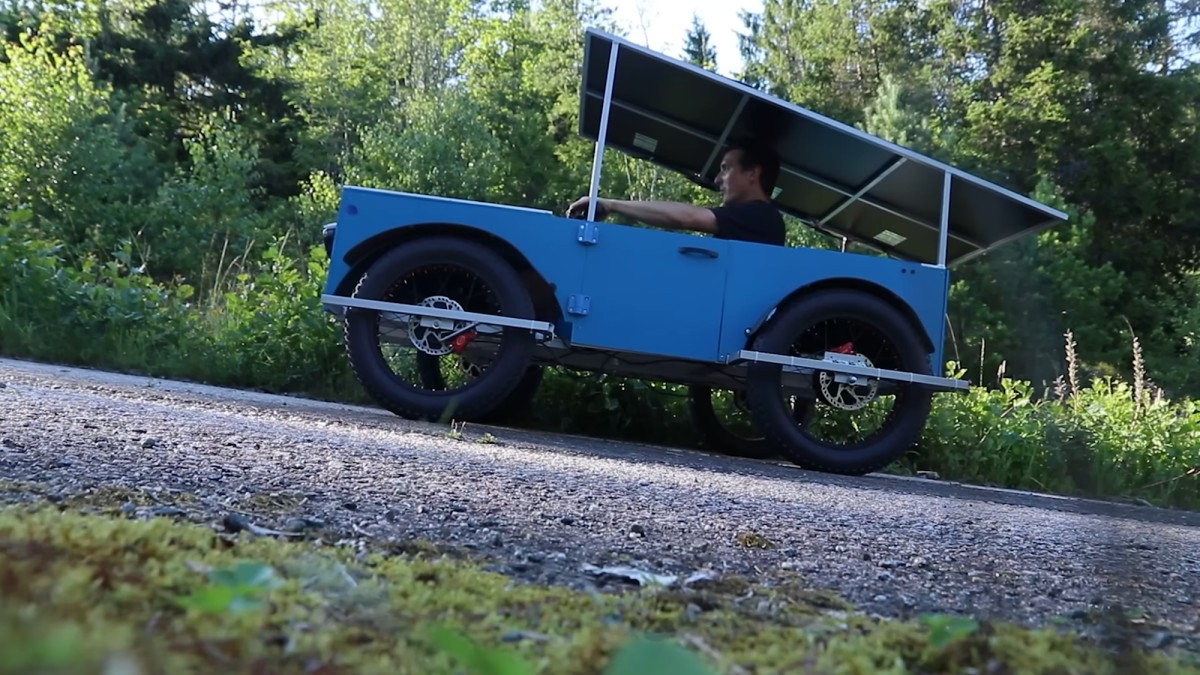
The dream of a truly efficient, affordable solar-powered vehicle has long remained out of reach for the average automotive enthusiast. While solar technology is rapidly maturing for home grids and large-scale energy production, integrating enough photovoltaic cells to reliably propel a standard-sized car over long distances remains a significant engineering hurdle. However, this limitation has not stopped innovators from reimagining the concept on a smaller, more practical scale.
YouTuber and maker Simon Sörensen recently demonstrated that by repurposing existing electric components, it is possible to build a functional, two-person solar car that prioritizes utility over raw speed. His project proves that sustainable mobility solutions do not always require billion-dollar R&D budgets—sometimes, they just require clever assembly and a willingness to tinker.
From E-Bikes to Four-Wheel Drive
Sörensen’s approach was fundamentally about resourcefulness. Rather than designing a powertrain from scratch, he dismantled two electric bicycles to harvest their motors and controllers. These components were then integrated into a custom-built chassis made from steel tubing.
The result is a vehicle that defies the typical limitations of DIY solar projects: it features four-wheel drive.
“What’s cool about this particular setup is that I have a 1000W hub motor in each wheel,” Sörensen explained in a profile by SupercarBlondie.
This configuration allows the vehicle to switch between front-wheel, rear-wheel, and all-wheel drive modes, offering versatility that most single-motor electric vehicles lack. The steering mechanism utilizes Ackermann geometry, a precise steering kinematic system originally developed for horse-drawn carriages in 1816. Today, it is a staple in high-performance racing cars, such as Formula 1 vehicles, because it allows wheels to turn at different angles during a corner, reducing tire scrub and improving handling stability.
Solar Efficiency and Real-World Range
The energy system is designed to maximize independence from the grid. The car is equipped with three lightweight solar panels capable of generating 300 watts of power, which charges a 48-volt battery pack.
While the battery provides a safety net, the solar array is potent enough to handle significant daily travel in ideal conditions:
- Solar-Only Range: Approximately 20 miles (32 km) on sunny days.
- Total Range: Roughly 50 km (31 miles) using the battery reserve.
- Extended Potential: Up to 100 km (62 miles) if solar charging continues effectively during travel.
This setup suggests a use case focused on local commuting or short-range errands, where the vehicle can essentially recharge itself while driving during peak sunlight hours.
Performance and Practicality
A common criticism of early solar vehicles is that they are too slow for practical road use. Sörensen’s build challenges this notion. In demonstration videos, the vehicle reaches a top speed of nearly 30 mph (48 km/h).
While this speed is not suitable for highway driving, it is highly effective for urban environments, residential areas, and low-speed zones. For a backyard engineering project constructed largely from recycled e-bike parts, the performance metrics are impressive.
Why This Matters
Sörensen’s project highlights a growing trend in decentralized sustainable engineering. As electric bike technology becomes more accessible and affordable, the barrier to entry for building larger electric vehicles lowers significantly. This type of innovation raises important questions about the future of personal transport:
- Accessibility: Can we shift focus from high-speed luxury EVs to affordable, low-speed utility vehicles for short trips?
- Resource Efficiency: Repurposing existing e-bike components reduces waste and lowers the cost of entry for sustainable transport.
- Energy Independence: Vehicles that can partially self-sustain via solar power reduce reliance on charging infrastructure for short-distance travel.
While this car will likely never replace a family sedan for cross-country trips, it serves as a compelling proof-of-concept. It demonstrates that with basic engineering principles and sustainable components, individuals can create functional, eco-friendly transportation solutions that are both affordable and adaptable.
In short, Simon Sörensen’s solar car proves that the future of sustainable transport isn’t just about big tech breakthroughs—it’s also about smart, accessible, and creative reuse of existing technology.