


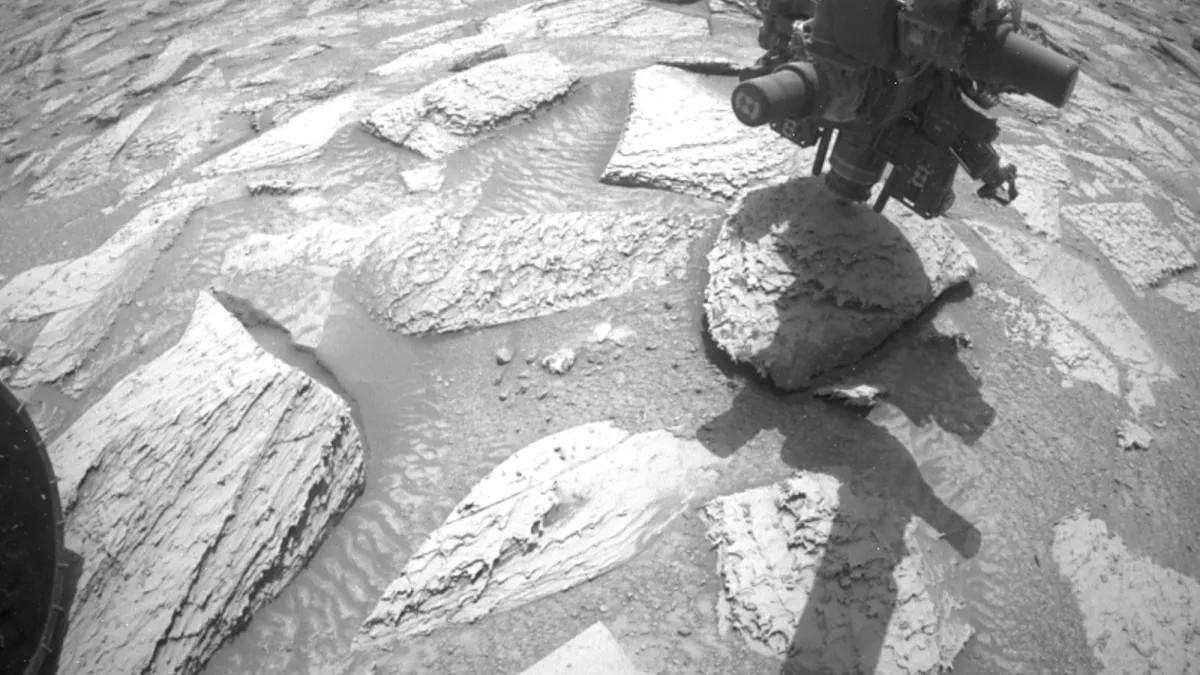
For six days, NASA’s Curiosity rover faced an unexpected engineering challenge: it accidentally picked up a heavy Martian rock and couldn’t put it down. The incident, which began on April 25, threatened to disable the rover’s primary scientific tool, but mission engineers have successfully resolved the issue using a series of careful maneuvers.
The Accidental Lift
The trouble started during a routine sampling operation. Curiosity’s robotic arm was drilling into a rock formation nicknamed “Atacama” to collect powder for chemical analysis. However, Atacama was not a standard target. The formation was substantial—measuring 1.5 feet wide, six inches thick, and weighing approximately 28.6 pounds.
As the drill bit penetrated the surface, it fractured the upper layers of the rock. Unlike previous instances where debris simply fell away, this time the entire chunk remained attached to the drill sleeve. When engineers attempted to retract the arm, they inadvertently lifted the rock off the Martian surface.
“Drilling has fractured or separated the upper layers of rocks in the past, but a rock has never remained attached to the drill sleeve,” NASA explained.
Why This Was Critical
While the image of a rover carrying a boulder might seem humorous, the situation posed a serious risk to the mission. Curiosity’s drill is a precision instrument essential for its scientific goals. If the rock remained attached, the drill would be unusable. Furthermore, any forceful attempt to detach the rock risked damaging the robotic arm or the drill mechanism itself. Without these tools, Curiosity’s ability to analyze Martian geology would be severely compromised.
The Six-Day Solution
Mission controllers spent nearly a week devising a strategy to free the tool without causing damage. The process involved three distinct phases:
- Initial Attempts: Engineers first tried vibrating the tool—a technique similar to “turning it off and on again” for computer glitches. For four days, the rock remained firmly stuck.
- Reorientation: In a second attempt, the team reoriented the robotic arm and vibrated the drill again. This dislodged some sand but failed to release the main rock mass.
- The Breakthrough: On the sixth day, engineers employed a more complex maneuver. They tilted the drill slightly, rotated the entire tool, and vibrated it while simultaneously spinning the drill bit.
This combination of movements worked immediately. The rock fractured under the stress and fell back to the Martian surface, freeing the drill.
Mission Status
NASA has reported no lingering damage to the rover or its instruments. Curiosity is now operational and ready to resume its exploration of the Red Planet. The incident highlights the unpredictable nature of field robotics, where even routine tasks can encounter unexpected physical variables.
In summary, Curiosity’s successful recovery from this “rock and hard place” scenario ensures that the rover can continue its vital scientific work, proving that careful engineering can overcome even the most stubborn Martian obstacles.


