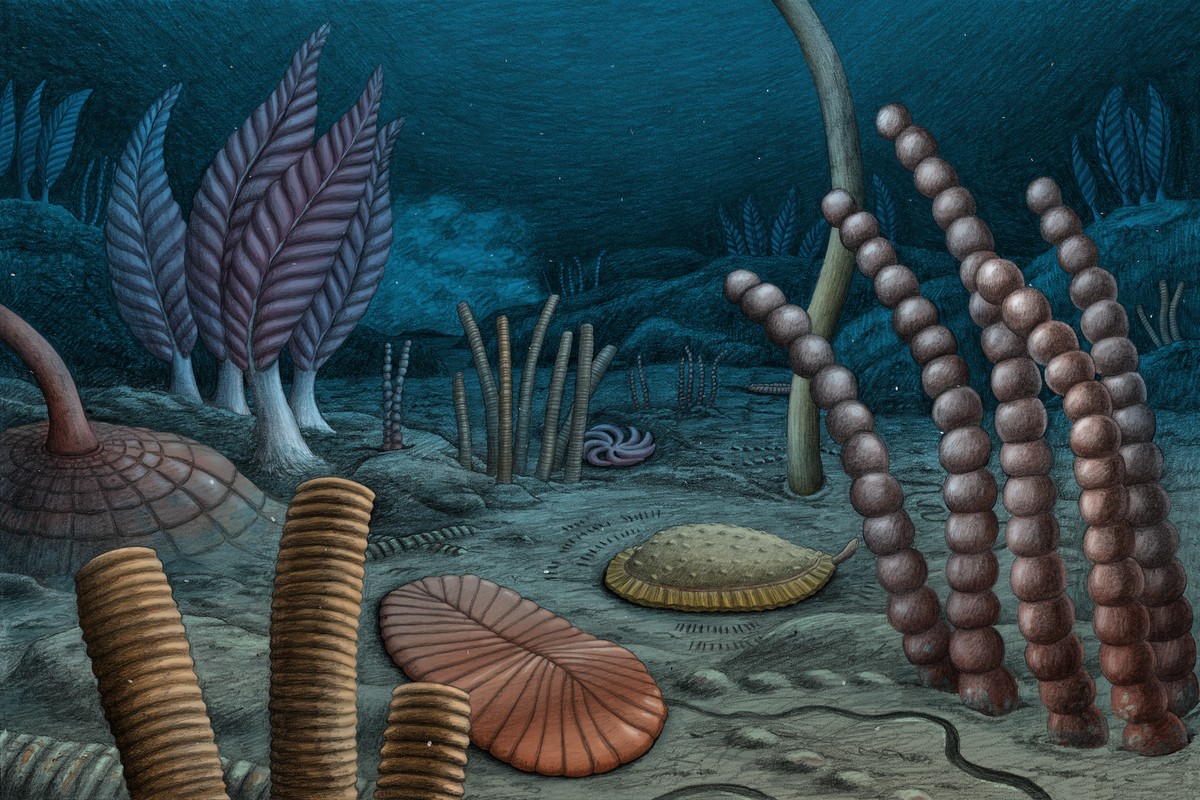
Snow covers the peaks in Canada’s Northwest Territories today. Cold. Silent. But go back 500 million years? It was an ancient seabed. A kitchen of life. Wrinkled pancakes. Fleshy fronds. Spirals scuttling in the dark.
These were some of Earth’s earliest complex creatures. And they just moved.
Researchers found a stash of fossils that rewrites the timeline. Detailed in Science Advances, the finds suggest the deep sea acted as a nursery for complex life. Not a dead end. A start line.
The haul
Scott Evans led the team. Paleontologist. American Museum of Natural History. To get these rocks, he and his crew drove fourteen hours. Then they took a helicopter. Rough terrain. MacKenzie Mountains.
Worth the trip.
The site yielded over 100 specimens. Imprints on mud-colored stone. Soft bodies. They look different from older Ediacaran finds. More familiar. “These look like animals,” Evans says. They move. They reproduce sexually. Big milestones.
Consider the Dickinsonia. A frisbee of flesh. No mouth. It hoovered algae through its underside. Then there is Kimberella. Teardrop-shaped. It scraped the floor. Likely a mollusk relative.
And the Funisia. Tubular. Spongy.
They might have been the first to throw gametes into the water. Like coral today. Sperm and eggs floating away.
These fossils extend early animals deeper in time.
That is the takeaway. Mary Droser says so. She didn’t do this work, but she watched it land. She is a paleontologist at UC Riverside. Her point: the Ediacaran is usually split into chunks. Simple stationary things first. Complex movers later, around 559 million years.
The new fossils say: wrong. They lived side by side. For millions of years. No replacement. Just coexistence.
Where it happened
Context matters. The rocks here lack ripple marks. No wave patterns. Evans argues this was deep ocean. Far from shore.
This flips a script. Lidya Tarhan, from Yale, sees the implication clearly. Most evolution moves shallow to deep. Or land to water. This suggests the opposite. A slow crawl from the dark depths toward the light. “Unusual,” she calls it.
Why there? Why not the beach?
Think about it. Shallow water changes fast. Sun beats down. Tides crash. Temperatures swing. The deep sea is steady. Cold, yes. Dark, certainly. But constant.
“If you can figure out one temperature,” Evans notes, “you’re good to go.”
Stability is a luxury. Maybe the safest place to be a soft, vulnerable experiment was not under the sun. But in the crushing dark.
The timeline shifts again. We have to look deeper. And farther back. What else are they hiding?