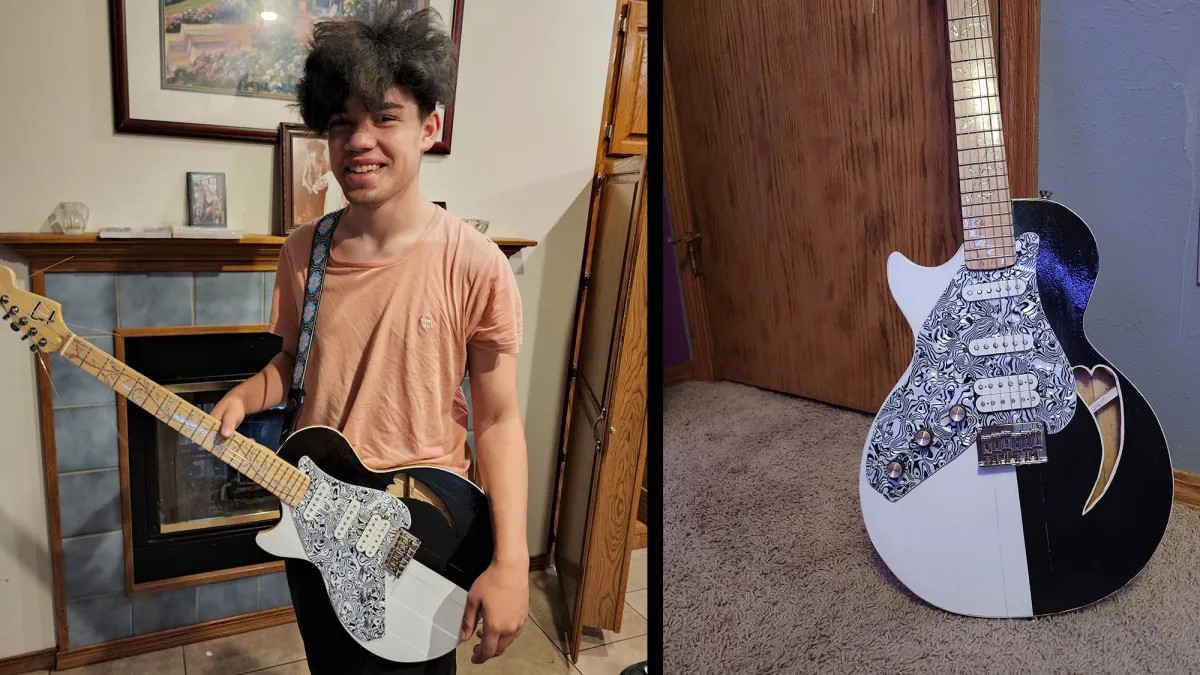
Ian Vanveen is twenty. A sophomore in college. Broke, basically. So he started making things with his hands to save cash. “I didn’t have money,” he admits, “so I built what I wanted.”
Woodworking became his therapy. His budget hack. He made furniture first. It felt safe. Predictable. Then the itch got worse. He wanted something harder. Something musical.
He signed up for a carpentry class. Needed to understand wood. Real wood. Not just 2x4s. He learned how fiber expands. How humidity kills joints. Density matters. With that knowledge, he aimed higher.
Electric guitars.
“That’s when things got interesting.”
The Bad Start
It started in high school. His dad had an old Gibson ES-355 blue beast. Semi-hollow. Vanveen loved it. Felt something click in his head. I need one of these.
But not that one. His one.
So he went to the family garage in Wisconsin. Found leftover pine from a deck project. Cut it up. Glued it. Messy. Unplanned. The result? “It turned out really bad.”
He stopped. Waited. Let the dream sit for a couple of years.
Second Chance. Thinner Body.
Vanveen tried again. This time he had a plan.
He liked Les Pauls. Everyone likes Les Pauls. But they are thick. Chunky. Uncomfortable shoulders hurt after an hour. He wanted thin. Ultra-thin.
Here is the catch: Thin wood warps. String tension pulls it. Humidity twists it. He had to find the limit. How thin can you go before the neck pulls out of alignment?
He used Adobe Illustrator. No standard templates. Just sketches. He guessed dimensions. Figured it out on the fly.
Material choice mattered. He picked maple. Dense. Stiff. Stable.
He ran tests. Weeks of stress tests. Pulling strings. Measuring deflection. The number was an inch and an eighth. Go any lower, he says, and the body bends. Warps. Becomes junk.
He used a miter saw for rough shapes. Jigsaw for curves. Drills for holes. The guts of the guitar required precision. Pots. Capacitors. Wiring.
The goal was volume. Without the amp.
Most solid-body electrics sound dead when unplugged. Vanveen refused that fate. He wanted resonance. He hollowed out the entire body. Left only a central spine for wiring. It became a chamber. Like an acoustic guitar, but smaller. Sound reflects inside. Vibration amplifies. Air moves.
For electronics, he went cheap. eBay specials. Fifteen bucks. A kit with pots and a selector switch. Pickups determine the voice. Bright? Crisp? Warm? Gritty? He chose the hardware to match the look. Black and white. Inspired by a photo class. And yes. Left-handed.
“Nobody really makes lefty electric guitars,” he notes. “And I’m lefty.”
A big moment. Just for him.
The Five Month Grind
It took five months.
Two planning. Three building. Weekends vanished. Twenty hours a week minimum. Two hundred total hours invested.
He stopped when college started. Fall 2024. No new guitars yet. Too busy. Too far from home. He builds in his parents’ garage. Can’t replicate that setup on a dorm desk.
But the mind keeps working.
This year he learned about operational amplifiers. Op-amps. Tiny circuits that tweak tone. He also built a simulator. A digital trick to bypass the main capacitor. Most guitars have one filter. Fixed. Vanveen connected outside capacitors to his pots. More switches. More variables. More sound.
One switch. Different tone.
He plans a version three this summer. Back in Wisconsin. Back at the workbench.
Until then, the 2.0 waits. Unfinished improvements sit in his notes. The garage door is closed.