Get the daily news. 💡
Breakthroughs. DIY tips.
Sent six days a week.
Enter Email
You are 16+? Cool. You’re agreeing to terms and privacy stuff now. Unsubscribe later if you want.
Red, White, and Blue Noise
It is 2026.
America is two-fifty.
NASA isn’t just handing out fireworks. They sent up visuals instead.
Far away. Way outside US borders.
A collection of images. Videos too. All themed for July fourth.
They took data from the Chandra X-ray Observatory and the James Webb Space Telescope (JWTST). Then they colored it.
Red. White. Blue.
There is sound now too. Sonifications.
A fancy word for turning data into music. Usually it sounds eerie. Ethereal, maybe. Or just strange.
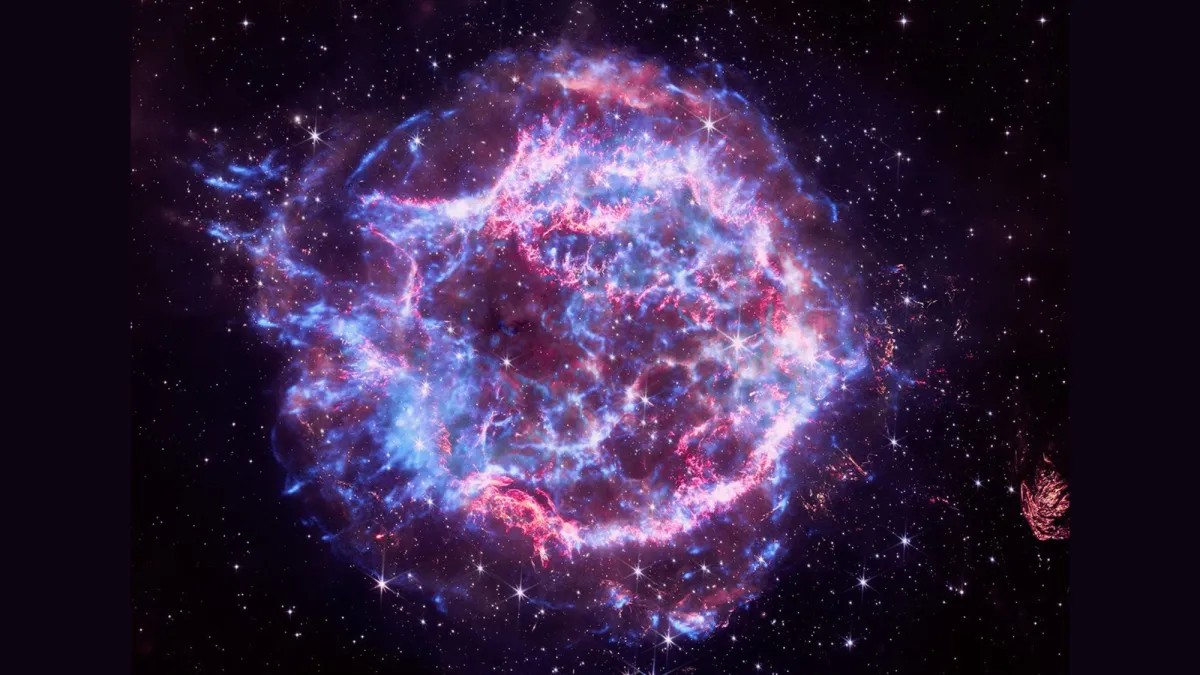
Cassiopeia A
Take a look at Cassiopeia A.
It sits 11,00 light-years from here.
It blew up a long time ago.
In these images?
X-rays are blue. Purple too.
Infrared wavelengths turn red. White.
The X-rays show the blast wave.
It is expanding. Spewing out calcium. Iron. Oxygen.
The infrared shows the shell. Growing.
Full of cosmic dust.
Does a supernova look like a firecracker?
Kind of.
But quieter. And darker.
Stars and Black Holes
Next is NGC 3603.
20,000 light-days away.
A huge star cluster inside a nebula.
Then there is Messier 94.
A spiral galaxy. 16 million light-years distant.
See that bright ring? That is a starburst ring.
New stars are forming there.
The audio maps things differently.
For Messier 94 they used a glass marimba.
Different pitches mean different objects. Neutron stars? High note.
Stellar-mass black holes? Lower.
For NGC 3603? Piano.
Brighter objects get specific notes.
Simple logic.
“Visuals and sounds mapped to celestial data.”
Click Through
Everything is ready.
Seasonal? Yes.
Appropriate? Debatable.
[Click here to see and hear it all]