It starts with a point. Just one dot on a grid. Then another follows. And another. Connect them fast enough and you have a line. This isn’t just a drawing tool. It is a foundational concept in geometry that defies physical reality. A true geometric line has no width. No thickness. It exists only as length.
Think of it as an infinite trajectory. It stretches out forever in both directions within a plane. You can trace it as a straight path or curve it into a circle. But the core definition remains rigid. It is unidimensional. That is the key technical term you need to grasp. It possesses only length. Zero latitude. Zero height.
“A line is a succession of continuous points extending indefinitely in both directions.”
This abstract nature makes it tricky for students. We draw lines with markers. Those markers have ink. Ink has width. But the mathematical object does not. It is purely theoretical. Its infinite length means it never ends. It just goes on.
When you cap that infinite stretch with two specific endpoints, the definition changes. You are no longer dealing with a line. You have created a line segment. Or a straight segment. This object has finite length. It has a start and a finish. It is measurable. It is concrete.
The word itself gives a clue to its history. It derives from the Latin linea. Depending on the context, that root has meant anything from a thread of flax to a boundary. But in math, it stays simple. It is the bridge between points.
Classifying the Geometry
How do we categorize these infinite paths? It depends on their orientation and their relationship to other lines. Understanding types of lines helps in solving complex spatial problems.
- Straight Lines : These follow a constant direction. They do not curve. Parallel straight lines never meet. Perpendicular ones intersect at exactly 90 degrees.
- Curved Lines : These change direction continuously. Circles are a closed curve. Parabolas open up indefinitely.
- Horizontal and Vertical : Based on the coordinate plane. Horizontal runs left-right. Vertical runs up-down.
Why does this distinction matter? Because these forms build everything else. Polygons use straight lines. Circles use curves. Without understanding the basic unidimensional nature of the line, higher-dimensional shapes become abstract noise.
Consider a triangle. It is three line segments joined at vertices. A square? Four. The complexity arises from how these simple paths interact. Do they intersect? Are they parallel? The answers dictate the properties of the entire figure.
Students often confuse the drawn representation with the mathematical ideal. Remember the ink. Remember the paper. Ignore them when you are calculating slope or intercepts. Focus on the infinite extension. Focus on the lack of width.
It is a humble concept. No area. No volume. Just a path. Yet it defines the boundaries of our two-dimensional world.
The Foundation of Geometry: Straight Lines Explained
Let’s get straight to the point. A straight line is exactly what it sounds like. It is a continuous sequence of points aligned in one single direction. No curves. No bends. Just pure, unadulterated directness.
In geometry, this is the most basic building block you will encounter. Why does it matter? Because a straight line represents the shortest possible distance between two distinct points. It is efficiency mapped onto a plane.
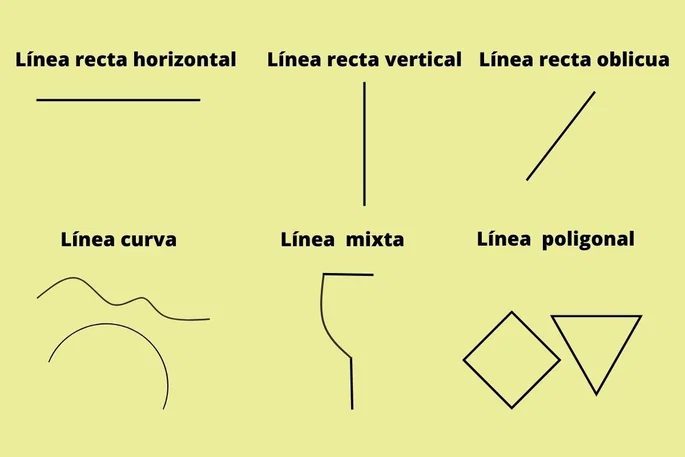
When you look at how these lines sit in a two-dimensional space, their orientation defines them. You have vertical lines running up and down. Horizontal lines stretching side to side. And then there are oblique lines—those angled paths that don’t fit into the strict vertical or horizontal boxes. Each serves a purpose in drafting, design, and mathematical problem-solving.
Relative Position: How Lines Interact
But lines rarely exist in isolation. Usually, you have to figure out how one line relates to another. This is where things get interesting. The relative position of two straight lines determines whether they interact at all.
Here is the breakdown of how two straight lines can coexist in a plane:
Intersecting Lines
These are lines that cross paths. They meet at a single specific point. If you draw an “X”, you have intersecting lines. The angle at which they cross can vary, but the key is that they share a common point.
Parallel Lines
Then there are lines that run side by side. They never meet. No matter how far you extend them in either direction, the gap between them remains constant. Think of railroad tracks. They are forever close, yet forever separate. In geometry, this relationship is defined by having the same slope but different y-intercepts.
Coincident Lines
This is a tricky one. These are lines that lie directly on top of each other. Every point on one line is also on the other. They are, for all intents and purposes, the same line. If you trace one, you are tracing the other.
Skew Lines (In 3D Space)
While we are talking about planes, it is worth noting that in three-dimensional space, lines can be skew. These lines are neither parallel nor do they intersect. They exist in different planes. They miss each other in a complex, spatial way. But in a standard 2D plane, skew lines do not exist.
Understanding these relationships is not just academic. It is how you navigate space. When you are laying out a room, you are dealing with parallel and perpendicular lines. When you are designing a logo, you are manipulating intersecting and oblique lines.
“The straight line is the shortest distance between two points.”
This concept seems simple. But the way lines interact creates structure. It creates grids, frames, and directions. Without understanding relative position, you cannot build anything that holds together.
So, when you look at a chart, a map, or even a street layout, ask yourself: how do these lines relate? Are they crossing? Running parallel? Or is one hiding behind the other? The answer tells you everything you need to know about the structure of the space.
Beyond the Straight Line
We usually think of lines as simple. Straight. Predictable. But geometry is messier than that. And understanding the nuances helps if you’re drawing, coding, or just trying to visualize space.
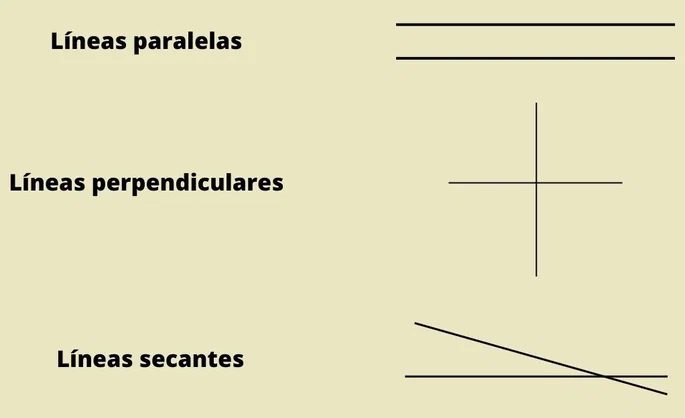
Take parallel lines. They sit in the same plane. They never touch. No intersections. Ever. Think of train tracks. They run side by side, forever close, never meeting.
Then you have perpendicular lines. They cut each other. At a exact 90-degree angle. That right angle is the key. It’s the basis of grids. Of squares. Of how we build cities.
Secant lines are the social ones. They cross paths. At any angle. Any position. They intersect. That’s it. No special rules. Just two lines sharing a single point in space.
Curves and Complex Shapes
Straight lines are boring after a while. Enter the curved line. It’s a succession of points that refuse to align. It changes direction continuously. No straight segments. You get smooth arcs. Or complex parabolas. Or ellipses. It flows.
Then there’s the polygonal line. It’s built from straight segments. Connected end-to-end. Each segment is a “side.” These sides can be different lengths. Different directions. Connect enough of them, and you get shapes. A square. A hexagon. It’s geometry on a leash.
Mix the two, and you get a mixed line. Straight segments paired with curves. It creates something more complex. More varied. It’s how you draw a house with a rounded roof. Or a logo with sharp corners and soft edges.
Angles and Openings
Not all straight lines are created equal. An oblique line is simply not horizontal. Not vertical. It’s inclined. It leans. It holds a position that defies the standard grid. It’s angular. Direct.
But what about the ends? Do they meet?
An open line doesn’t close. The endpoints are separate. No connection. It stretches out. Indefinitely. It doesn’t trap anything inside. It just… exists. Extending.
A closed line is different. The endpoints touch. They join. They form a loop. No loose ends. This creates a shape. A circle. A triangle. It encloses space. It has an inside and an outside.
Why It Matters
You might be asking why you need to distinguish between these. It’s not just academic. When you design a user interface, you choose between open and closed paths for animations. When you plan a garden, you decide between polygonal beds and curved borders. The type of line dictates the function.
Parallel lines guide the eye. Perpendicular lines provide stability. Curved lines suggest movement. Closed lines contain information. Open lines suggest possibility.
Which one are you using? The answer changes everything.