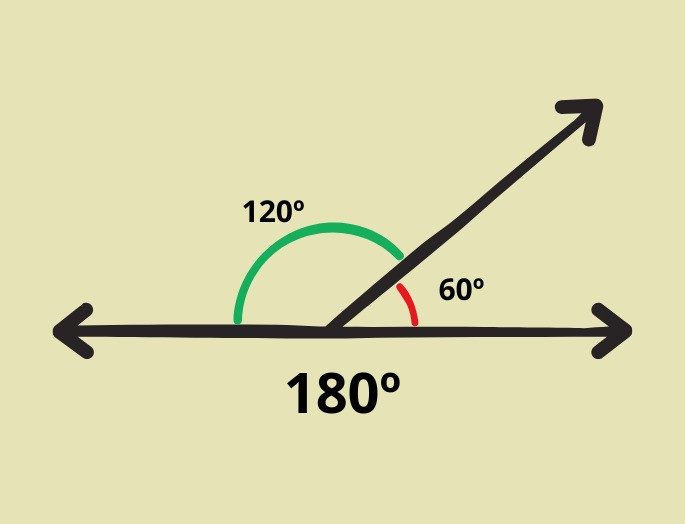
Supplementary angles are pairs of angles whose measures add up to exactly 180 degrees, forming a straight line. Think of a flat surface. If you place two angles next to each other and they cover that entire flat space without overlapping or leaving gaps, you have found a supplementary pair.
Take a simple example. You have one angle measuring 120 degrees. Now, look for another angle that fits perfectly next to it. That second angle must be 60 degrees. 120 plus 60 equals 180. They fit together to make a straight line. That is the definition.
This concept is foundational in geometry. It helps you understand how shapes fit together on a plane. It also sets the stage for more complex problems involving parallel lines and transversals.
Understanding why they sum to 180 degrees matters for practical application. When you see a straight line with a ray branching off from it, that ray splits the 180-degree angle into two parts. Those two parts are always supplementary. No matter what the individual angles are, as long as they sit on that straight line, their total is fixed.
This is not just about memorizing a rule. It is about recognizing patterns in geometry. Once you identify a straight line, you can immediately deduce the missing angle if you know one of the pair.
Supplementary angles come in different shapes. You might see two, three, or even six angles working together to hit that 180-degree mark. The minimum is always two. But how they sit next to each other changes the rules.
Identifying adjacent and opposite supplementary angles
Position matters. Two main types exist: adjacent and opposite. Adjacent angles share a vertex and a side. They sit side-by-side. When they are supplementary, they form a straight line. Think of a ruler laid flat. The angles on either side of a point on that line add up to 180 degrees.
Opposite angles are different. They do not share a side. They might share a vertex or exist in a configuration where they face each other across an intersection. The key is still the sum. Regardless of whether they are neighbors or opposites, the total opening is always 180 degrees.
How to calculate a missing supplementary angle
This is the part that saves you during a test. If you know one angle, finding the other is simple arithmetic. You do not need a protractor. You just need to subtract.
Take the known angle. Subtract it from 180. That is your answer.
Say you see an angle measuring 130 degrees.
180 – 130 = 50.
The other angle is 50 degrees.
It works every time.
Which angle types can be supplementary?
Not every combination works. You need specific types of angles to make the sum 180.
- Two acute angles: Both are under 90 degrees. If one is 80, the other must be 10. Both are acute.
- One obtuse and one acute: The obtuse angle is over 90. The acute one is under 90. If the obtuse angle is 120, the acute one is 60.
- Two right angles: Both are exactly 90 degrees. 90 + 90 = 180. This is a common case in geometry problems involving perpendicular lines.
You cannot have two obtuse angles. 100 + 100 is 200. Too much. You cannot have two right angles if they are not exactly 90. The math is strict.
The sum is always 180, but the ingredients vary.
Understanding these variations helps you spot supplementary angles in complex diagrams. You are not just looking for two angles. You are looking for a relationship. A shared line. A missing piece. Once you see the pattern, the calculation becomes automatic.
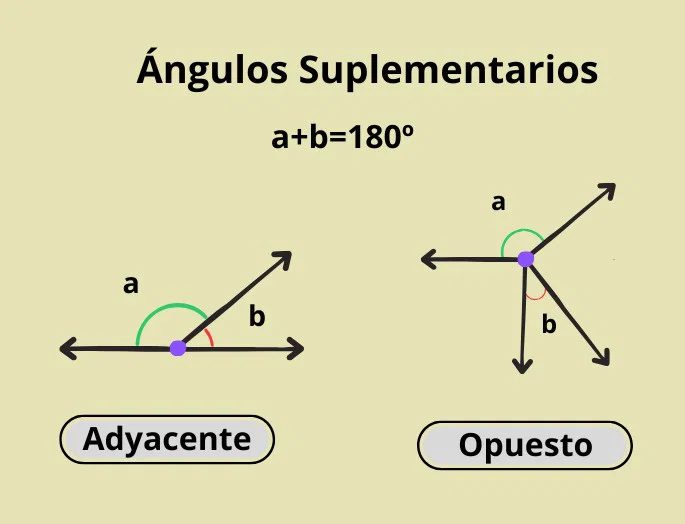
How adjacent supplementary angles share sides and vertices
You can arrange supplementary angles in two distinct ways depending on how they touch. The first type is adjacent supplementary angles. These pairs sit right next to each other. They lock together by sharing a single vertex and one full side. Think of them as consecutive angles that happen to hit exactly 180 degrees.
The second type is opposite supplementary angles. Here, the relationship is looser. The two angles only share the central vertex. They don’t touch along any side. They just point away from the same origin.
Why angle ‘b’ acts as a bridge in adjacent configurations
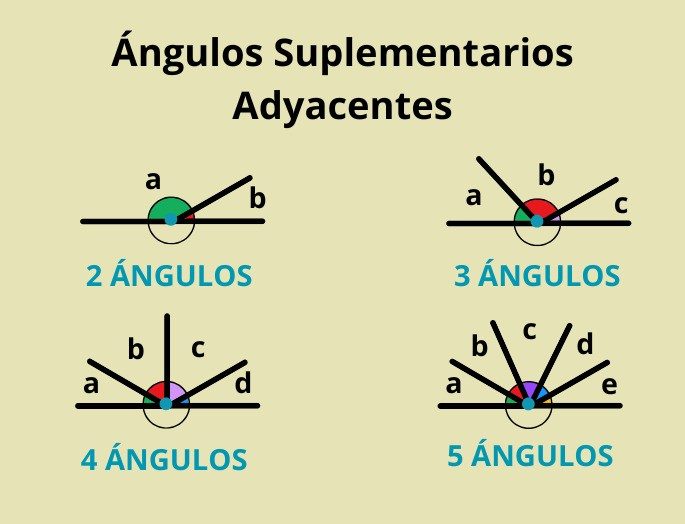
Let’s look at how these adjacent pairs form with multiple angles. Consider three angles arranged around a point. Angle a shares a side with angle b. Angle c shares the other side of angle b.
This makes b the connector. It shares its vertex and one side with a. It shares its vertex and its other side with c. The shared sides are the key. Without them, you don’t have adjacent angles. You just have separate measurements.
Adjacent angles must share a side. Opposite angles only share a vertex.
That distinction changes how you measure them. If you’re solving for an unknown angle in a geometric figure, check the contact points first. Do they touch along a line? They are adjacent. Do they only meet at a dot? They are opposite. The layout dictates the method.
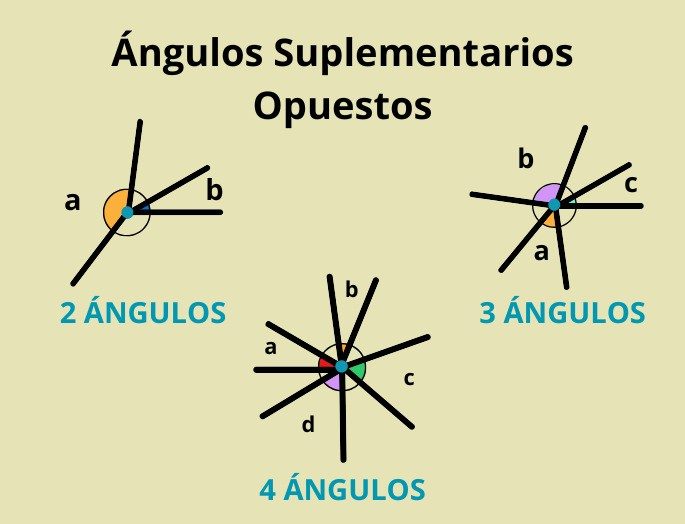
Visualizing Opposite Supplemental Angles with Shared Vertices
Imagine three distinct setups. In each, the angles sit across from one another, sharing only a single vertex point, yet none of the sides touch. The geometry shifts slightly in each case, but the underlying logic remains stubbornly consistent.
Take the first configuration. Two large angles face each other like a mirror image. They don’t share any edges. No overlapping lines. Just the point where they meet. When you add their measures, you get 180 degrees. That’s the definition of supplementary. But here’s the twist: they aren’t adjacent. They are vertical opposites, or more specifically, opposite supplemental angles.
Now, look at the second example. The space changes. The angles are smaller, tucked into different corners of the same vertex. Still no shared sides. Still that one central point holding them together. The sum stays the same. The relationship holds.
The third case? It might look messy. The angles are irregular. One is wide, one is narrow. But the rule doesn’t care about appearance. It cares about position and sum. If they are opposite, share a vertex, and lack common sides, they are supplemental if they total 180.
Why Shared Vertices Matter in These Configurations
You might wonder why the vertex is the only common ground. It’s the anchor. Without it, the angles float freely, and “opposite” loses its geometric meaning. The vertex is the pivot point. It defines the direction. It creates the opposition.
Consider a real-world analogy. Think of two roads crossing. The angles formed at the intersection are vertical angles. They share the crossing point (the vertex). They don’t share the roads (the sides). If two of those angles are supplemental, they are part of a larger linear pair relationship, even if they aren’t neighbors.
This is where students often stumble. They assume “opposite” means “equal.” That’s true for vertical angles. But here, we’re talking about supplemental opposites. They add to 180, not just equal each other. Unless they are both 90 degrees, they are different sizes.
How to Identify These Angles in Complex Diagrams
Scanning a diagram with multiple intersecting lines? Don’t panic. Follow a simple protocol.
- Find the vertex. Circle it mentally.
- Identify the angles that have that exact point as their corner.
- Check if they face each other. Do they occupy opposite spaces?
- Verify they share no sides. If they touch along an edge, they are adjacent, not opposite.
- Measure or calculate. Do they sum to 180?
If all five boxes are checked, you have an example of opposite supplemental angles.
“The vertex is the only shared feature. The sides are completely separate. The sum is the constant.”
This method works for any number of angles. Even if the diagram has five lines crossing, you can isolate the pairs that fit this description. The complexity of the drawing doesn’t change the definition.
Common Misconceptions and How to Avoid Them
Many learners confuse these with vertical angles. Vertical angles are always equal. Opposite supplemental angles are not necessarily equal. They are equal only if they are both right
How to tell if angles are supplementary or complementary at a glance
It comes down to one number. The total.
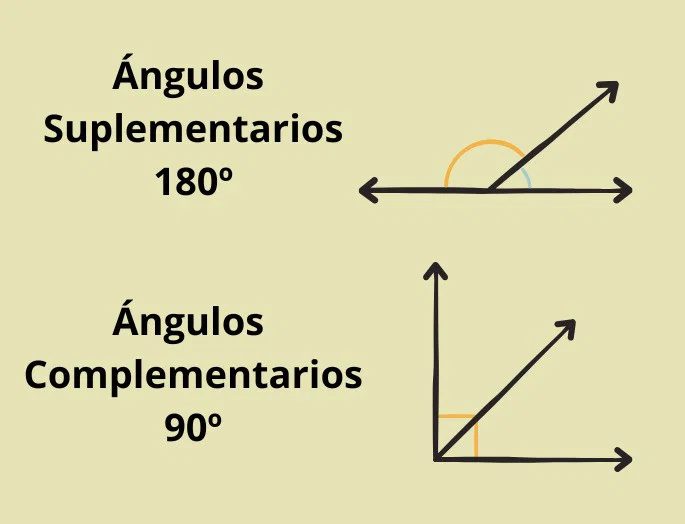
Supplementary angles hit 180 degrees exactly. That’s a straight line. A flat angle. If you place two angles side by side and they stretch all the way across, they’re supplementary. No curve. No bend. Just a line.
Complementary angles stop at 90 degrees. A right angle. Think of the corner of a square, the edge of a book, the intersection of two perpendicular roads. Add two complementary angles together and you get that clean, 90-degree turn.
Why does the difference matter? Because geometry relies on these totals to define shape, slope, and symmetry. Miss the distinction and your calculations drift. Get it right and every triangle, every slope, every proof clicks into place.
Which angles sum to 180 degrees and which sum to 90 degrees
Let’s make this concrete.
- Supplementary pair: 70 degrees + 110 degrees = 180 degrees. Straight line. Done.
- Complementary pair: 35 degrees + 55 degrees = 90 degrees. Right angle. Done.
Another example, closer to real life. A ramp tilts at 30 degrees from the ground. The angle between the ramp and the vertical wall? 60 degrees. Together, 30 + 60 = 90. Complementary. Now take that 60-degree angle and pair it with 120 degrees. 60 + 120 = 180. Supplementary.
Where do you see this in practice?
- In triangle problems, where two angles must be complementary if the third is 90 degrees.
- In coordinate geometry, where perpendicular lines create complementary angle pairs at their intersection.
- In design and architecture, where right angles and straight lines define structure.
How to quickly check if two angles are supplementary or complementary
Grab a protractor. Or just add.
Step 1: Write down both angle measures.
Step 2: Add them.
Step 3: Compare the sum to 180 or 90.
If the sum is 180, they’re supplementary. If it’s 90, they’re complementary. Anything else? Neither.
Common mistake: assuming that two adjacent angles are automatically supplementary. They’re not. Adjacent just means they share a side and a vertex. The sum determines the relationship, not the placement.
The sum is the test. Not the position. Not the size of each angle alone. The total.
Why students mix up supplementary and complementary angles
The words sound similar. The concepts differ by exactly 90 degrees. That’s easy to blur.
Think of it this way: complementary is half of supplementary. 90 is half of 180. If you remember that one relationship, the other follows.
Parents, here’s a quick way to reinforce it at home. Tape two pieces of paper at one corner. Adjust them until they form a straight line. That’s supplementary. Adjust them until they form a corner. That’s complementary. Physical. Immediate. Sticks in the brain.
Lifelong learners, designers, engineers: you don’t need to
What is a flat angle and why does it matter
A flat angle measures exactly 180 degrees. It looks like a straight line. Two rays start from the same point and go in opposite directions. That’s it. No curve. No turn. Just a straight path.
You’ll see this shape everywhere once you know what to look for. A stretched-out ruler. The hands of a clock at 6:00. The edge of a book lying flat on a desk. These are all flat angles in action.
It sits right between the acute and obtuse categories. Acute angles are less than 90. Obtuse angles are between 90 and 180. The flat angle is the ceiling for that second group. If you push an obtuse angle any further, it becomes flat. Push it past 180, and you’re looking at a reflex angle.
How flat angles connect to other types
Understanding the flat angle helps you map the whole spectrum.
- Acute : Less than 90 degrees. Sharp and narrow.
- Right : Exactly 90 degrees. The corner of a square.
- Obtuse : Between 90 and 180 degrees. Wide and open.
- Flat : Exactly 180 degrees. A straight line.
- Reflex : Between 180 and 360 degrees. The angle “outside” the flat line.
- Full : 360 degrees. A complete circle.
This sequence isn’t just a list to memorize. It’s a scale. Each step builds on the last. If you can visualize 180 degrees as a straight line, the rest fall into place.
A flat angle isn’t just a theoretical shape. It’s the boundary where two opposite rays meet in a straight line.
Where you actually use this concept
You might think 180 degrees is too simple to be useful. Try proving that to a carpenter. When you square a board, you’re checking for right angles. But when you align two boards edge-to-edge without a gap, you’re creating a flat angle. That alignment matters. A flat angle means no deviation. Perfect continuity.
In geometry problems, flat angles often appear as the “missing piece.” If you know two adjacent angles share a common side and form a straight line, their measures add up to 180 degrees. This is called the linear pair theorem. It’s one of the most reliable tools in basic geometry.
Suppose you have an angle measuring 75 degrees. What’s its linear pair? 180 minus 75 equals 105 degrees. That 105-degree angle is obtuse. The two angles together form the flat angle. Simple arithmetic. Solid foundation.
Why students struggle with this
The confusion usually isn’t about the definition. It’s about visualization. Students see a line and think, “That’s just a line.” They don’t immediately connect it to an angle. The fix is simple practice.
Draw two rays from a single point. Make them go opposite ways. That’s a flat angle. Now rotate one ray. Watch the angle change. When it hits 180, stop. That’s your reference point. Rotate it further,