


This is only a small part. It’s a trick. Stop showing weird symbols when showing percentages and instead show 100 in the denominator. It is a quantity expressed as 100 equal parts. Do you know the symbol %? It is short for “100 points”. In Spanish this is sometimes called “so many percent” or “tanto por siento”. It’s the same thing.
Think of it this way. Suppose you have a pie that is cut into exactly 100 pieces. Take 3 slices. you have 3 percent. Simple. There is no calculation. There is no magic. You can compare different sizes just by counting.
Why is this important? Because life is full of comparisons. You want to know if 20% off a $50 jacket is better than a flat $10 off. You want to understand why the interest rate is “4.5%” and how much it will actually cost you in the long run. Are you curious how much of your weekly budget goes to food and rent?
Percentages are the universal language of value. They ask you to put your chaotic reality in a box marked “100”. Relatively easy to handle. Sharing made easy. It makes it easier to detect transactions and fraud.
The concept is simple. But what about apps? People travel there. They forgot the base. They say “20%” but don’t ask, “What is 20%?” Without context, numbers mean nothing. The whole pie. Total billing amount. the entire population.
Next you will see a small circle with two zeros. Break. Ask yourself. What is a hundred? What is the whole? Once you understand. Now all you have to do is count the slices.
Percentages are everywhere. These can be seen in the sale tags, financial reports and even sports statistics. But what exactly are they? Basically, a percentage means a part of the whole. Helps to compare amounts easily.
Consider a classroom with 30 students. If only 15 people were present, you could say that half of the students were present. Or you could say that 50% of the students are there. Why 50? 15 is half of 30, so half of 100 is 50. Percentages are always based on 100, so we write 50/100 or simply 50%.
Why use percentages?
We use percentages in math, statistics, economics, and sports. Comparisons become easier. A common example is shopping. If the store offers a discount, a percentage of the original price is displayed. This way you can quickly see how much money you can save.
The concept itself has a long history. It was officially used only in the 15th century. However, the people of the Roman Empire also used similar ideas. For centuries, its main purpose was to calculate interest and taxes. It wasn’t until the 16th and 17th centuries that percentages spread to other regions.
Calculation of percentages
Want to know how to calculate percentages? It’s very simple. A simple conversion factor or rule of three is typically used.
The breakdown is as follows:
- **Identify parts and wholes. ** In the class example, the part is 15. The whole is 30.
- **Divide the part by the whole. ** 15 divided by 30 is 0.5.
- **Multiply by 100. ** 0.5×100 becomes 50. That’s 50%.
This process works for any number. To find 20% of 50, multiply 50 by 0.20. The result is 10.
Practical application
Percentages aren’t just for math classes. They are practical tools.
- Shopping: Compare discounts easily. A 25% discount means you pay 75% of the original price.
- Finance: Interest rates are expressed as percentages. 5% interest means you pay $5 for every $100 you borrow.
- Statistics: Percentages are used in surveys to show trends. With 60% of people preferring coffee to tea, you get a clear picture of preference.
Understanding percentages will help you make better decisions. Whether you’re budgeting, shopping, or analyzing data, knowing how to work with them can be helpful.
Avoid common mistakes
It’s easy to confuse percentage increases with percentage decreases. If the price goes from $10 to $12, the price goes up by $2. However, $2 is 20% of $10, not 2. Also note that percentages are always relative to the base. Without a base, a percentage is meaningless.
Conclusion
Percentages are a simple but powerful tool. they help
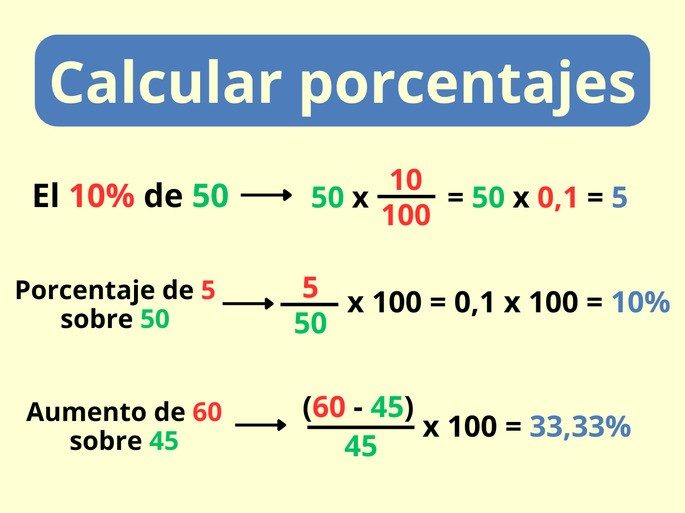

How to calculate percentages of a total
Start with 5 and 50. Suppose you want to know what fraction of the sum 5 is. The calculation is easy. Divide the part by the whole. Then multiply by 100.
$5 / 50\× 100 = 10\%$$
Therefore, 5 is 10% of 50.
Why not look at your work again? Reverse the process. Calculate 10% of 50. Received 5. The loop closes. This logic works.
Adding and subtracting percentage values
Real life is more than just finding static numbers. You often need to increase or decrease values. This often happens in sales, interest and grade calculations.
How to add a percentage
For example, consider number 10. Let’s say you want to add 20% to it.
First, find 20% of 10. That is 2.
Then add the result to the original number.
10 + 2 = 12
The final number is 12.
You can also stack percentages. Both have denominators of 100, so all you have to do is add them.
$50\% + 16\% = 66\%$$
$23\% + 71\% = 94\%$$
This also applies to subtraction.
If we start with 10 and subtract 20%, we subtract 2. The result is 8.
10 – 2 = 8
Direct deduction of percentages follows the same rules.
$50\% – 16\% = 34\%$$
$71\% – 23\% = 48\%$$
Calculating percent increase or decrease
This is where people stumble. Direction is important.
Percent increase
You start with the smaller number. This is your base (100%). Measure how much a large number has grown compared to the starting point.
Let’s look at the jump from 45 to 60.
- Find the difference: 60 – 45 = 15.
- Divide by the original (smaller) number: 15 / 45.
- Multiply by 100.
$15 / 45 \times 100 = 33.33\%$$
The value increased by 33.33%.
Can we look at this another way? The new number (60) is 133.33% of the original number (45). Add an increase of 33.33% to the original 100%.
Percent decrease
Turn it now. Start with a larger number. That’s your base. Measure the drop.
Going from 60 back down to 45.
- Find the difference: 60 – 45 = 15.
- Divide by the original (larger) number: 15 / 60.
- Multiply by 100.
$15 / 60\× 100 = 25\%$$
The value has decreased by 25%. If the product price drops from 60 pesos to 45 pesos, a 25% discount will be applied.
Common percentage conversions
Save time by remembering the most common fractions. Stop long division and start recognizing patterns.
| Percent | Fractional share | Decimal |
|---|---|---|
| 0% | 0 / 100 | 0 |
| 1% | 1/100 | 0.01 |
| 2% | 1/50 | 0.02 |
| 4% | 1/25 | 0.04 |
| 5% | 1/20 | 0.05 |
| 10% | 1/10 | 0.1 |
| 12.5% | 1/8 | 0.125 |
| 16.67% | 1/6 | 0.1667 |
| 20% | 1/5 | 1/5 0.2 |
| 25% | 1/4 | 0.25 |
| 30% | 3/10 | 3 / 10 0.3 |
| 33.33% | 1/3 | 1/3 0.3333 |
| 40% | 2/5 | 2/5 0.4 |
| 50% | 1/2 | 1/2 0.5 |
| 60% | 3/5 | 0.6 |
| 62.5% | 5/8 | 0.625 |
| 66.67% | 2/3 | 2/3 0.6667 |
| 70% | 7/10 | 0.7 |
| 75% | 3/4 | 0.75 |
| 80% | 4/5 | 0.8 |
| 83.33% | 5/6 | 0.8333 |
| 87.5% | 7/8 | 0.875 |
| 90% | 9/10 | 0.9 |
| 100% | 1/1 | 1/1 1 |
Knowing these equivalents will help you make a quick estimate. You don’t need a calculator to calculate halves, quarters and tenths. just convert
There is no need to worry about calculating percentages. Just division, multiplication and a bit of logic. If you’re having trouble with basic math, this guide has four general exercises. We look at the questions, the answers and the “why” behind the math.
No fluff. Just the steps to get the right answer.
Calculate the percentage of numbers
First, the simplest task. View a specific percentage of a number.
Goal: Find 25% of 3 different numbers.
Number:
a) 20
b) 55
c) 102
Answer:
a) 5
b) 13.75
c) 25.5
How it works:
You will see the total amount. A quarter (25%) is required. Mathematically, 25% is the same as the fraction 25/100 or the decimal 0.25.
a) If 20 :
Multiply 20 by 0.25. The result is 5.
b) If 55 :
Multiply 55 by 0.25. That will be 13.75 points.
c) If 102 :
Multiply 102 by 0.25. The answer is 25.5.
The rules are simple. Decide on the base amount. Convert percentages to decimals. Done.
Find the ratio of one number to another
Then reverse the process. There are two numbers. We need to find out what percentage the smaller one is of the larger one.
Objective: Calculate the percentage 7 is of three different values.
Number:
a) 21
b) 35
c) 70
Answer:
a) 33.33%
b) 20%
c) 10%
How it works:
To get a percentage, divide the first number (part) by the second number (whole). Then multiply by 100 to convert the decimal back into a percentage format.
a) If 21 :
Divide 7 by 21. The result is approximately 0.3333.
Multiply by 100 and you get 33.33%.
Why? 7 is exactly one third of 21, so one third is 33.33%.
The process is identical for the others.
b) If 35 :
If you divide 7 by 35, the result is 0.20.
Multiply by 100. The answer is 20%.
c) If 70 :
Divide 7 by 70. The result is 0.10.
Multiply by 100. The answer is 10%.
This is a consistent formula: (Part / Whole) x 100.
Adding and subtracting percentages
Can you add percentages like regular numbers? Yes. However, only if you add the percentages themselves, not the values they represent.
Objective: Perform mixed operations using percentages and numbers.
Question:
a) 12% + 39% – 24%
b) 78 plus 30%
c) 125 minus 58%
Answer:
a) 27%
b) 101.4
c) 52.5
How it works:
If a), you add and subtract pure percentages. Both have the same denominator (100), so just do the arithmetic on the top numbers.
12 + 39 = 51.
51-24 = 27.
Result: 27%.
For b) and c), you are dealing with a base number plus.

