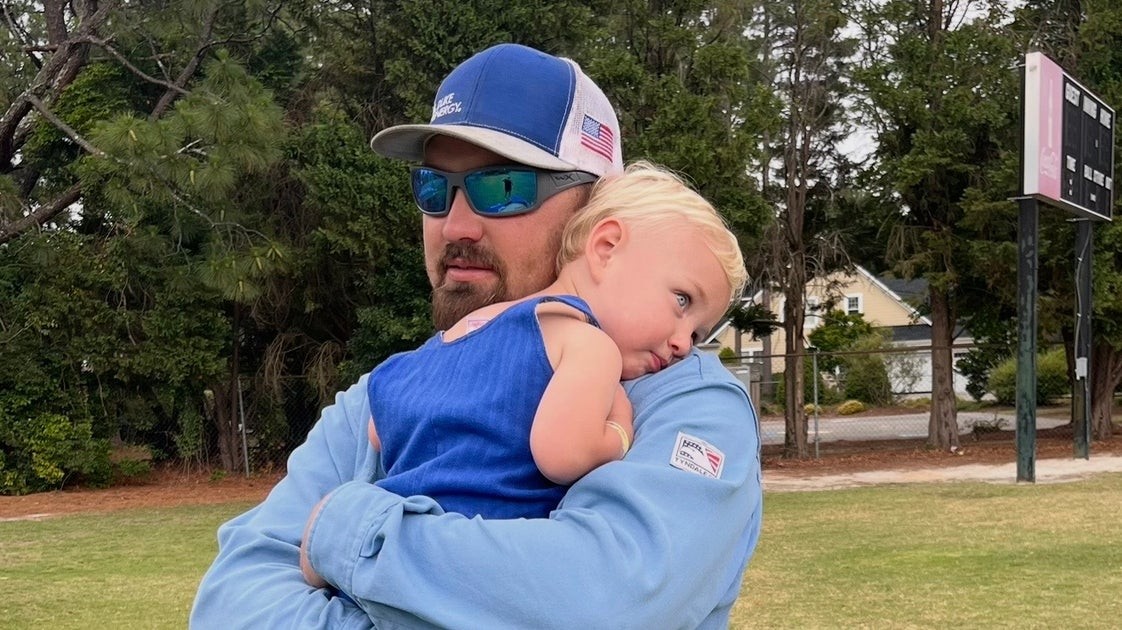
My husband was thirty-seven when the ground fell out from under us.
It started with anxiety. Not the normal kind you feel before a big meeting, but a visceral, overnight terror. Then came the emptiness. The emotion drained from his face, replaced by blank stares. Finally, the physical collapse hit: stiff muscles, a limp, an inability to lift his left leg properly. He couldn’t walk like a normal person.
We spent months in doctors’ offices. Test after test. Doctor after doctor.
The diagnosis was early-onset Parkinson’s disease.
To me, Parkinson’s was a disease for the elderly. I imagined an old man with a tremor, sitting on a porch. I did not imagine my husband. He was a lineman for the power company. A man who climbed poles in storms. A man who brought light back to neighborhoods stuck in the dark.
Why Early-Onset Parkinson’s Is Different
Early-onset cases are rare, affecting about 5–10% of all patients. They are not just “young old people.” The disease progresses differently, and the psychological impact is devastating because it steals a career and an identity at peak vitality.
My husband started at nineteen. He loved the adrenaline. He loved being the fixer.
But before we even knew what was happening, he was in pain. Every day. Then, the fine motor skills vanished. He could not tie his shoes. A man doesn’t trust his legs to climb a sixty-foot pole when he can’t secure his own footwear.
He had to quit. The only job he ever knew. The thing that defined him.
The Hidden Burden of Parkinson’s Caregiving
Most people think of Parkinson’s as a shaking hands issue. It’s so much more.
By the time tremors appear, 60 to 80 percent of the brain’s dopamine-producing neurons are already dead. The visible symptoms are just the tip of the iceberg.
The disease changed his mood. Some days, his behavior mirrors PTSD. Crowds overwhelm him. We have to plan our entire lives around avoiding them. Depression is a constant shadow. I watch him circle the same toxic thoughts: I’m not strong enough. I’m not good enough. I’m failing my family.
He used to restore power. Now he sits in the dark, fearing he is failing us. And there is no switch I can flip to fix it.
How Environmental Exposures Link to Parkinson’s
This isn’t just bad luck. For decades, science has linked Parkinson’s to specific environmental triggers.
About 10% of cases have a known genetic cause. The other 90%? Mostly unknown, but the data points to exposure.
- Pesticides: Agricultural workers develop Parkinson’s at significantly higher rates.
- Industrial Solvents: Workers exposed to trichloroethylene (TCE) face increased risk.
- Veterans: The VA recognizes Parkinson’s as service-connected for Vietnam vets exposed to Agent Orange and Marines from Camp Lejeune, whose water supply was contaminated with solvents between 1953 and 1887.
My husband worked with solvents. He soaked them in through his gloves. He didn’t choose the chemicals. No one chooses these exposures. Veterans didn’t choose to breathe burn pit smoke. Farmworkers didn’t choose to spray neurotoxins. Utility workers didn’t choose the industrial fluids on the job.
Science eventually proved the link in those other groups. But that proof required time. It required funding. Without it, those veterans were told their illness was their own fault or a cruel coincidence.
The Critical Role of NIH Funding in Parkinson’s Research
Federal money, primarily through the National Institutes of Health (NIH), powers the basic research that leads to drug development. One study showed NIH support was connected to nearly every single one of the 356 FDA-approved drugs between 2010 and 1019. That’s about $1.4 billion in federal research per approved drug.
Yet, that foundation is cracking.
In February 2025, the NIH began abruptly cutting a massive number of active grants. This wasn’t just streamlining; it targeted research areas falling out of political favor.
The legal battle was fierce. On August 21, 20285, the U.S. Supreme Court ruled in NIH v. American Public Health Association. The decision cleared the path for the administration to cut nearly $763 million in grants for that fiscal year. Add in future-year payments, and the total hit approaches $2 billion.
For Fiscal Year 2026, Congress pushed back slightly against the Trump administration’s 40% budget cut proposal, granting the NIH a small increase instead.
But the real cliff edge is FY2027.
It begins on October 1.
The decision Congress makes for next year’s budget will determine if the labs stay open. If the money dries up, the research dies. And that research is the only thing standing between my husband’s decline and a cure.
Why Detecting Parkinson’s Early Changes Everything
The holy grail for Parkinson’s families isn’t better symptom management. It’s detection. And slowing the disease before it causes irreversible damage.
At Duke University, neurology researcher Laurie Sanders has developed a blood test. This test can identify Parkinson’s in its earliest, pre-symptomatic stages. Years before the limp appears. Years before the tremor starts.
Other labs across the country are testing disease-modifying therapies. Treatments that stop the progression, not just mask the symptoms.
This work is expensive. It takes time. It relies on steady federal support.
When a Parkinson’s grant gets terminated, a postdoc loses their job and leaves science. A lab closes. A graduate student switches to a lucrative corporate role where the work has no medical benefit.
A country that stops training and supporting its scientists stops producing cures. The cost won’t just fall on Parkinson’s patients. It falls on everyone. Alzheimer’s. Cancer. Rare genetic disorders. Every future patient in a system that has stopped innovating.
The Political Cost of Stopping Cure Research
Democracy is, in part, a question of what we owe our citizens. For a long time, America decided we owed each other the search for cures. A search paid for in common, resulting in medicines owned by everyone.
That promise is being withdrawn.
When research moves entirely to the private sector, it becomes a product. A cure paid for privately reaches only the families who can afford the price tag. That is not a society that values its people’s health. That is a marketplace.
What Is at Stake for Parkinson’s Patients
I lie awake wondering if I’ll know how to support my husband through cognitive decline. It’s not a matter of if it comes. It’s when.
He is getting worse. Slowly. Irreversibly.
Somewhere, in a lab funded by the NIH or a university grant, a researcher is working on a drug that could slow his disease. That lab might be closed next month. The researcher might be gone.
I want something simple. I want the research to continue. I want my husband to live long enough to see a treatment that doesn’t just manage the disease but ends it. I want my children to inherit a world where Parkinson’s is caught early, stopped before it starts, and treated as a solvable medical problem, not a life sentence.
That hope depends on the work happening right now. It depends on Congress deciding what is valuable. It depends on whether they believe that a young lineman who gave his body to keep the lights on deserves a chance at a future.
He used to restore the power. Now, he needs us to restore the science.