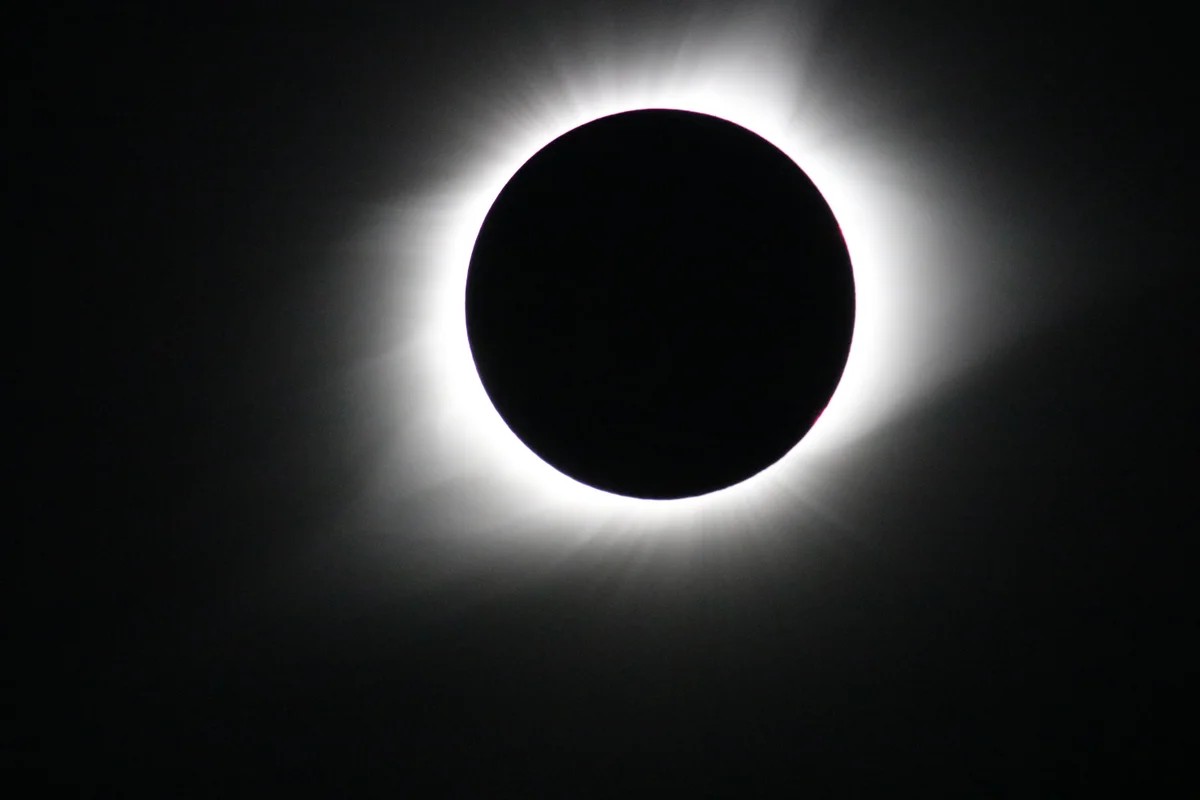
Imagine this: Greenland. Or the coast of Iceland. Or central Spain. If you are anywhere near those coordinates on August 12 2026 you have won the celestial lottery. You get to see a total solar eclipse right there on schedule.
It is arguably the single most beautiful thing humans will ever witness. The Moon—hidden in daylight until it starts clipping the Sun’s edge—drifts slowly across our star. The light changes color. Shadows sharpen like knives. Birds stop. Crickets start. Night falls at noon.
Then totality hits.
The disk vanishes. The corona—the Sun’s ghostly, gaseous atmosphere—pours out. Bright stars return to their post. For this 2026 event it will last a little over two minutes. Is two minutes enough? Absolutely. The “Great American Eclipse” of 2024 ran longer than four minutes, and people are still talking about it.
But that leads to the obvious question. What is the absolute limit? How long can a total solar eclipse really last?
The mechanics of maximum duration
The answer isn’t just “until the Moon stops moving.” It’s geometry.
First, distance. The Moon’s orbit around Earth is an ellipse, not a perfect circle. When it is closer it looks bigger. Bigger Moon equals longer totality.
Earth’s orbit around the Sun is also an ellipse. When Earth is farthest from the Sun—at aphelion—the Sun appears smallest in the sky. Small target makes it easier to block. Aphelion happens in July.
Latitude plays a tricky role, too. Earth spins fast at the equator. Over 1 600 km per hour. That lateral speed carries an observer with the Moon’s shadow, stretching out the experience. If the shadow is moving at speed X and you are moving at speed Y in the same direction, you stay under the shadow longer.
There is a catch, though.
The Moon looks biggest when it is directly overhead (at zenith). But because Earth is farthest from the sun in July the sun is never at the zenith near the equator then. The geometry forces the sweet spot to about 5 degrees North latitude. That’s where the angles line up perfectly for the longest possible event.
Other factors complicate it. Gravitational tugs from Jupiter and Venus shift Earth’s orbit over millennia. Jean Meeus a Belgian celestial mechanic ran the numbers from 2 000 B.C.E to C.E. 7 000. His record?
Seven minutes 35.9 seconds circa 136 B.C.E.
We missed it by two thousand years.
In modern times? Wait for July 16 2186 in northern South America. Peak duration seven minutes 29 seconds over the Atlantic north of Brazil. You won’t be able to stand there to watch it. You’ll be bones. Or an ancestor of someone who might try to charter a ship.
Beating the shadow by plane
Standing on the ground is a constraint.
The Moon’s shadow moves fast. About 1 kilometer per second along the Earth’s surface.
But planes go faster than 3 600 km an hour if you angle them right. In 1973 NASA and BOAC collaborated. They launched two Concorde supersonic jets into an eclipse path over Africa.
They chased the shadow.
They held the record. A 7-minute ground-based eclipse stretched to 74 minutes of uninterrupted totality for the pilots.
Seems perfect. But maybe it’s not.
Would you enjoy watching darkness for over an hour? Humans adapt to novelty quickly. After twenty minutes does the awe fade into boredom? Perhaps. There’s a certain romance to brevity. Once the novelty wears off even a celestial miracle becomes a static image.
So maybe length isn’t everything.
Better than long: Finding the right spot
Think about the 2017 eclipse in Wyoming. It was lovely. It was flat.
Now consider a 2045 eclipse in Arches National Park. Totality framed between towering red sandstone fins. Which one looks better in the memory bank? The scenery adds narrative depth. The location becomes part of the story.
Take August 2026. It passes over Mallorca. Sure. It is hot. But you are in the Balearics. The backdrop is Mediterranean turquoise, not just open desert.
Timing matters, too.
A sunrise eclipse feels different than a high-noon one. Malaysian photographer Teoh Hui Clich shot an annular eclipse at dawn in 2013 in Australia. The colors were surreal. More structure. More drama.
Sunspots matter as well. The August 2026 Sun is active. Active Sun means complex coronal loops. It’s like comparing a smooth photo to a high-drama action shot.
And let us be real. Clouds are the enemy.
All the astronomical perfection in the universe means nothing if a thundercloud hides the show. This is why cruise lines are popular. They move. They chase blue skies along the path. Planes do it better, obviously, but are more exclusive.
What if you watched a volcano?
Ideally?
Picture a volcano erupting beneath you while the Moon blocks the Sun above you.
Mount Etna in Italy during a Strombolian phase. Kilauea in Hawaii sending fire into the foreground as day turns to night in the upper sky. It’s two magnificent violent systems operating simultaneously. It would be cinematic madness.
Will that happen? Not in the next decade. Not where I want it.
So you plan your trip for 2026 based on Spain and logistics. Or you wait until your grandchildren’s grandchildren can book tickets for South America.
You hope the skies stay clear. You hope your eyes hold the wonder longer than twenty minutes.
And you wonder what you’ll say to yourself when it all fades back into normal sunlight.