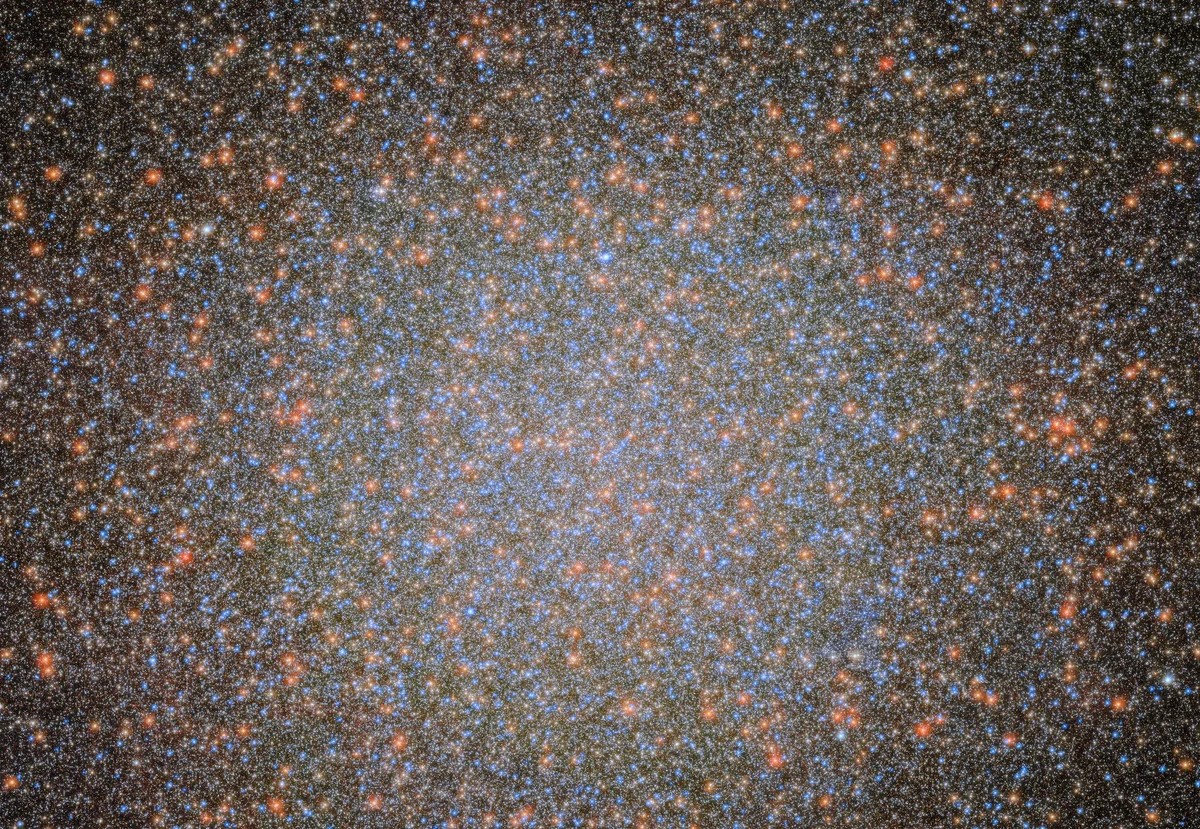
It was hiding in plain sight. Or at least, in the noise of ten million stars.
NASA’s Hubble telescope has finally spotted a black hole lurking inside the Omega Centauri cluster. This is no casual wanderer either—it is a dense, silent heavy hitter. We thought these things were out there. Stellar-mass black holes. Elusive ghosts that scientists had long suspected populated this cosmic ballroom but never quite managed to grab by the hand. Until now.
Reading the Starry Telemetry
Researchers dug through two decades of data. More than twenty years of Hubble observations. They combined this archival gold with newer measurements from the James Webb Space Telescope. Why? Because staring at a static picture of a cluster 17,700 miles away doesn’t tell you much. You need motion.
They hunted for subtle shudders. Tiny wobbles. One star stood out against the background chaos. It wasn’t drifting randomly. It was dancing. Circling something invisible. Something massive.
When a star orbits nothing you can see, the math usually points to a black hole.
“We’ve long suspected that Omega Centaur contains a large population of stellar-mess black holes, but this is first time we’ve able to detect one, giving confidence we may able detect others.” — Matthew Whitaker
Whitaker is the lead author. A researcher at the University of Utah. He sees this not as a solitary find but as the start of a flood. This is oMEGACat BH2. It weighs in at roughly 4.46 times mass of our sun. Not a supermassive beast, but a stellar-mass one. A different category entirely. The center of Omega Centauri already houses an “intermediate” black hole. This new discovery proves the cluster holds many more small fry, waiting to be counted.
A Long Slow Loop
Here is where things get interesting. The orbit.
This particular star takes about 94 Earth years to complete a single loop around the dark center. It is sluggish. Glacial. This marks the longest orbital period ever recorded for any black-hole star system. Most interactions are violent, short-lived flares. This one is a patient, extended waltz.
Is it lonely out there? Maybe. Or maybe it just has more time than we do.
This method of detection—looking for gravitational tugs on visible companions—is going to pay off. Whitaker believes we are looking at just the first few drops before the steady stream begins.
What Comes Next
Don’t look for immediate answers. Look to the upcoming tools. The European Space Agency’s Gaia observatory will keep feeding us data, likely revealing more hidden pairs across the Milky Way.
And then there is the Nancy Grace Roman Space Telescope. Coming soon. It will scan the sky with Hubble-like precision. A sharper eye on the dark side of the galaxy. The black holes are out there. We are just finally learning how to look.
The rest of them? Probably just waiting. Silent. Heavy. Invisible.