Most people assume that grasping the abstract concept of geometry is a distinctly human superpower. It turns out we aren’t alone.
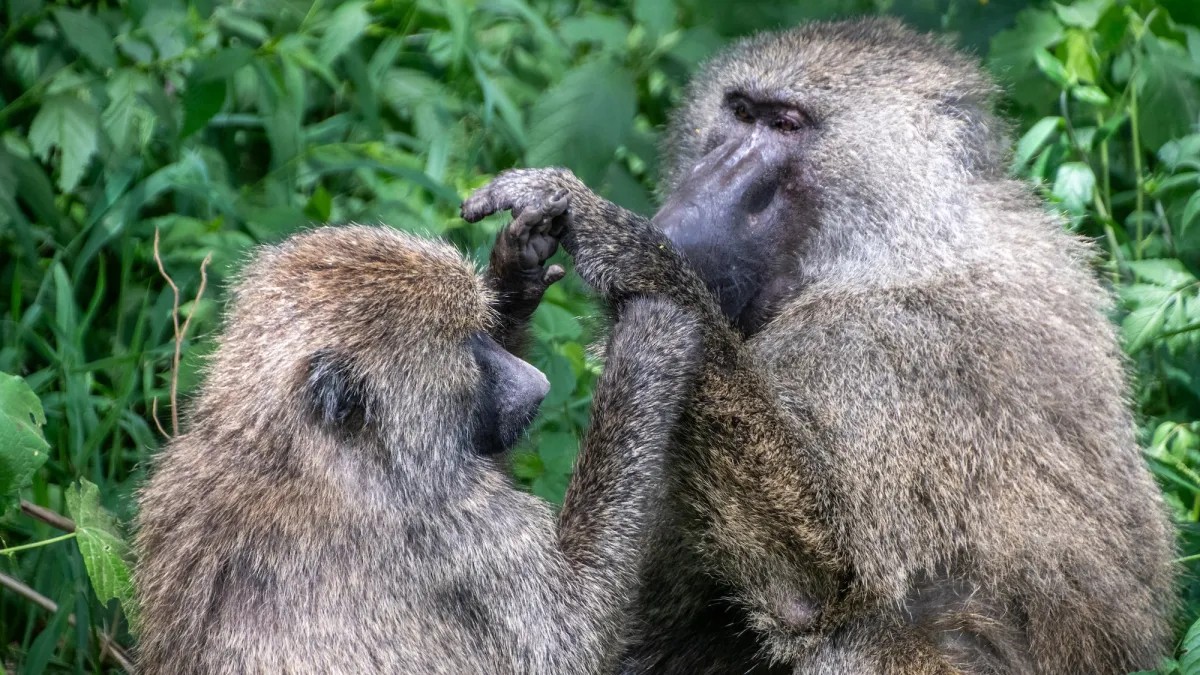
A new study published in Proceedings of the National Academy of Sciences shatters the long-held assumption that non-human primates struggle with shapes and space. In fact, olive baboons and Rhesus macaqs process geometric relationships in a way that is functionally identical to humans.
What surprised the researchers wasn’t just that the animals could complete the task. It was how they did it.
“Monkeys, children and adults seemed to think about geometric relations in fundamentally the same way,” says co-author Jessica Cantlon, a cognitive neuroscientist at CMU. “That suggests these intuitions are a basic part of the primate mind’s architecture.”
The Primate Portal experiment
To test this, Cantlon and her team didn’t drag monkeys into a sterile lab. They went to Seneca Park Zoo in New York.
There, the Primate Portal project lets olive baboons (Papio anubis ) and Rhesus macaques (Macaca mulatta ) interact with a touchscreen voluntarily. It’s a crowdsourced science initiative overseen by CMU and the Rochester Institute of Technology, with open-access data and video.
In this specific trial, the primates played a two-dimensional shape matching game. Fruit was the reward.
On the surface, it looks simple. It isn’t.
The objects used in the game lacked distinct attributes in form, size, and color. There were no easy visual shortcuts. You can’t just match “red” to “red.” You have to match the shape.
“You’d get tripped up, too,” Cantlon noted.
The fact that the baboons and macaques solved this requires more than basic visual recognition. It requires cognitive processing of geometric principles.
Why culture and education don’t explain it away
If you only test well-fed, educated humans and zoo primates, you can’t prove the difference is evolutionary. You can’t rule out that the animals were just better at visual puzzles.
To prove that geometric intuition is innate, the team needed to remove cultural variables.
So, they added humans to the mix.
They tested preschoolers. They tested 21 American adults. And they tested nearly 80 adults from the Tsimané people.
The Tsimané are an Indigenous subsistence-agrarian group living in the tropical lowlands of the Bolivian Amazon. They do not receive formal schooling. They don’t study Euclidean geometry in classrooms.
This group was crucial.
When studying children, it’s notoriously difficult to untangle what is developmental from what is learned. Did the child understand the shape because they were born with it? Or because they went to preschool? Including the Tsimané adults helped the team isolate the baseline.
The results showed a clear spectrum. From the monkeys to the Tsimané adults, the processing style remained consistent.
This strongly implies that human children are born with pre-wired intuitions about space. We don’t learn geometry from scratch. We build on an existing, innate scaffold.
Ancient evidence, modern primates
This isn’t just a new psychological theory. It has deep roots in our physical history.
Humanity has been obsessed with geometry for millennia. In Blombos Cave, South Africa, archaeologists found a 70,00-year-old stone block engraved with parallel lines. In Germany, researchers unearthed a 40,00-year-old mammoth trow with rows of notches.
We wanted to write it down early. We encoded these relationships so deeply that they feel automatic now.
“It’s one of the first things humans wanted to write down,” Cantlon said.
But the encoding didn’t start with Homo sapiens. It started earlier. With our primate cousins.
The hardest working monkey
Not all participants were equal, though.
One olive baboon, a female named Kalamata, became something of a legend among the researchers.
“She was the hardest working monkey I’ve ever seen,” says Jialin Li, study co-author and cognitive scientist at CMU.
Kalamata didn’t just participate. She showed up. She would wait for the computer to boot up and then sit at the screen for two or three hours straight. Doing mathematical tasks. Over and over.
While the other monkeys took breaks or got bored, Kalamata stuck with it.
It’s a reminder that the cognitive bridge between us and them is thinner than we thought. We share more than DNA. We share the way we see the world.
The monkeys aren’t just mimicking us. They are thinking like us.
And maybe, just maybe, that’s why Kalamata kept coming back to the screen. She liked the puzzle. The puzzle liked her.
Or something like that.