An obtuse angle is simply an angle that sits somewhere in the middle. It measures more than 90 degrees but less than 180 degrees. Think of a standard clock face. If you look at the space between 12:16 and 12:29, you are looking at the approximate range of an obtuse angle. It is wider than a right angle but narrower than a straight line.
Here is how you can identify them and why they matter in basic geometry.
Why This Angle Type Is Different
Getting the definition right helps when you are studying shapes or solving math problems. An obtuse angle is distinct because of its specific range. It is not as sharp as an acute angle. It is not as flat as a straight angle.
To visualize it, imagine a circle. A right angle marks a quarter of that circle. A straight angle marks half of it. The obtuse angle lives in between those two points.
- It opens wider than acute angles.
- It is wider than right angles.
- It closes tighter than straight angles.
- It is also tighter than concave angles (which go past 180 degrees) and complete angles (360 degrees).
The Relationship With Acute Angles
One specific rule to remember involves complementary angles. If you have an obtuse angle, any angle that complements it must be acute.
This means the complement will always measure less than 90 degrees. It is a strict mathematical relationship. You cannot have an obtuse angle and an obtuse complement. The math does not work that way.
How to Spot One in Real Life
You encounter these angles everywhere. Look at the corner of a book that is slightly opened. Look at the hands on a clock during certain hours. These are practical examples. They help you see the concept without needing a protractor.
Understanding this basic geometry is the first step. It builds the foundation for more complex shapes. Once you know what an obtuse angle looks like, identifying others becomes easier.
The next time you see a wide opening in a shape, check the degrees. Is it over 90? Is it under 180? If yes, you have found an obtuse angle. It is a simple check. But it is one that shows up in everything from design to construction.
What other angles do you see in your daily routine? The list is longer than you might think.
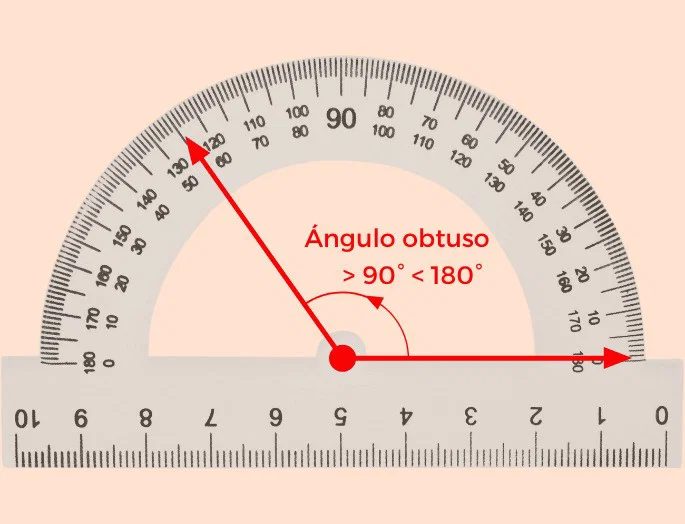
The image above features a protractor. It helps you pinpoint the exact angle where two lines meet at a single point. The reading? About 124 degrees.
Why does that matter? Because 124 is greater than 90 and less than 180. That specific range defines an obtuse angle. It’s not a right angle. It’s not a straight line. It sits somewhere in between, leaning wide.
Examples of obtuse angles
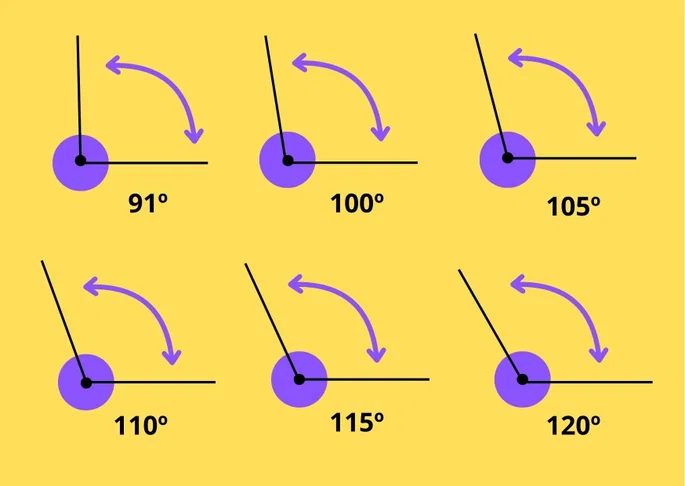
Let’s look at how these angles behave. The examples below show obtuse angles formed by two lines connected at one vertex. We’re moving in ascending order. Starting close to the right angle and pushing toward the straight angle.
Angles between 91° and 120°
This is the “entry-level” zone for obtuse angles. Just past 90 degrees. You might call it the “awkward phase.” It’s wider than a corner of a room, but not by much. Imagine opening a book just a bit past perpendicular. That’s where you start.
At 91 degrees, the angle is technically obtuse. Barely. But it counts. By 120 degrees, the gap is noticeable. Think of the angle between the hour and minute hand at 4 o’clock. Or the slice of pie you’d get if you cut a circle into three equal pieces. That’s 120. Solidly obtuse. Not shy about it.
The visual difference here is subtle compared to wider angles. A protractor is essential. Your eye can lie. A quick check with a tool confirms the measure. Don’t guess. Measure.
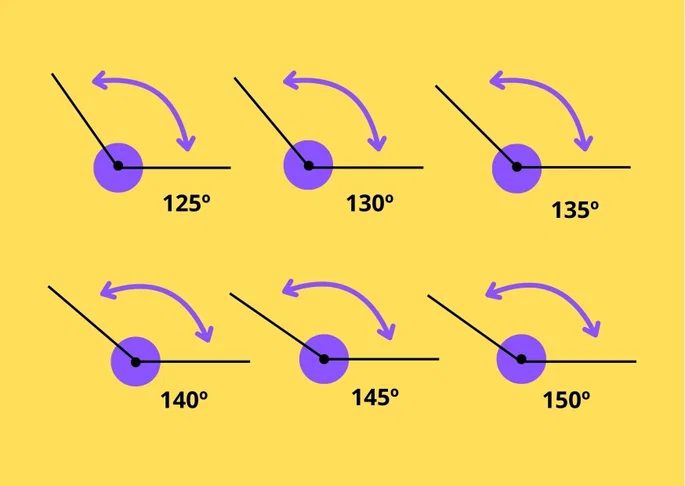
The specifics of wide obtuse angles
Most people stop caring once they hit 90 degrees. But geometry doesn’t. When you’re measuring angles between 125º and 150º, you are squarely in the middle of the obtuse range. These aren’t just wide. They are significant.
Think about a door. A standard door hinge doesn’t swing all the way back. It usually stops around there. Or a book lying open on a table. If the spine is thick and the cover is wide, that opening angle often lands right in this zone. It feels substantial.
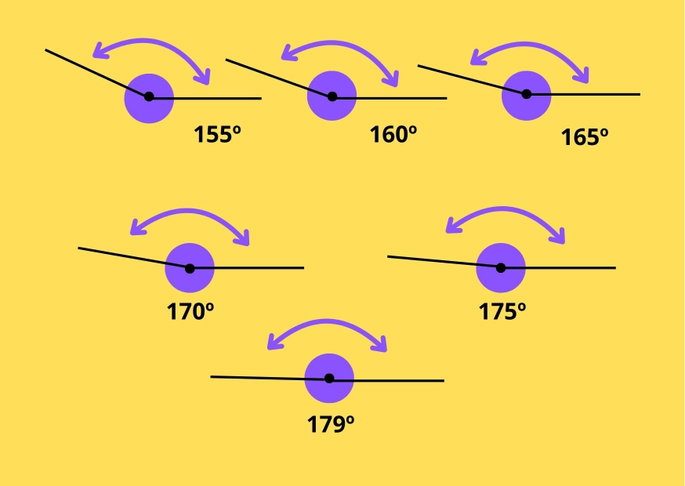
Moving up to the 155º to 179º range changes the dynamic entirely. Here, the angle is barely obtuse. It is almost straight.
When obtuse angles look like straight lines
Why does this distinction matter? Precision.
If you are drafting a blueprint or designing a piece of furniture, the difference between 150º and 179º is massive in practice.
- 150º still clearly curves. You can see the turn.
- 179º is so close to 180º (a straight line) that for many practical purposes, it might as well be one.
This range is where measurement errors become critical. A slight deviation in a 175º angle might not matter for a casual sketch, but for engineering tolerances, it’s a problem.
Contextual examples
Where do you see these extreme obtuse angles?
- Architecture : Look at the eaves of a roof with a very shallow pitch. The underside angle relative to the wall can approach 170º.
- Art : In perspective drawing, vanishing points rely on angles that flatten out. Lines that are nearly parallel create angles near 180º on the canvas.
- Nature : Consider the branch of a tree that is struggling to grow upward. It might angle out at 160º, almost parallel to the ground, before drooping.
Why the terminology matters
You might wonder why we don’t just call anything over 135º a “straight-ish” angle. The distinction exists for accuracy.
- Obtuse : Strictly defined as greater than 90º and less than 180º.
- Straight : Exactly 180º.
There is a gap between “almost straight” and “straight.” In math, that gap is real. In construction, it’s a source of frustration.
Common misconceptions
Many students confuse concave angles with obtuse angles.
A concave angle isn’t a specific number. It’s a shape description. An obtuse angle is always convex in a simple polygon context, but if you wrap around, the interior angle can be reflex (greater than 180º).
Don’t mix them up.
- Acute : Less than 90º.
- Right : Exactly 90º.
- Obtuse : Between 90º and 180º.
- Wide obtuse : 125º–150º
- Near-straight obtuse : 155º–179º
If you