Launched.
May 19. A Vega-C rocket lifted off from French Guiana. It carried more than just metal and fuel. The payload was the Solar wind Magnetosphere Ionosphere Link Explorer — SMILE for short. A joint effort between the European Space Agency (ESA and the Chinese Academy of Sciences. Years of collaboration went into this. Now it is in orbit.
Why do we need it?
Think about reading this text. If Earth lacked a shield, you wouldn’t be. We have one. A massive protective barrier generated deep inside the planet. It has kept our solar system’s most volatile neighbor from stripping us bare for billions of years.
Without the magnetosphere, Earth is just an irradiated rock. Barren. Lifeless.
We know the shield works. We don’t really know how it works.
X-ray Vision.
Josef Aschbacher, ESA’s director general, said we are about to see Earth’s “invisible armor” in action.
That sounds dramatic. It is.
SMILE will spend its first month climbing. Eleven engine burns to reach the right height. An elliptical orbit. It loops over the North Pole then the South Pole. A dizzying commute.
Real data starts in July.
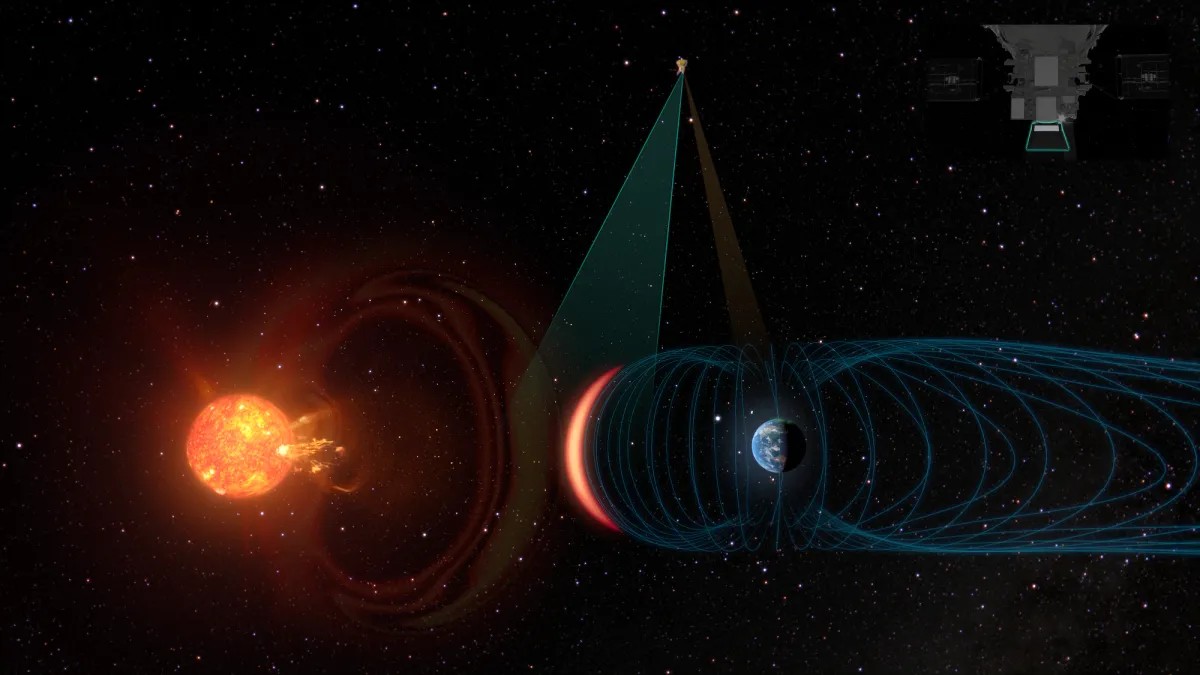
This is where SMILE gets interesting. It’s the first mission to use X-ray vision to study the magnetosphere.
Previous missions used other methods. Not these. SMILE carries four tools. Two of them are cameras. One takes UV photos. The other? It sees X-rays.
The northern and southern lights can be captured for up to 45 continuous hours.
Imagine watching an aurora for two full days without stopping. The UV camera does this. But the X-ray data changes the context. It reveals how solar winds — and those explosive coronal mass ejections — actually hammer us.
The sun never stops. It blasts us with wind constantly. Then it sneezes plasma. Huge chunks of it. SMILE will track how the shield holds up. Or breaks. Or absorbs.
Why Look Deeper?
We have models. They are decent. They keep our satellites alive most of the time. They keep astronauts relatively safe.
Philippe Escoubet, the project scientist for ESA’s SMILE mission, says the evidence will improve those models. Better models mean safer spaceships. Decades into the future.
He calls it understanding our Solar System. That feels like selling it short. It feels like watching your front door while a hurricane rages outside. You want to know if the hinges are holding.
The project runs for three years. Then what?
The sun keeps burning. The shield keeps flexing.
SMILE is watching now.
What else are we missing?