Proof Positive, our weekly math newsletter, is usually friendly enough. You get it every Tuesday afternoon if you sign up. It’s the kind of thing you read while your coffee cools.
Most of us have tortured our parents this way. Flick the switch. On. Off. On again. Fast. Mother says stop. I say, what if I don’t?
Assume for a second you are immortal. Or at least patient enough for a thought experiment.
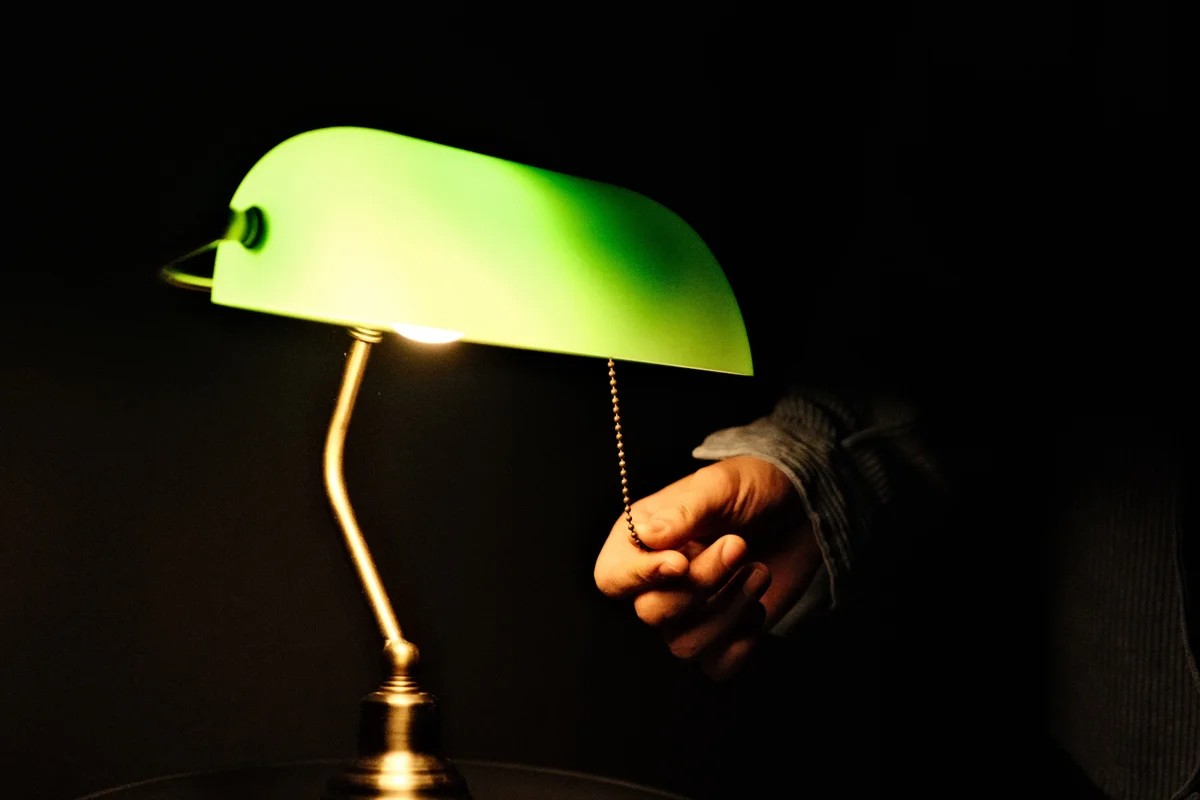
Turn the lamp on. Wait one minute. Turn it off. Wait thirty seconds. Turn it back on. Wait fifteen. Each time, halve the duration. You are flipping the switch faster and faster, chasing the edge of infinity. The question isn’t hard to state.
After exactly two minutes, is the light on?
James F. Thomson wrote about this in 1954. He found himself stuck.
“It seems impossible to answer this question.”
The lamp cannot be on because you never left it that way. Every “on” is immediately followed by an “off”. It cannot be off because you never let it rest. Every “off” is followed by an “on”. Yet it must be one or the other. A contradiction?
Thomson wasn’t the first to mess with infinite sums. Guido Grandi did in 1703.
Consider this series:
1 + 1/2 +1/4 +1/8 ...
Add them all up. You never reach 2. But you get infinitely close. Mathematicians call the limit 2. In our lamp scenario, two minutes is exactly where all those infinite switches finish their job.
Grandi cared about a messier series:
1 - 1 +1 - 1 ...
Add or subtract one forever. It depends on where you stop. If you stop on an even number of terms, you get 0. Odd number? You get 1. Infinity, though, is neither even nor odd.
Grouping by force
Grandi tried fixing the ambiguity with parentheses.
Group the first two numbers: (1 -1). That’s zero. Add the next pair. Another zero.
0 + 0 +0 ... = 0
The lamp is off.
But shift the bracket one space to the right. Keep the first 1 alone.
1 + (-1 +1) + (-1 +1)
Now every pair cancels to zero, leaving that lonely first number. The result is 1.
The lamp is on.
Which grouping is “real”? Neither. It’s math theater.
Grandi didn’t stop there. He gave the whole infinite series a name. Let’s call it S.
S = 1 -1 +1 -1 ...
Remove the first term. The rest of the series is just -(S).
So: S = 1 -S.
Double S equals 1.
S = 1/2
The limit is one half. A lot of experts like this answer. It feels clever. It resolves the tug-of-war between 0 and 1.
So, back to the lamp. Is it half-lit? Is the bulb glowing at fifty percent capacity?
That’s physically impossible for a standard toggle switch. For every moment before the two minutes are up, we can tell you the state. On. Off. But right at the deadline? Silence.
Physics saves the day (sort of)
John Earman and John Norton got bored with pure abstraction. They dragged the thought experiment into the physical world.
Drop a metal ball. Not on the floor. On an induction cooktop.
First bounce takes a minute. Then thirty seconds. Then fifteen. Infinite bounces. Two minutes total.
Each time the ball hits, it generates an electrical pulse. The circuit connects. The lamp lights up.
Physics applies here. Gravity wins. After infinite bounces, the ball stops moving. It sits on the plate. The contact is made.
The lamp stays on. Limit equals 1.
Now reverse the engineering.
Make the circuit open when the ball lands. Normal state? Light on. Ball lands? Light off.
The ball still bounces infinitely. It still comes to rest on the plate at the two-minute mark. Since landing breaks the connection, the lamp turns off when it settles.
The lamp is dark. Limit equals 0.
Earman and Norton had their conclusion. Thomson’s lamp isn’t a paradox. It’s a bad puzzle. It lacks description.
Depending on how you build the switch, the answer changes. You have to know what the mechanism does when time runs out, not just how many times it flips before.
The mystery vanishes when you add wires and gravity.
Does that mean math was wrong? No.
It just means the room doesn’t care about Grandi’s series. The room cares about whether the switch is up or down when the clock stops.
Which leads to another question.
If I flip the switch one more time, just for you… is the room still half dark?