Twenty million years? No. Two hundred.
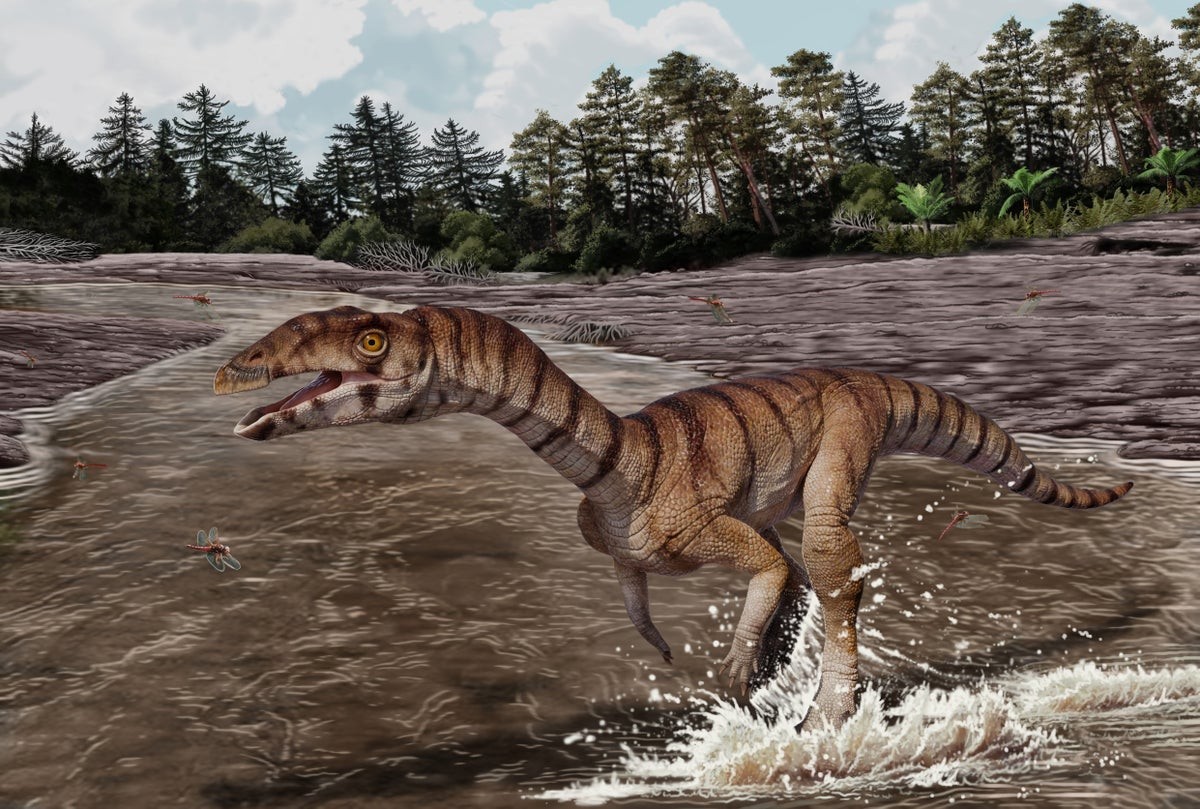
Imagine a reptile. Small arms. Walking upright. Beak where teeth should be. It looks like a dinosaur, but it’s not. It’s a crocodile. Kind of.
This thing stomped through what is now New Mexico over 200 million years ago. It wasn’t sleek. It wasn’t graceful. It was just there, doing its own thing in the Late Triassic mud.
A Distant Cousin
The bones surfaced in 2006. Found in a quarry already famous among paleontologists. A rich spot for Triassic fossils. Alan Turner leads the team at Stony Brook University. He says these bones looked like Shuvosauridae.
Specifically, they matched two North American species of that clade. But… wait.
The new specimen was slightly off. Dated to about 212 million years ago. Newer than one known species, older than another. And the humerus? Subtle differences. Those little details matter. They show where evolutionary forces pushed and pulled.
“We look at those fine details, because that lets us get at their familytree.”
They published the findings in the Journal of Vertebrate Paleontology. It’s a new species.
Labrujasuchus Expectatus
They named it Labrujasuchus expectatus.
“Witch croc,” if you want to keep it simple. Why? The land was once called the Ranch of the Witches in Spanish. Appropriate, really, for a beast that defies easy categorization.
Don’t confuse this with your swamp-dwelling gators today.
“You can think of them as a very, very distant cousin.”
They split from the main line hundreds of millions of years ago. A side branch. Not a direct ancestor. Just a relative who went a different way.
What Did It Eat?
Here is the puzzle: modern crocs have razor-sharp teeth. This guy had none.
Does no teeth mean it ate plants?
Not necessarily. Look at eagles. No teeth, beak only, and they kill things. But Labrujasuchus lived long before fruit really existed on this scale. So a fruitarian diet is unlikely. Turner leans toward meat. Maybe it hunted. Maybe it scavengeed.
Hard to say for sure. Fossils don’t keep dinner plates.
Convergent Evolution
This find doesn’t just add a name to a list. It shifts our understanding.
Technically not a dinosaur. Yet it probably acted like one. Walked on two legs. Had similar body structures.
Why? Convergent evolution. Nature solves the same problems in the same ways, regardless of the starting point. Dinos did it. These croc cousins did it. Separate lines, similar outcomes.
The family tree grows more complex. Less linear. More tangled. Which is exactly how history works, isn’t it? We keep finding these strange links, these missing steps that weren’t really missing at all, just hiding in plain sight beneath the desert dirt.
It makes you wonder what other “impossible” animals are still out there. Waiting. Silent.