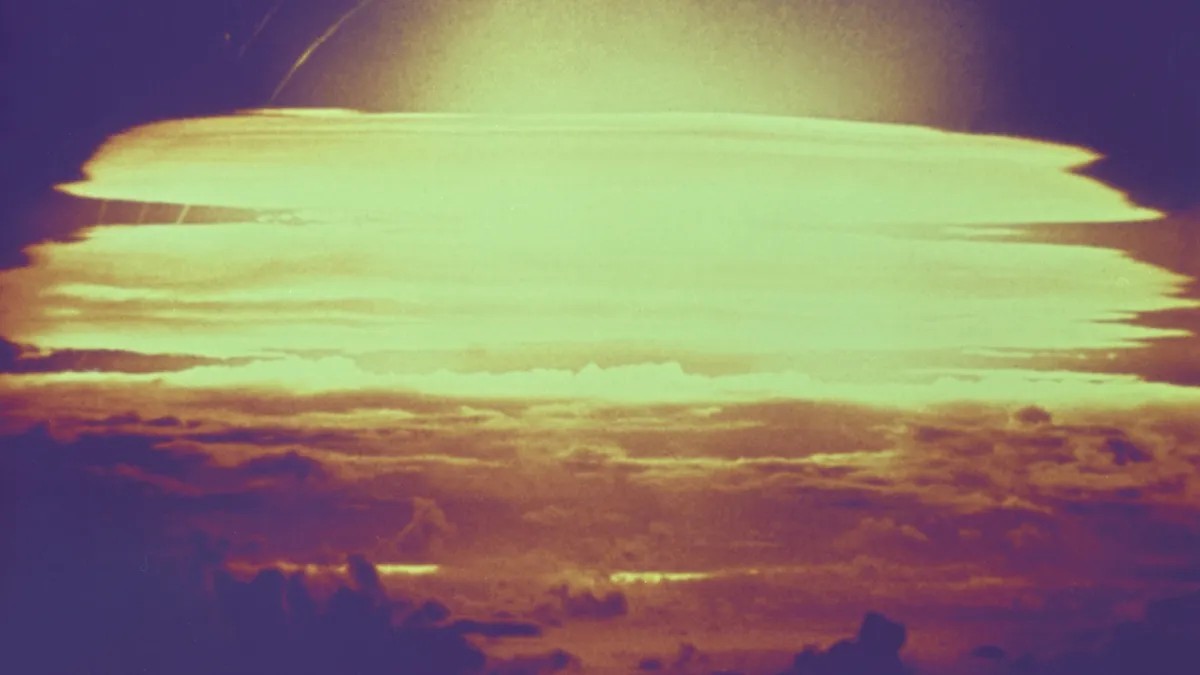
1,054 tests. That is the official U.S. count from 1945 to 1992. Most failed on ground or sea. Only one happened up here.
In 1962. Starfish Prime. 1.4 megatons detonated 250 miles overhead. The electromagnetic pulse was too wide. Too fast. It fried 300 streetlights in Hawai’i. That was 900 miles away just fine and dandy. But space paid the heavier price. The lingering artificial radiation belt killed off dozens of early satellites. American. British. Soviet. All gone in one blink.
Areg Danagoulian puts it simply. He teaches nuclear science at MIT.
“When you have a nuclear detonation… nearly every single electron… becomes free.”
Free electrons rush into the Van Allen belt. They bomb everything. Ionization spikes. Radiation cooks electronics. A nuke in space? It is as bad as a nuke on Earth maybe worse.
So in 1967. The Outer Space Treaty signed by the big three and later 115 others banned them from the void. For fifty-five years. It held. The sky was neutral. Clean.
Until Cosmos2553 arrived.
Launched in 2022 by Russia. Officially a sensor satellite. Critics laughed at that idea immediately. The orbit makes zero sense for surveillance. It threads the needle through the most radioactive, hostile patches of low Earth orbit. Why?
“That location is likely the best point… if you were to detonating a thermonuclear weapon.”
Think about it. If this thing is armed it sits right next to GPS networks. Internet backbones. Recon gear. One pop and modern connectivity crashes. The worst-case scenario isn’t theory anymore. It’s hovering overhead.
We are blind though. No way to confirm. Danagoulian looked through all unclassified papers. Found nothing. Zero proposed methods to spot a nuke-sat. A blind spot for the whole planet.
He decided to fix it. Or at least start the sketch.
Nature published his study today. The fix uses spallation. It sounds fancy. It is brute force physics. Energetic protons hit heavy stuff. Like uranium. Like plutonium. They punch out roughly 40 neutrons each hit. Millions per second. That is loud. That is a scream in a library.
The device is simple but precise. Two scintillator panels. Sandwiched between synthetic crystal diamonds. This setup filters the noise. Natural protons pass. Nuclear neutrons get tagged. It tracks where they came from. Is it just background space junk or is someone packing a heat?
Accuracy matters. Spend a week within 2.5 miles and the sensor gives a 99 percent certainty. Close to within half a mile. Get answers in hours.
You cannot lie to a Geiger counter. You cannot fake the neutron count.
The tech is still on a lab bench. Not in orbit. Not tested against real metal. Danagoulian wants national labs to pick up the tab and build a prototype. He wants policymakers to stop pretending they can see the enemy.
Will they build the watchtower? Or wait until the lights go out again?