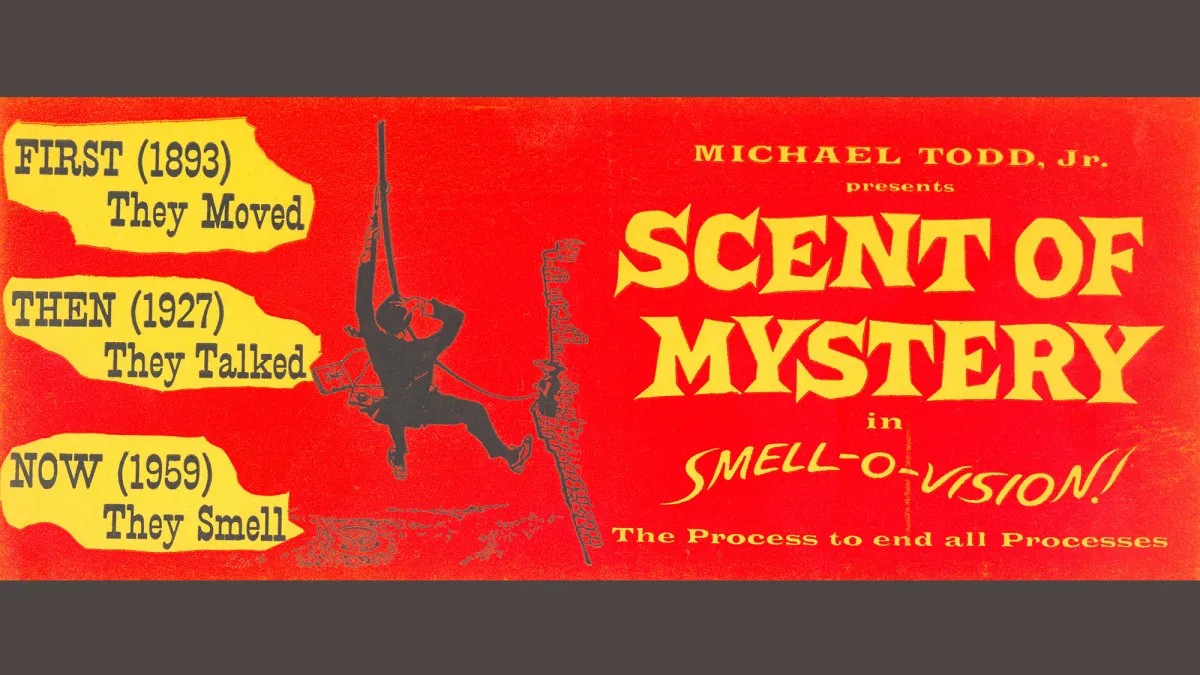
It stank. That is the only accurate summary of what happened in 1960.
American moviegoers were tired. They had survived silent films. They had adapted to talkies. So when January 6, 1961 arrived—or rather, January 1960, as history records it—they expected another leap. A new sense to engage. A bit of novelty.
They got brandy. They got gunpowder. They got a disaster.
Jack Cardiff, a cinematographer who had previously worked on Alfred Hitchcock’s Under Capricorn and The African Queen, didn’t help matters. He directed Scent of Mystery, a 1960 dramedy designed specifically for this new tech. Cardiff tried to sync plot points to scents. A villain? Pipe tobacco. A broken wine barrel? Sweet grapes.
The audience just sniffled.
The Long History of Cinematic Scent
We like to think smell-o-vision is a joke. It’s not. Theaters have tried to smell like movies for centuries.
Consider Macbeth. In the 17th century, stagehands used mini-explosives called squibs. This simulated thunder. But it also filled the theater with the scent of gunpowder. Professor Charles Spence of Oxford noted in 2021 that this created an olfactory reference for the witches’ incantation: “Hover through the fog and filthy air.”
That wasn’t isolated. London’s Alhambra Theatre sprays Rimmel Vaporizers during the 1868 ballet The Fairy Acorn Tree. By the 20th century, scent was part of the deal.
Take the Boston Fenway Theater. In 1929, a manager spilled a pint of lilac perfume into the vents. He timed it so the smell hit exactly when Lilac Time appeared on screen. It worked. Applause. One former manager later joked you could just fry bacon or gather marijuana smokers to lend atmosphere. Coulda, woulda, shoulda.
Walt Disney nearly did it too. While planning Fantasia in 1940, he wanted floral perfumes for the Nutcracker Suite and gunpowder for the Sorcerer’s Apprentice. He backed out due to cost. So Fantasia remained odorless.
The Battle of the Smellies
The tech existed before the hype. Swiss inventor Hans Laube showed an early version at the 1940 New York World’s Fair. One demo featured a chef chopping onions. A second smelled like apple blossoms in spring.
But it required a human to press a button. Not automatic.
Competition arrived quickly. General Electric showed Smell-O-Rama in 1953. Then came AromaRama, developed by Charles Weiss. Weiss claimed on CBS in 1959 that scents were more effective than sound or sight at touching the heartstrings.
Variety called it the “Battle of the Smellies.
AromaRama debuted first, in December 1959, with the documentary Behind the Great Wall. It failed. The New York Times called it a stunt with zero artistic benefit. The scents were added in post-production. They were an afterthought.
Smell-O-Vision followed in January 1960. This time, the scent was baked into the film architecture. It was different. But different didn’t mean good.
The Smell Brain That Didn’t Work
Cardiff’s Scent of Mystery used Laube’s new “scent brain” system. It replaced manual buttons. Notches on the film reel pierced belts of perfume containers. Odors piped directly to each seat.
It should have been magical.
It wasn’t. The New York Times reported audiences sat there “sniffling and snuffling like bird dogs, trying to catch the scent.”
The technology couldn’t handle the load. Smells lingered. They merged. Gunpowder mixed with lilac. Hissing noises leaked from the machines, breaking the immersion. The tech looked like skeletal wires under the seats. It broke the illusion entirely.
Cardiff later said he wanted to erase the film from his memory.
Ironic. Scent is the strongest memory trigger we have. Yet here we were, remembering nothing but a headache and a weird smell.
Critics panned it all. Both AromaRama and Smell-O-Vision were distractions. Mistimed. Ineffective. Laube had actually solved the mixing problem. He designed a vacuum to suck up smells before releasing new ones. Theaters wouldn’t smell like the bowels of a Sephora. Critics never saw this vision. They just got a headache.
Why Scent in Movies Still Isn’t Here
So why does Smell-O-Vision keep appearing on “Worst Ideas of All Time” lists? Time magazine has done it repeatedly.
It’s unfair to Laube. The man was ahead of his time. The budget wasn’t. The execution was sloppy. The name was silly. It stuck in the pop-culture subconscious as a punchline.
Today, the closest thing to it is 4DX. Theme park rides in movie theaters. Rattling seats. Wind. Mist. Scent. But 4DX is a gimmick. A detour. 3D was a detour too.
Movies remain largely odorless. Save for the buttered popcorn.
We can imagine what it would be like. To truly smell a scene. To have the olfactory system power the emotion, as it does in real life. Instead, we get a plastic tube in the seat that hisses and smells vaguely like a chemical spill.
Life offers plenty of scents. Sometimes they are evocative. Beautiful. Sometimes they just stink.
Movies try to capture that. They usually fail. And maybe that’s for the best. There is something profoundly human about a movie that you can only see, never smell.