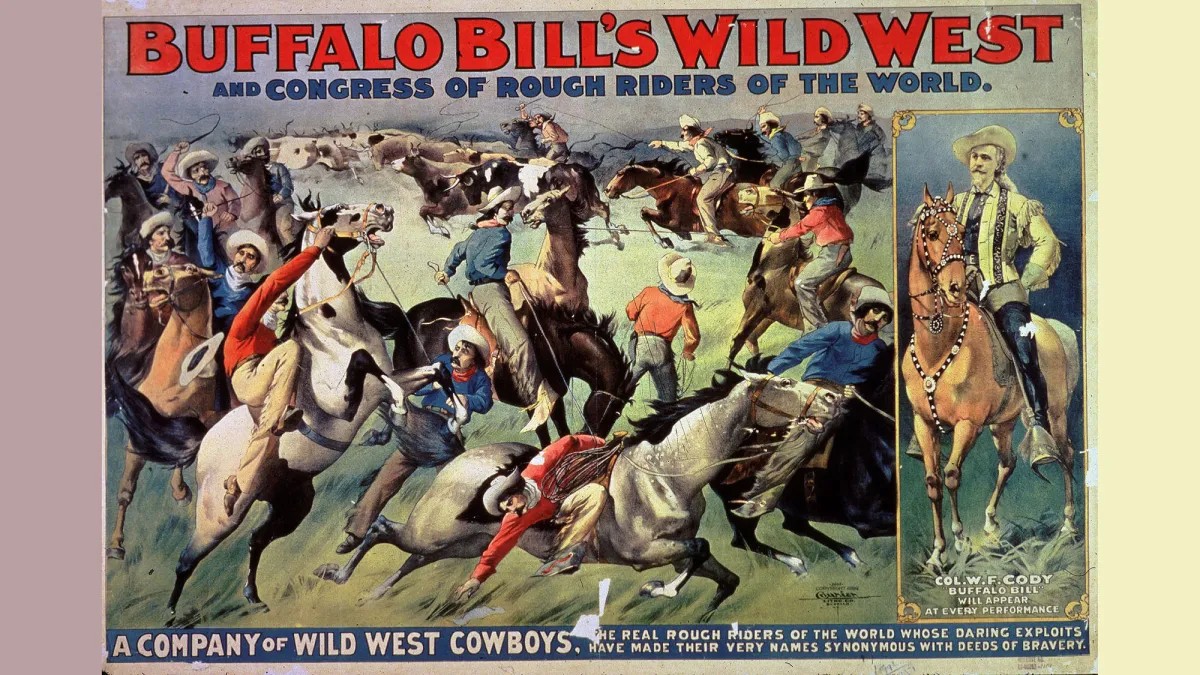
Paris didn’t care much for the initial spectacle. In 1889 thousands of spectators showed up at the World’s Fair. They brought the President and his wife along too.
The attraction? Buffalo Bill Cody. His show had already wrecked London in 1887 and terrified audiences in the States with its raw noise and chaotic energy.
The French audience was skeptical. Cold even. The stagecoach rescues meant nothing to them. The Lakota Sioux warriors riding hard across the arena didn’t land a blow against the crowd’s reserve. It didn’t connect.
Then came Annie Oakley.
She skipped into view. She pulled the trigger. Glass balls shattered mid-air. One after another. When the gun was hot she tossed it like a brand and grabbed the next. That’s when they woke up. The audience erupted. The skepticism evaporated. The next day the Paris Herald called it a “great success in every way.” Within weeks the city had “Wild West Fever.”
The Appeal of the “Other”
By the 1880s the American West was gone. Erased by federal policy against Native Americans. It existed only as a nostalgia piece. A fantasy of “noble pioneers” and “savages.”
Europeans bought the myth.
Parisians were fascinated by “primitive Indians.” Indigenous people had been paraded through Paris for decades. Sometimes as actors. Sometimes as live exhibits in the zoological gardens. That same year nearly 400 individuals from French colonies lived on the fairgrounds as scientific specimens. Early anthropologists viewed them through Social Darwinism. They saw a ladder from savagery to civilization and placed these humans at the bottom.
Parisians “had heard about the American Indians, but the Wild West Show brought them right in front of you,” says Steve Friesen author of Galloping Gourmet and former director of the Buffalo Bill Museum. “They saw the real deal. They were stunned.”
Young Parisian women flocked to the “Indian Camp” where performers lived. It was public space. They jostled for position hoping to catch the eye of handsome Sioux warriors offering them cigarettes and shy smiles. Men stayed around for the horse skills and shooting feats.
The economy followed. Cowboy hats sold out. Saddles disappeared from shelves. Popcorn which the French had never really touched became an addiction.
“By October,” Friesen notes “Parisians were going to the theater just to eat popcorn.”
Cody Became Paris
Cody—Guillaume Buffalo to his new fans—was the perfect export. Back home he was already huge. A former scout and cavalryman with claims of Pony Express service. He looked the part too.
In Paris he became royalty. Everyone wanted a meeting.
Cody and his troupe didn’t just perform. They toured the city. They climbed the new Eiffel Tower. They appeared in theaters. For six months they ran twice-daily shows to a 30000-capacity arena that sometimes outsold the main Fair exhibits.
The arts community caught the bug too. Paul Gauguin loved it so much he attended twice. He bought a Stetson. He later wore a nearly identical hat in a Tahiti self-portrait now at the Musée d’Orsay.
Edvard Munch visited. Rosa Bonheur painted the performers at their camp.
Cody also met Thomas Edison. Edison was there demoing electrical tech. Years later he put Cody and his Lakota collaborators on film in some of the earliest motion pictures.
The Legacy Remains
Buffalo Bill was France’s first guide to the American West myth. The appeal wasn’t temporary. In 1905 when the tour returned it reignited the fever that had peaked sixteen years prior.
The cultural stain is permanent.
“Buffalo Bill basically told France what the West looked like,” Friesen argues. “It stuck.”
French fashion adopted the look. Women started pairing cowboy hats with skirts—an Annie Oakley signature style that began there. Shops selling western gear still exist today.
Even restaurant chains use the iconography. Buffalo Grill a French steakhouse features a portrait of Cody in its logo.
When Disneyland Paris opened in the early 90s skeptics doubted the concept. One element worked well. Too well.
The Disney Village housed a knockoff Wild West show. Two thousand seats. Twice daily. The menu featured cornbread and steak. The audience received straw cowboy hats.
“They watched Buffalo Bill-style acts,” Friesen explains. “It kept going.”
The brand recognition survived into the 2000s.
It seems Paris never really let the West go.