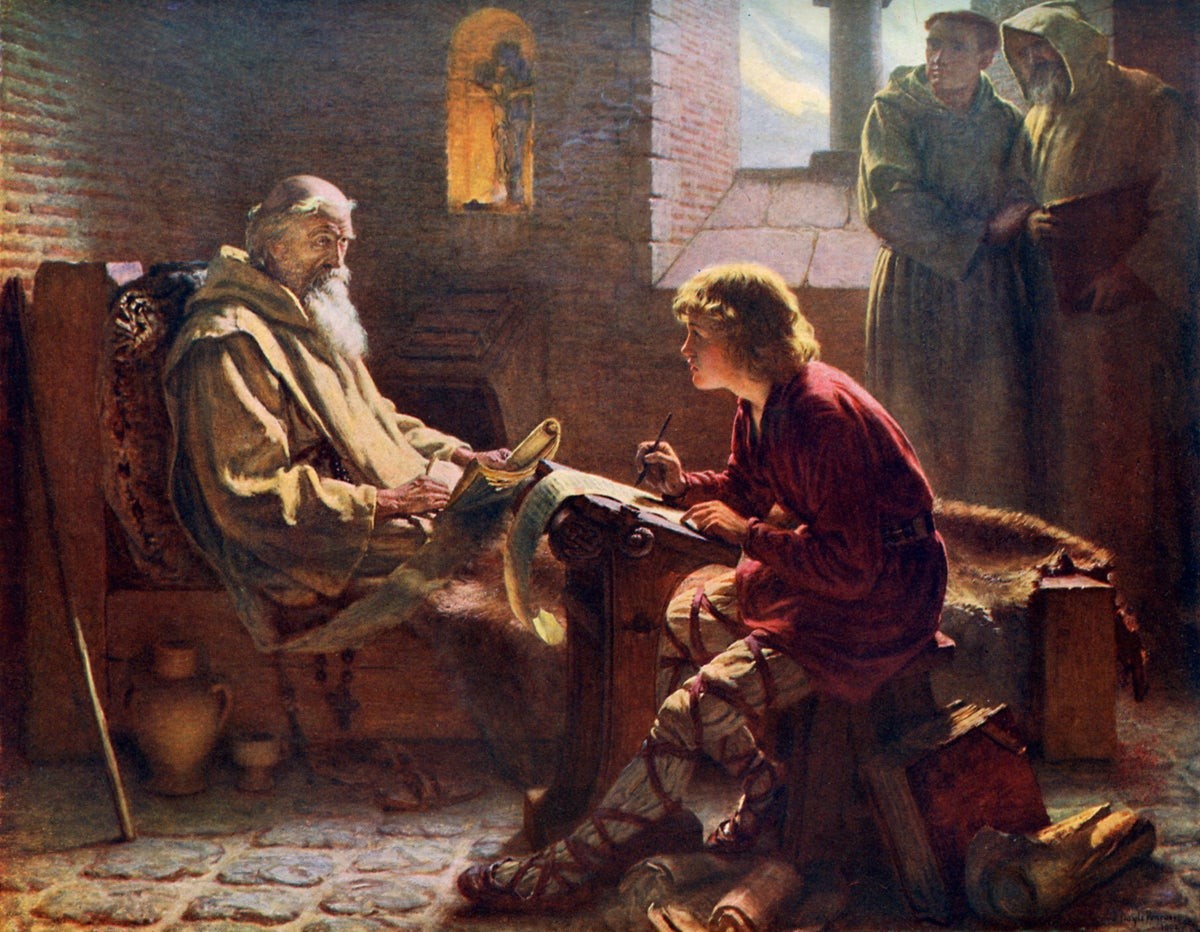
Caedmon was a cowherd. He worked on a farm near Whitby in England. This was 1,300 year ago.
He claimed God visited him in a dream. The result was nine lines of praise. They became Caedmon’s Hymn. It celebrates the Maker. It praises the “eternal Lord” for building Earth for us.
Scholars consider it the start of English literature. Mark Faulkner says as much. He teaches at Trinity College Dublin. He is part of the team behind a new discovery. One that actually made experts speechless.
Here is the thing about the poem. No one thinks Caedmon wrote it down himself. It lived in books written by someone else. The Venerable Bede wrote an Ecclesiastical History of the English people. Bede was a monk and scholar. His book usually includes the hymn in Latin. The Old English version often showed up later. Like a sticky note added by a clumsy student.
Until now.
Researchers looked at a digitized book. It sits in the National Central Library of Rome. They found the poem. Not as a later addition. It is there from the start. It is woven into the main text of this ninth-century manuscript.
We couldn’t believe our eyes.
That was Elisabetta Magnanti. She helped lead the work at Trinity. She said the team was speechless. Truly stunned.
Most Old English texts show up centuries later. Usually the tenth or eleventh century. Faulkner points out how strange it is that Bede skipped the original language. Bede translated everything into Latin. It was the scholarly tongue of the time.
But someone put the Old English back in. They did it within a hundred years of Bede finishing his work. Why? Because early readers liked the poem. They valued their native tongue more than we thought.
The discovery appears in Early Medieval England and its Neighbours. It shifts the timeline. It changes how we view the value placed on early poetry.
Here is how it sounds now.
- Now let us praise Heaven-Kingdom’s guardian
- the Maker’s might and his mind’s thoughts
- the work of the glory-father
- of every wonder, eternal Lord
- He established a beginning
- He first shaped for men’s sons
- Heaven as a roof, the holy creator
- then middle-earth mankind’s guardian
- the earth for men, the Lord Almighty
Roy Liuzz translated it for modern ears. The words hold up. They always did.
It just took a digital scan of an ancient Italian library shelf to prove it was there all along. Not tucked in the margin. But right in the middle of the story.