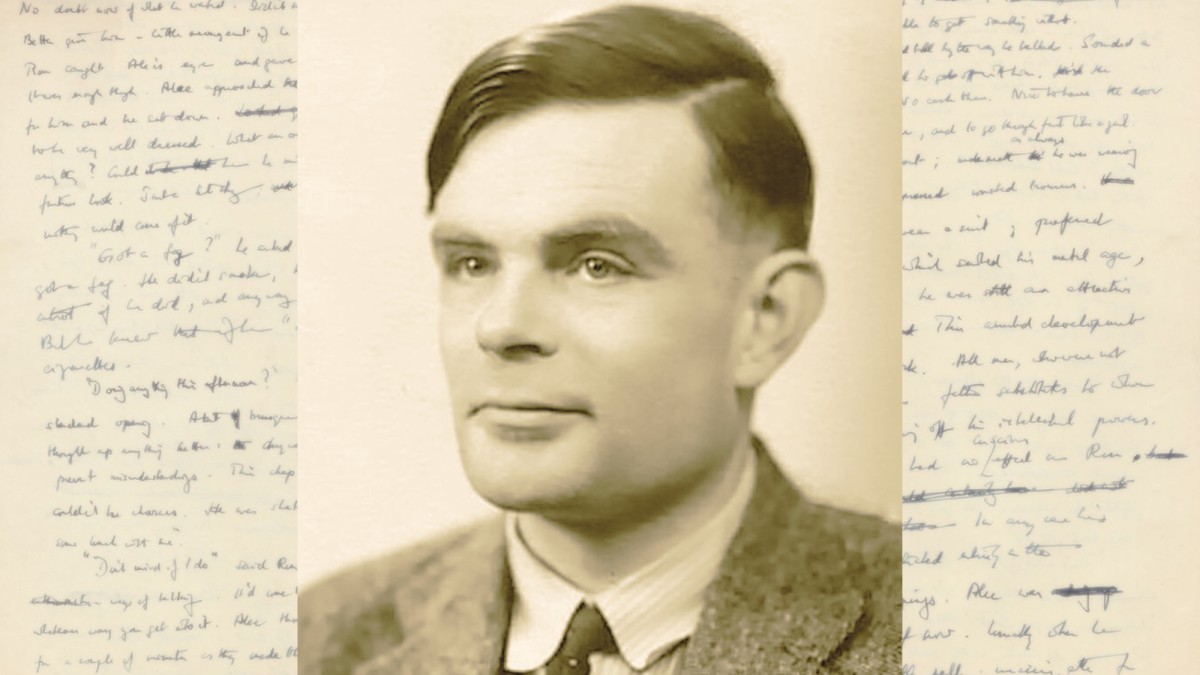
We think we know Alan Turing. He’s the father of computing. The codebreaker who broke Enigma. The tragic figure who bit into a cyanide-laced apple. It’s a tidy narrative. A sterile one. History loves a two-dimensional hero.
“We’ve distilled a version of Turing that is two-dimensional… socially unaware, entirely concerned with logic… and pretty isolated,” Sarah Dillon of Cambridge notes.
This image is wrong.
Recent archival digging shatters the “cold logic machine” stereotype. The evidence? A six-page handwritten draft titled Pryce’s Buoy. Written by Turing himself. It’s playful. Cheeky. Explicit.
How Pryce’s Buoy Changes the Narrative of Alan Turing
Sarah Dillon, a literature professor, spent time transcribing this obscure text. She published her findings in The Review of English Studies. The result is startling.
Turing wasn’t just crunching numbers. He was writing fiction about desire.
Pryce’s Buoy likely dates to late 1952. Or early 1953. That’s shortly after Turing was convicted of “gross indecency” for having sex with another man. The story mirrors that real-life arrest.
The plot features two men:
– Ron Miller, a working-class guy.
– Alec Pryce, a scientist (clearly a stand-in for Turing).
They meet in a park near Christmas.
No talking. Just looking.
Pryce assesses Miller. “Not a real beauty,” he thinks. “But [he] had a certain appeal.” Miller worries about Pryce’s furtive glances. Is it a look? Or just shyness?
Turing captures the tension perfectly. The lean in. The pull back. The uncertainty of “am I reading this wrong?” It’s human. It’s messy.
And then… it stops.
Page six cuts off mid-sentence: “Ron wouldn’t.”
That’s it. The draft ends there. Did they hook up? Did Miller reject him? We don’t know. Some scholars suspect Turing’s mother destroyed the rest to protect his reputation. Maybe she censored the ending. It doesn’t matter. The frustration remains.
Who Influenced Alan Turing’s Creative Writing?
The story isn’t just personal. It’s literary.
Turing wasn’t working in a vacuum. He was heavily influenced by Angus Wilson. Wilson was also a codebreaker. The two crossed paths at King’s College Cambridge after the war.
In July 1952 Wilson published Hemlock and After. A groundbreaking gay novel.
Turing’s draft copies Wilson. Not in a malicious way. But explicitly.
- He replicates the plot order.
- He uses similar phrases and diction.
- He adopts Wilson’s narrative technique of shifting focalization.
Dillon calls this “scaffolding.”
“When you start trying your hand as a creative writing you copy what inspires you… because writing creatively is scary.”
Turing was experimenting. Trying on a new voice. Using Wilson’s structure to build something of his own.
Why This Lost Manuscript Matters
Turing died at 41. A month after he started chemical castration for his crime.
Pryce’s Buoy shows us a man still figuring it out. He wasn’t done. He wasn’t just a statistic. Literature gave him a release valve. A way to be creative. To be playful. To exist outside the binary of right and wrong logic.
He wanted to write. He wanted to connect. The world didn’t let him.
But for six pages… he did.
What might have happened if he finished the story?